
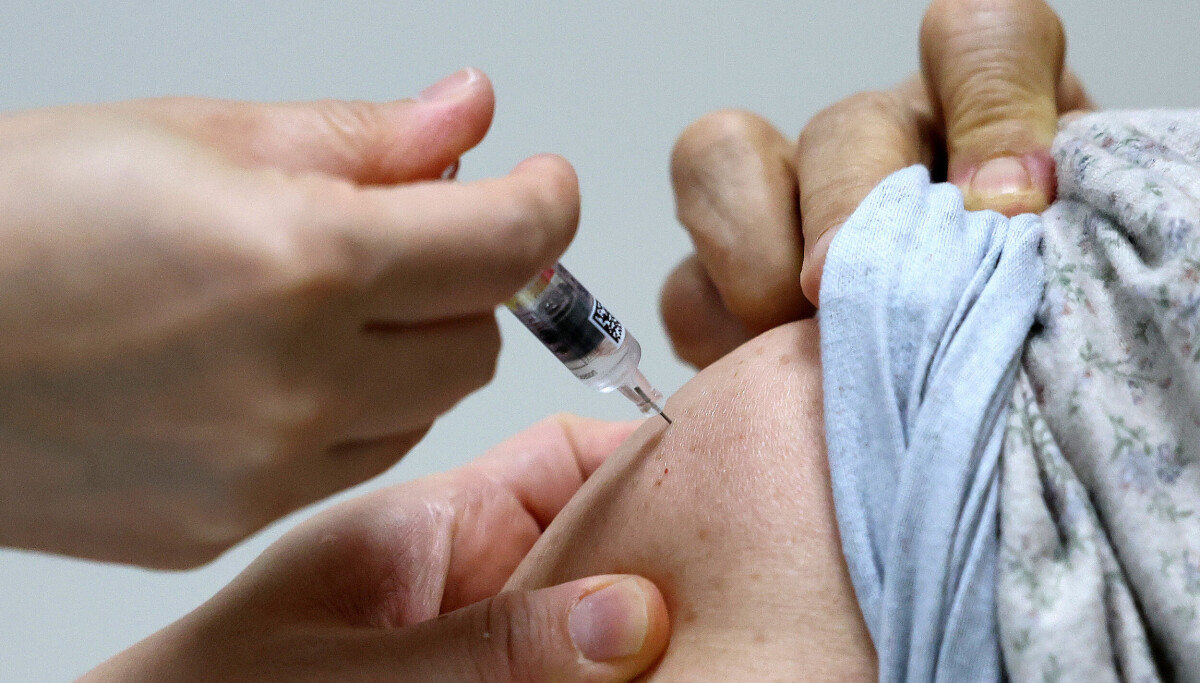
The expanded 2026-27 program offers free influenza vaccines to children through age 14, pregnant women and adults 65 and older.
Patients receive flu vaccinations at a family health clinic in Suwon, Gyeonggi, on Nov. 28, 2025.
NEWS1
Korean health authorities are expanding free flu shots to children up to age 14 this year in a bid to curb the virus’s spread among school-age children and strengthen herd immunity, the Korea Disease Control and Prevention Agency (KDCA) said Tuesday.
The agency will run its 2026-2027 national influenza vaccination program from Sept. 21 through April 30 next year. Free shots will be available to children between 6 months and 14 years old, pregnant women and adults 65 and older.
Eligibility for children was previously capped at 13; children and teenagers born on or after Jan. 1, 2012, now qualify.
“As the eligible age has expanded to 14, we ask parents to pay close attention and make sure their children and teenagers get vaccinated on schedule,” said KDCA Commissioner Im Seung-kwan.
The start date for vaccination varies by group. Children between 6 months and under 9 years old who have never been vaccinated against influenza, or who have received only one prior dose, will need two doses this year; they can begin receiving shots, along with pregnant women, starting Sept. 21. Children between 6 months and 14 years old who only need a single dose can begin Sept. 28.
For adults 65 and older, the KDCA staggered start dates by age group to avoid crowding at clinics early in the campaign: those 75 and older can begin Oct. 12, those 70 to 74 on Oct. 15, and those 65 to 69 on Oct. 19. Covid-19 vaccinations for adults 65 and older will run on the same schedule, and the KDCA is recommending people get both shots at the same time, administered in different injection sites when given together.
This year’s program will use a trivalent vaccine covering all the strains the World Health Organization expects to circulate this winter. Eligible recipients can get vaccinated for free at any of roughly 23,000 designated clinics or public health centers nationwide, regardless of their registered address. Nearby vaccination sites can be found through the government’s vaccination information website.
It takes about two weeks after vaccination for antibodies to fully form. The shot does not prevent infection entirely, but it lowers the risk of severe illness and death. Recipients may experience redness or pain at the injection site, though this typically clears up within one to two days.
BY RHEE ESTHER [lee.jian@joongang.co.kr]
This article was originally written in Korean and translated by a bilingual reporter with the help of generative AI tools. It was then edited by a native English-speaking editor. All AI-assisted translations are reviewed and refined by our newsroom.