
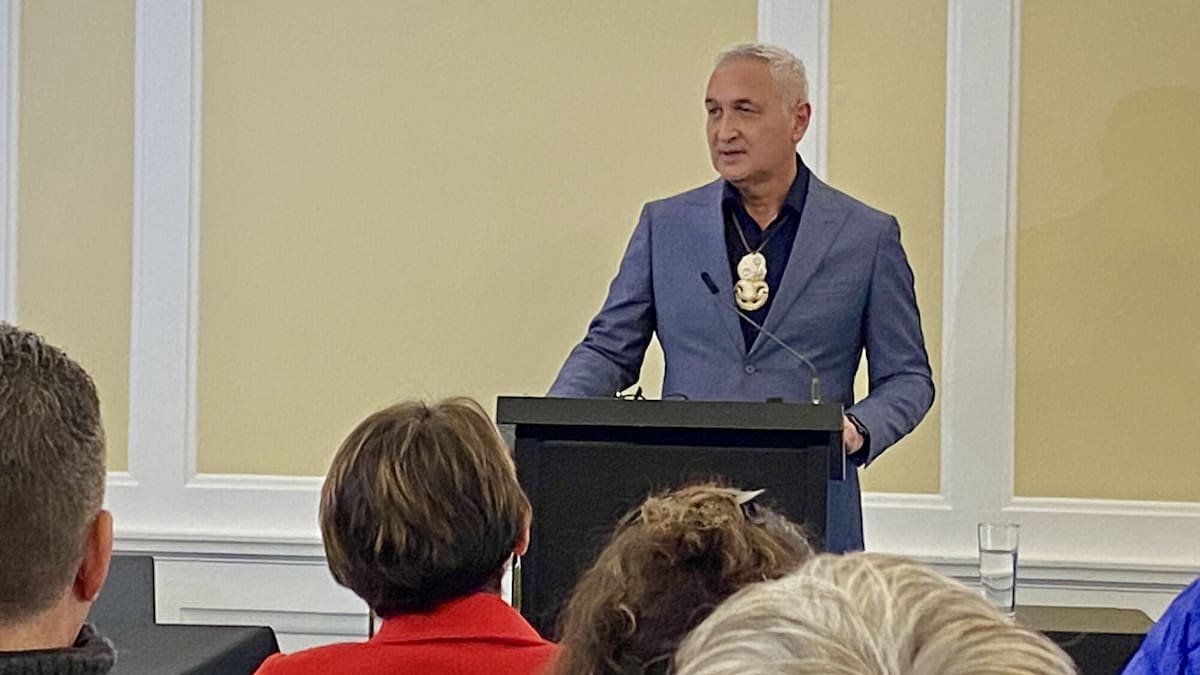
McRoberts said he agreed to chair the talk because his 80-year-old aunt in Wairoa had been on dialysis for a decade.
He said in his opinion there weren’t enough staff at Wairoa Hospital to ensure she had the best care.
Board co-chair Kerri Nuku said it wasn’t typical for Iwi-Māori Partnership Boards to make political manifestos, and this was the first time Tihei Takitimu had done so.
“What we wanted to do is to make sure that hauora providers and communities had the opportunity to hear from the candidates and make the best decision for health.”
The manifesto contained three priority pillars, or pou:
A call for urgent primary care access and workforce stabilisation.Upstream health promotion and preventive education.Whānau-centric mental wellbeing and suicide prevention.
“Every day we try to make the best of what is largely a bad situation,” Nuku said.
Tihei Takitimu co-chair Kerri Nuku. Photo / Jack Riddell
She said having politicians at the launch sharing their aspirations meant the crowd could hold them accountable for what would work for Māori.
About 35 people attended to hear from National’s MP for Napier Katie Nimon, Labour’s Ikaroa-Rāwhiti MP Cushla Tangaere-Manuel, Te Pāti Māori Ikaroa-Rāwhiti candidate Haley Maxwell, Opportunity Party’s Tukituki candidate Rachel Ward and Hastings councillor Nick Ratcliffe, filling in for the Greens’ Ikaroa-Rāwhiti candidate Heather Te Au-Skipworth.
Nimon spoke of expanding services outside GPs; Tangaere-Manuel spoke of Labour’s plan to give three free doctor’s visits a year through its new Medicard; Ratcliffe said he wanted to restore pay equity while ensuring the Treaty of Waitangi was embedded across the entire legislative framework; Maxwell said Te Pāti Māori would back community health providers with more resources; and Ward spoke of redistributing priority funding to priority care.
It’s early in the election campaign, and Nuku noted most candidates were unable to promise much.
“There was a little bit of skirting around as opposed to really addressing the questions, especially when it came to reducing inequities and health as a human right as opposed to a needs-based kind of approach.”
She said voters should look at which policies meet their values when deciding who to vote for.
“We’ve always talked about mokopuna futures, a future that’s unburdened, that allows us to exert our mana motuhake, our tino rangatiratanga, and if that’s where whānau sit, then they need to look for parties that align with that and vote in that way.”
Jack Riddell is a multimedia journalist with Hawke’s Bay Today and has worked in radio and media in the UK, Germany and New Zealand.