
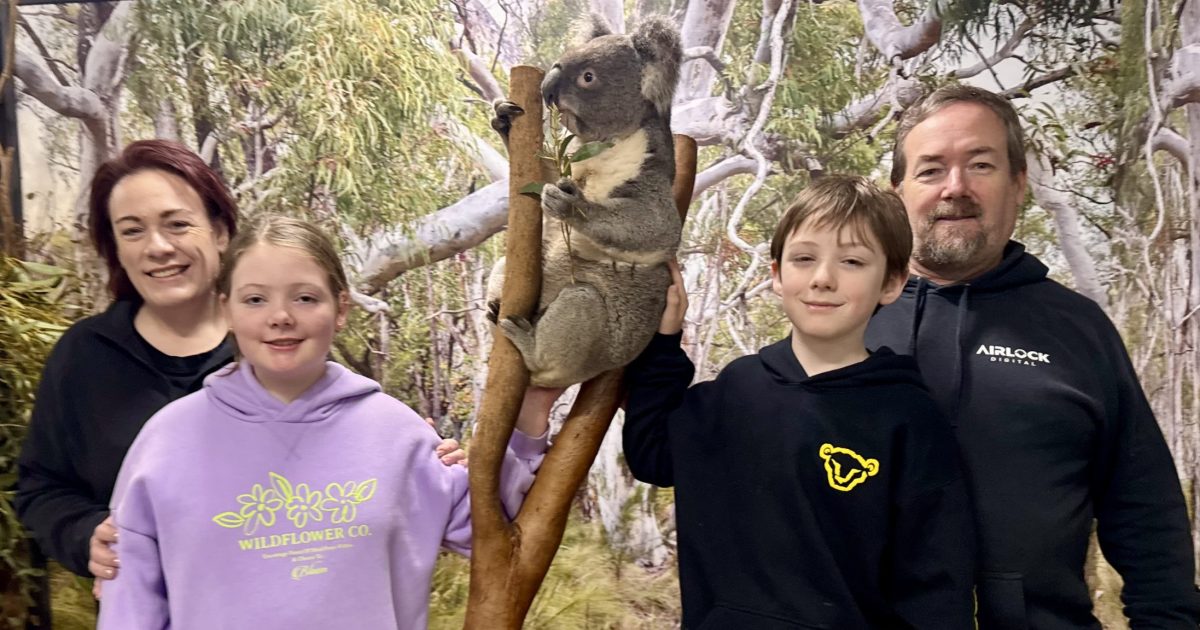
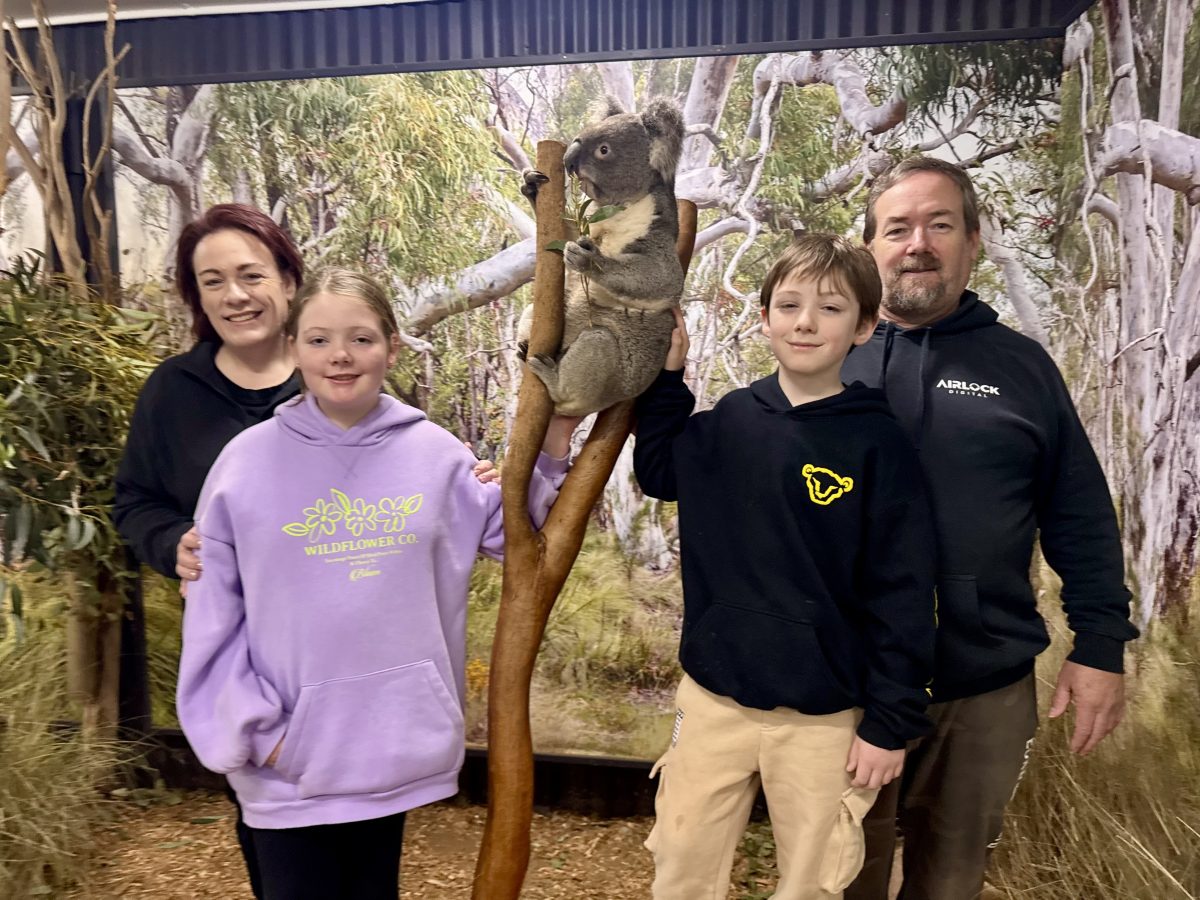
“It’s the not knowing that’s the hardest part” … mum Sandi and Addy (left), with her dad Ben and younger brother Owen. Photo: Canberra Hospitals Foundation.
Driving to the emergency department with her 11-year-old daughter, Sandi remembers thinking quite clearly she wasn’t sure what to expect when they got there because “it wasn’t urgent”.
The only outward sign Addy was unwell was a slight temperature – that and the fact her daughter just seemed “off”, Sandi says.
In the months leading up to that day in February 2025, Addy had seemed more anxious than usual, she’d complained about sore knees and joints, and been increasingly reluctant to go to school, according to the Canberra mum of two.
They’d consulted a GP, who attributed the episodes to a routine viral infection or a response to mental health challenges.
“We just assumed it was the end of the school year (Addy was in Year 5) and when she said she wasn’t feeling well and wanted to stay home, we thought it was anxiety around school,” Sandi says.
Sandi can’t pinpoint exactly what it was that drove her decision to take Addy to the ED that day, “but something told me to take her to hospital”.
Within hours of stepping through the hospital doors, blood tests would reveal those vague symptoms hid something far more sinister.
“You know when the doctor walks back in the room and their disposition is completely different that something is seriously wrong,” Sandi says.
“Her bloods were through the roof; her liver wasn’t great, her kidneys weren’t great …”
Addy was rushed from North Canberra Hospital to Canberra Hospital for specialist assessment. A team at Westmead Children’s Hospital would also come on board.
“Initially they thought it was a massive infection … when they said they still don’t know, well the ‘C’ word jumps into your mind,” Sandi says. “It was the hardest time.”
More than a year later and Addy still doesn’t have a definitive diagnosis – instead the family has been thrust into an ongoing and complex autoimmune battle.
Sandi says not knowing exactly what’s wrong with your child is one of the hardest parts of this journey.
“It’s like you need to name it to tame it,” she says. “If we could just give her something from our bodies to make her better, we would.
“We haven’t been told this is life-ending, but it is life-impacting … we still don’t know what her future will be like.”
In addition to the dedicated teams at Canberra Hospital and Westmead, Addy has come under the care of Associate Professor Simon Jiang, director of the newly opened Centre for Personalised Medicine at Canberra Hospital.
The partnership between the Australian National University and Canberra Health Services has brought to life Australia’s first personalised medicine clinic for immune diseases.
Associate Professor Jiang explains that instead of “throwing everything at it”, the centre uses advanced technology to drill down to the unique genetic and immunological drivers of a patient’s disease to personalise their treatment – and, in many cases, fast-track it.
Essentially, it means the chance of earlier diagnosis, better health outcomes and fewer unnecessary side effects for patients.
And hope.
While it doesn’t always promise a cure, Associate Professor Jiang says there are already many stories of success in which the centre has made meaningful impacts by intervening to prevent serious illness.
“As a junior doctor, I saw so many patients with autoimmune diseases with really bad outcomes, of people dying in their 40s, and I thought we must be able to do better,” he says.
“I wanted to be able to make changes that would alter the trajectory of people’s lives.”
It’s why he is passionate about expanding the centre’s work to build its clinical capacity, extend its reach and translate more of its research capability into patient care.
The centre is already receiving referrals from the US and Europe as well as major metropolitan hospitals across Australia. Currently, capacity is limited to about 60-70 patients, with referrals and inquiries pouring in since the centre’s launch two months ago.
“This is a new frontier which really excites me, and it’s unique to Canberra – it’s putting our health service on the map,” Associate Professor Jiang says.
“Through support, we can only grow and develop that more.”
This vision is why Canberra Hospitals Foundation has committed to helping raise funds to back the expansion.
On Thursday, 27 August, the community is invited to join the foundation to support patients, families and healthcare teams across Canberra as part of 2026 Can Give Day.
For 12 hours only, every donation will be matched dollar-for-dollar by participating partners in an online giving campaign that changes local lives for the better.
Lives like those of 12-year-old Addy and her family.
Addy is now on a targeted treatment plan of morning and nightly medication combined with six-monthly rounds of antibody infusions that have helped settle her symptoms and essentially stop her own body attacking her liver.
Yes, there are side effects from the steroids, constant blood tests and biopsies to monitor function, and fatigue after the infusions, and no, there is still no definitive diagnosis.
But it means Addy can live as normally as possible every day, according to Sandi.
Thanks to the work being done at the centre, she says Associate Professor Jiang has been able to provide further insights into a potential diagnosis of Addy’s disease and identify additional treatment options if her condition changes, her results deteriorate, or her current treatments become ineffective.
“She’s only 12 years old; we just want options so she can live well, be happy and healthy,” Sandi says.
“We feel so thankful for all the care we’ve received, and having the Centre for Personalised Medicine on board has helped make the pathways clearer and provided comfort in the face of the unknown.
“We also hope that what it discovers might help another family in the same situation to get an early diagnosis and start treatment earlier.”
To find out more or to make a donation, visit CAN GIVE DAY 2026.