
Drumm said there were two possible explanations – families were enrolling unusually early, or far more children were now living within the school’s zone.
“When I look around Mount Albert and see the huge amount of infill housing development, I think it’s the latter.”
Could the former Unitec building be transformed to support central Auckland schools with growing cohorts? Photo / Jason Dorday
Mount Albert Grammar already has about 3500 students, but Drumm is planning for a world where that rises to 4000 or even 4500.
He said Auckland’s growth meant that large schools were unlikely to be a temporary phenomenon.
The issue was increasingly about how schools maintained the experience of individual students as their rolls ballooned, Drumm said.
One answer Mount Albert Grammar has already begun testing is creating smaller schools within the school.
Years 9 to 11 now make up its middle school, while Years 12 and 13 form its senior school. Mount Albert Grammar has appointed separate heads of each, with full delegations to oversee their respective groups.
It is an unusual model for a state secondary school operating on one campus in New Zealand.
Drumm said Mount Albert Grammar had looked overseas for inspiration, including visiting large state co-educational schools in Australia where middle and senior school structures were more established.
Students remain on the same timetable, and teachers can work across both schools.
Mount Albert Grammar has already appointed Year 11 student leaders for the middle school and Drumm said staff could eventually become more specialised in one part of the school.
The model also gives Mount Albert Grammar options if enrolments suddenly accelerate beyond what its current campus can comfortably handle.
“If we … got a huge influx next year and we had to … offset the timetable … you might start the senior school at 8am and finish them at quarter to two … and you start the junior school a little bit later.”
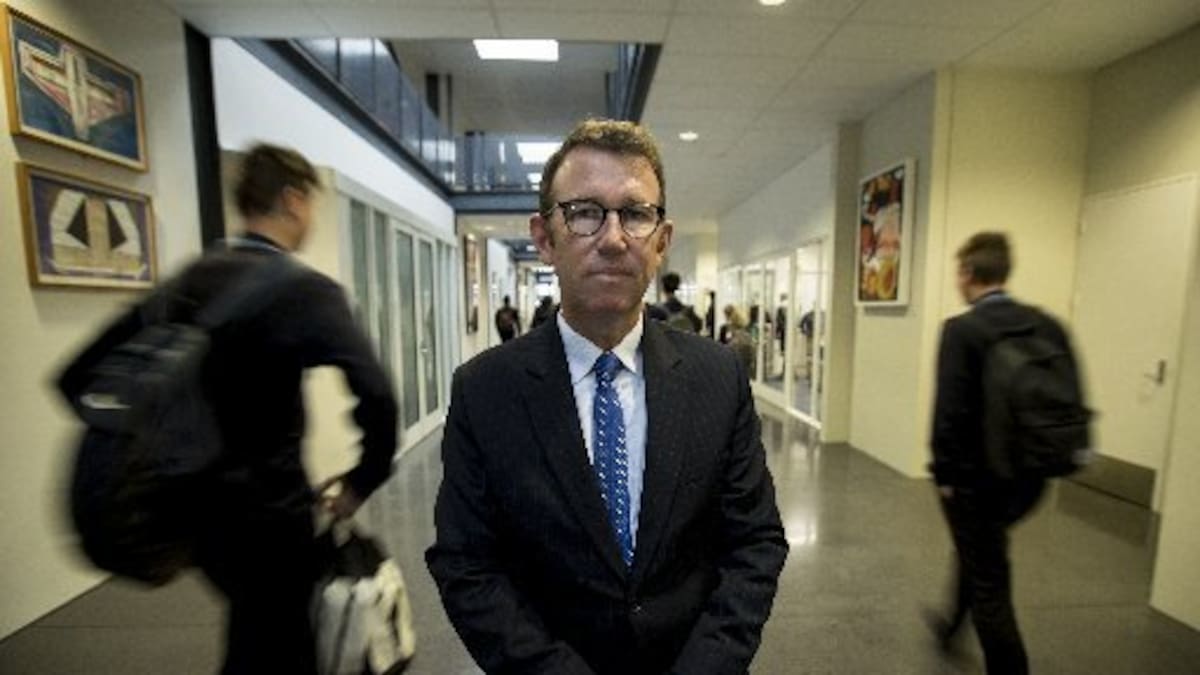
Mount Albert Grammar School headmaster Patrick Drumm.
The division also reflects Drumm’s belief that Years 9 to 11 require a different educational approach from students in their final two years.
He sees the younger years as more formative, while Years 12 and 13 are focused on higher-level learning and preparing students for tertiary education, training or work.
The coming qualification changes reinforce that split, with Year 11 set to become a foundation year before students move into formal qualifications from Year 12.
Second campus eyed, Carrington site a potential option
But restructuring how Mount Albert Grammar operates does not solve the physical problem of where to put its growing number of students.
The recently announced 18 classrooms could theoretically cater for another 500 to 550 students, Drumm said.
However, Mount Albert Grammar already had more than 30 prefabricated classrooms dotted around its congested site, some of which Drumm said were not in great condition.
“If you’re starting to replace them, all you’re actually doing is playing catch-up.
“You’re turning temporary classrooms into a more permanent solution, but we actually need additional classrooms.”
Finding room for those additional classrooms is another challenge.
Drumm wants to protect Mount Albert Grammar’s remaining green space rather than putting buildings on sports fields.
Asked whether the sheer scale of the school could eventually force Mount Albert Grammar across two sites, Drumm said: “Everything’s on the table.”
One option could be Carrington, where the former Unitec building, Building One, is still lying dormant.
Just down the road from the Mount Albert Grammar campus, the former Unitec building lies dormant. Photo / Jason Dorday
Rather than creating another conventional secondary school, Drumm believes there is an opportunity to think differently about what could be built there.
He suggested a school of between 1500 and 2000 students could specialise heavily in vocational and industry-led subjects, taking advantage of Unitec’s existing strengths in trades, technology and tertiary education.
Such a campus could also relieve roll pressure across several surrounding schools rather than serving Mount Albert Grammar alone, like a “dovetail” with Avondale College and other local schools.
“You could actually have a really clear vision for a school like that which would alleviate a lot of the challenges we’ve got with growing our own technologists and tradespeople and all of the vocational skills which we still tend to be importing.”
Mount Albert Grammar is not alone. Drumm said several other major Auckland secondary schools were already above 3000 students, with principals sharing ideas about how to manage what he called “mega-communities”.
In April, Avondale College principal Lyndy Watkinson warned growing intensification and population pressures were already making enrolments “increasingly challenging to manage”.
Ministry of Education Auckland Central and East director Jason Swann said the ministry was confident that 18 new classrooms planned for Mount Albert Grammar were enough to accommodate expected in-zone growth over the next few years.
Swann said the school would need to manage the number of out-of-zone students it accepted to ensure it had enough places for in-zone children.
Ministry analysis forecast the school’s in-zone roll reaching about 3300 to 3400 students by 2030, although its total roll would depend on out-of-zone enrolments.
Swann said the ministry would continue monitoring enrolment and housing trends, with future property requirements considered alongside the classroom project.
The ministry had not considered a new Mount Albert Grammar campus or made any decisions about secondary schooling provision connected to the Carrington development.
“As with all school property investment decisions, funding for new schools, campus expansions and roll growth projects must be prioritised nationally based on areas of greatest need.”
Sign up to The Daily H, a free newsletter curated by our editors and delivered straight to your inbox every weekday.