
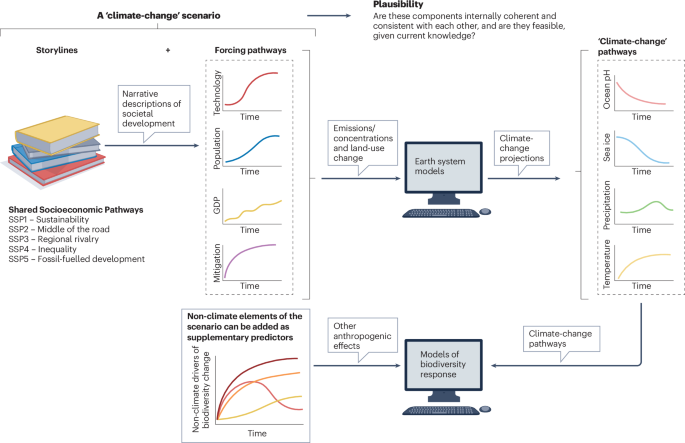
Pörtner, H.-O. et al. Overcoming the coupled climate and biodiversity crises and their societal impacts. Science 380, eabl4881 (2023).
IPBES. The Methodological Assessment Report on Scenarios and Models of Biodiversity and Ecosystem Services (Intergovernmental Science-Policy Platform on Biodiversity and Ecosystem Services (IPBES) Secretariat, 2016).
IPCC Climate Change 2022: Impacts, Adaptation, and Vulnerability. Contribution of Working Group II to the Sixth Assessment Report of the Intergovernmental Panel on Climate Change https://doi.org/10.1017/9781009325844 (Cambridge Univ. Press, 2022).
Paris Agreement to the United Nations Framework Convention on Climate Change. UNFCCC https://unfccc.int/documents/184656 (2015).
Kunming–Montreal Global Biodiversity Framework. CBD/COP/DEC/15/4. Convention on Biological Diversity/United Nations Environment Programme https://www.cbd.int/doc/decisions/cop-15/cop-15-dec-04-en.pdf (2022).
O’Neill, B. C. et al. The scenario model intercomparison project (ScenarioMIP) for CMIP6. Geosci. Model. Dev. 9, 3461–3482 (2016).
Schoeman, D. S. et al. Demystifying global climate models for use in the life sciences. Trends Ecol. Evol. 38, 843–858 (2023).
Transforming our world: the 2030 Agenda for Sustainable Development (Resolution A/RES/70/1). United Nations General Assembly https://www.refworld.org/legal/resolution/unga/2015/en/111816 (2015).
IPCC Climate Change 2021: The Physical Science Basis. Contribution of Working Group I to the Sixth Assessment Report of the Intergovernmental Panel on Climate Change. https://doi.org/10.1017/9781009157896 (Cambridge Univ. Press, 2021).
Matthews, H. D. & Wynes, S. Current global efforts are insufficient to limit warming to 1.5. Science 376, 1404–1409 (2022).
Bevacqua, E., Schleussner, C.-F. & Zscheischler, J. A year above 1.5 °C signals that Earth is most probably within the 20-year period that will reach the Paris Agreement limit. Nat. Clim. Change 15, 262–265 (2025).
Bindl, M., Edwards, M. R. & Cui, R. Y. Risks of relying on uncertain carbon dioxide removal in climate policy. Nat. Commun. 16, 5958 (2025).
Emissions gap report 2025: off target — continued collective inaction puts global temperature goal at risk. 53 United Nations Environment Programme https://wedocs.unep.org/items/9f0bf855-2069-42a6-a856-4b389f740c5c (2025).
Molinos, J. G. et al. Climate velocity and the future global redistribution of marine biodiversity. Nat. Clim. Change 6, 83–88 (2016).
Warren, R., Price, J., Graham, E., Forstenhaeusler, N. & VanDerWal, J. The projected effect on insects, vertebrates, and plants of limiting global warming to 1.5°C rather than 2°C. Science 360, 791–795 (2018).
Franklin, J. Species distribution modelling supports the study of past, present and future biogeographies. J. Biogeogr. 50, 1533–1545 (2023).
Pereira, H. M. et al. Global trends and scenarios for terrestrial biodiversity and ecosystem services from 1900 to 2050. Science 384, 458–465 (2024).
Reygondeau, G. et al. AquaX: an enhanced and revised AquaMaps framework to model marine species distributions and biodiversity. PLoS ONE 21, e0335823 (2026).
Meynard, C. N., Record, S., Galiana, N., Gravel, D. & Araújo, M. B. Emerging horizons in predictive biogeography. Ecography https://doi.org/10.1111/ecog.07910 (2025).
Yates, K. L. et al. Outstanding challenges in the transferability of ecological models. Trends Ecol. Evol. 33, 790–802 (2018).
Zurell, D., Fritz, S. A., Rönnfeldt, A. & Steinbauer, M. J. Predicting extinctions with species distribution models. Camb. Prism. Extinction 1, e8 (2023).
Urban, M. C. Climate change extinctions. Science 386, 1123–1128 (2024).
Deure, T., van der, Nogués-Bravo, D., Njotto, L. L. & Stensgaard, A. Climate change favors African malaria vector mosquitoes. Glob. Change Biol. 31, e70610 (2025).
Kopsco, H. L., Smith, R. L. & Halsey, S. J. A scoping review of species distribution modeling methods for tick vectors. Front. Ecol. Evol. 10, 893016 (2022).
Valdez-Espinoza, U. M. et al. Current and future applications of species distribution and ecological niche modelling for the study of ticks and tick-borne pathogens. Méd. Vet. Èntomol. 39, 399–421 (2025).
Godefroid, M. Species distribution models predicting climate suitability for the psyllid Trioza erytreae, vector of citrus greening disease. Crop. Prot. 168, 106228 (2023).
Hubab, M., Lorestani, N., Al-Awabdeh, R. A. M. & Shabani, F. Climate change-driven shifts in the global distribution of tomato and potato crops and their associated bacterial pathogens. Front. Microbiol. 16, 1520104 (2025).
Esser, L. F., Neves, D. & Jarenkow, J. A. Species distribution models to help integrate community ecology. Austral Ecol. 50, e70091 (2025).
Kass, J. M., Fukaya, K., Thuiller, W. & Mori, A. S. Biodiversity modeling advances will improve predictions of nature’s contributions to people. Trends Ecol. Evol. 39, 338–348 (2024).
Tittensor, D. P. et al. Next-generation ensemble projections reveal higher climate risks for marine ecosystems. Nat. Clim. Change 11, 973–981 (2021).
Bergkvist, J. et al. Quantifying the impact of climate change and forest management on Swedish forest ecosystems using the Dynamic Vegetation Model LPJ-GUESS. Earth’s Futur. 13, e2024EF004662 (2025).
Murphy, K. et al. Developing a Southern Ocean marine ecosystem model ensemble to assess climate risks and uncertainties. Earth’s Future 13, e2024EF004849 (2025).
Verma, A. et al. Integrating high-resolution data and species-level traits for enhanced ecosystem projections using a dynamic vegetation model: case study in Wallonia, Belgium. J. Environ. Manag. 375, 124329 (2025).
Trisos, C. H., Merow, C. & Pigot, A. L. The projected timing of abrupt ecological disruption from climate change. Nature 580, 496–501 (2020).
Duffy, K., Gouhier, T. C. & Ganguly, A. R. Climate-mediated shifts in temperature fluctuations promote extinction risk. Nat. Clim. Change 12, 1037–1044 (2022).
Meyer, A. S. et al. Temporal dynamics of climate change exposure and opportunities for global marine biodiversity. Nat. Commun. 15, 5836 (2024).
Penn, J. L. & Deutsch, C. Avoiding ocean mass extinction from climate warming. Science 376, 524–526 (2022).
Saintilan, N. et al. Widespread retreat of coastal habitat is likely at warming levels above 1.5 °C. Nature https://doi.org/10.1038/s41586-023-06448-z (2023).
Anderegg, W. R. L. et al. Future climate risks from stress, insects and fire across US forests. Ecol. Lett. 25, 1510–1520 (2022).
van den Bosch, M., Costanza, J. K., Peek, R. A., Mola, J. M. & Steel, Z. L. Climate change scenarios forecast increased drought exposure for terrestrial vertebrates in the contiguous United States. Commun. Earth Environ. 5, 708 (2024).
Arafeh-Dalmau, N. et al. Global floating kelp forests have limited protection despite intensifying marine heatwave threats. Nat. Commun. 16, 3173 (2025).
Torres-Vázquez, M. Á et al. Large increase in extreme fire weather synchronicity over Europe. Environ. Res. Lett. 20, 024045 (2025).
Dabalà, A. et al. Safeguarding climate-resilient mangroves requires only a moderate increase in the global protected area. Nat. Commun. 17, 2063 (2026).
Buenafe, K. C. V. et al. Current approaches and future opportunities for climate-smart protected areas. Nat. Rev. Biodivers. https://doi.org/10.1038/s44358-025-00041-0 (2025).
Parmesan, C. et al. Terrestrial and freshwater ecosystems and their services. In Climate Change 2022: Impacts, Adaptation and Vulnerability. Contribution of Working Group II to the Sixth Assessment Report of the Intergovernmental Panel on Climate Change 197–377, https://doi.org/10.1017/9781009325844.004 (Cambridge Univ. Press, 2022).
Lin, W. et al. Projecting suitable habitats and prioritizing conservation areas for Dendrobium shixingense under climate change. Front. Plant. Sci. 16, 1620580 (2025).
Zou, Y., Backus, G. A., Safford, H. D., Sawyer, S. & Baskett, M. L. Quantifying the capacity for assisted migration to achieve conservation and forestry goals under climate change. J. Biogeogr. 51, 2440–2455 (2024).
Pielke, R. & Ritchie, J. Distorting the view of our climate future: the misuse and abuse of climate pathways and scenarios. Energy Res. Soc. Sci. 72, 101890 (2021).
Kemp, L. et al. Climate endgame: exploring catastrophic climate change scenarios. Proc. Natl Acad. Sci. 119, e2108146119 (2022).
Schleussner, C.-F. et al. Overconfidence in climate overshoot. Nature 634, 366–373 (2024).
Kahn, H. & Wiener, A. J. The Year 2000: A Framework for Speculation on the Next Thirty Years (MacMillan, 1967).
Amer, M., Daim, T. U. & Jetter, A. A review of scenario planning. Futures 46, 23–40 (2013).
van Vuuren, D. P., Kok, M. T. J., Girod, B., Lucas, P. L. & de Vries, B. J. M. Scenarios in global environmental assessments: key characteristics and lessons for future use. Glob. Environ. Change 22, 884–895 (2012).
IPCC Climate Change: The IPCC Scientific Assessment (Cambridge Univ. Press, 1990).
Meinshausen, M. et al. A perspective on the next generation of Earth system model scenarios: towards representative emission pathways (REPs). Geosci. Model. Dev. 17, 4533–4559 (2024).
Möller, V. R. et al. Annex II: glossary. In Contribution of Working Group II to the Sixth Assessment Report of the Intergovernmental Panel on Climate Change (eds Pörtner, H.-O. et al.) 2897–2930, https://doi.org/10.1017/9781009325844.029 (Cambridge Univ. Press, 2022).
IPCC Climate Change 2023: Synthesis Report. Contribution of Working Groups I, II and III to the Sixth Assessment Report of the Intergovernmental Panel on Climate Change (IPCC, 2023).
IPCC Climate Change 2022: Mitigation of Climate Change. Contribution of Working Group III to the Sixth Assessment Report of the Intergovernmental Panel on Climate Change https://doi.org/10.1017/9781009157926 (Cambridge Univ. Press, 2022).
O’Neill, B. C. et al. The roads ahead: narratives for Shared Socioeconomic Pathways describing world futures in the 21st century. Glob. Environ. Change 42, 169–180 (2017).
Riahi, K. et al. The Shared Socioeconomic Pathways and their energy, land use, and greenhouse gas emissions implications: an overview. Glob. Environ. Change 42, 153–168 (2017).
Chen, D. et al. Framing, context, and methods. In Climate Change 2021: The Physical Science Basis. Contribution of Working Group I to the Sixth Assessment Report of the Intergovernmental Panel on Climate Change (eds Masson-Delmotte, V. et al.) 147–286, https://doi.org/10.1017/9781009157896.003 (Cambridge Univ. Press, 2021).
Hausfather, Z. & Moore, F. C. Net-zero commitments could limit warming to below 2°C. Nature 604, 247–248 (2022).
Vuuren, D. P. et al. The representative concentration pathways: an overview. Clim. Change 109, 5 (2011).
O’Neill, B. C. et al. A new scenario framework for climate change research: the concept of shared socioeconomic pathways. Clim. Change 122, 387–400 (2014).
Vuuren, D. P. V. et al. The Scenario Model Intercomparison Project for CMIP7 (ScenarioMIP-CMIP7). Geosci. Model. Dev. 19, 2627–2656 (2026).
Kim, H. et al. Towards a better future for biodiversity and people: modelling nature futures. Glob. Environ. Change 82, 102681 (2023).
Maury, O. et al. From Shared Socio-economic Pathways (SSPs) to Oceanic System Pathways (OSPs): building policy-relevant scenarios for global oceanic ecosystems and fisheries. Glob. Environ. Change 45, 203–216 (2017).
Maury, O. et al. The ocean system pathways (OSPs): a new scenario and simulation framework to investigate the future of the world fisheries. Earth’s Future https://doi.org/10.1029/2024EF004851 (2025).
Cooley, S. et al. Ocean and coastal ecosystems and their services. In Climate Change 2022: Impacts, Adaptation, and Vulnerability. Contribution of Working Group II to the Sixth Assessment Report of the Intergovernmental Panel on Climate Change (eds Pörtner, H.-O. et al.) 379–550, https://doi.org/10.1017/9781009325844.005 (Cambridge Univ. Press, 2022).
Shin, Y. J. et al. Chapter 4: Plausible futures of nature, its contributions to people and their good quality of life. In The Global Assessment Report on Biodiversity and Ecosystem Services (eds Brondízio, E. S., Settele, J., Díaz, S. & Ngo, H. T.) https://doi.org/10.5281/zenodo.3832074 (Intergovernmental Science-Policy Platform on Biodiversity and Ecosystem Services (IPBES) Secretariat, 2019).
O’Neill, B. C. et al. Achievements and needs for the climate change scenario framework. Nat. Clim. Change 10, 1074–1084 (2020).
Burgess, M. G. & Dancer, A. Keeping emissions scenarios current. Nat. Clim. Change 15, 131–132 (2025).
Van de Ven, D. J. et al. Energy and socioeconomic system transformation through a decade of IPCC-assessed scenarios. Nat. Clim. Change 15, 218–226 (2025).
Burgess, M. G., Ritchie, J., Shapland, J. & Pielke, R. IPCC baseline scenarios have over-projected CO₂ emissions and economic growth. Environ. Res. Lett. 16, 014016 (2021).
Burgess, M. G., Becker, S. L., Langendorf, R. E., Fredston, A. & Brooks, C. M. Climate change scenarios in fisheries and aquatic conservation research. ICES J. Mar. Sci. 80, 1163–1178 (2023).
Hausfather, Z. & Peters, G. P. Emissions — the ‘business as usual’ story is misleading. Nature 577, 618–620 (2020).
Hausfather, Z., Marvel, K., Schcmidt, G. A., Nielsen-Gammon, J. W. & Zelinka, M. Climate simulations: recognize the ‘hot model’ problem. Nature 605, 26–29 (2022).
Anderson, C. M. et al. Planning for change: conservation-related impacts of climate overshoot. BioScience 70, 115–118 (2020).
King, A. D. et al. Transient and quasi-equilibrium climate states at 1.5°C and 2°C gobal warming. Earth’s Future 9, e2021EF002274 (2021).
Jewell, J. & Cherp, A. The feasibility of climate action: bridging the inside and the outside view through feasibility spaces. Wiley Interdisc. Rev. Clim. Change 14, e838 (2023).
United Nations decade on ecosystem restoration (2021–2030): resolution adopted by the General Assembly (A/RES/73/284). UN General Assembly https://digitallibrary.un.org/record/3794317 (2019).
Glasgow leaders’ declaration on forests and land use. UN Climate Change Conference UK 2021 https://ukcop26.org/glasgow-leaders-declaration-on-forests-and-land-use (2021).
Lee, J.-Y. et al. Future global climate: scenario-based projections and near term information. In Climate Change 2021: The Physical Science Basis. Contribution of Working Group I to the Sixth Assessment Report of the Intergovernmental Panel on Climate Change (eds Masson-Delmotte, V. et al.) 553–672, https://doi.org/10.1017/9781009157896.006 (Cambridge Univ. Press, 2021).
Schwalm, C. R., Glendon, S. & Duffy, P. B. RCP8.5 tracks cumulative CO₂ emissions. Proc. Natl Acad. Sci. 117, 19656–19657 (2020).
Sarofim, M. C. et al. High radiative forcing climate scenario relevance analyzed with a ten-million-member ensemble. Nat. Commun. 15, 8185 (2024).
Rogelj, J. et al. Credibility gap in net-zero climate targets leaves world at high risk. Science 380, 1014–1016 (2023).
Deng, Z. et al. Global carbon emissions and decarbonization in 2024. Nat. Rev. Earth Environ. 6, 231–233 (2025).
Trisos, C. H. et al. Potentially dangerous consequences for biodiversity of solar geoengineering implementation and termination. Nat. Ecol. Evol. 2, 475–482 (2018).
Tang, A. & Kemp, L. A fate worse than warming? Stratospheric aerosol injection and global catastrophic risk. Front. Clim. 3, 720312 (2021).
Meyer, A. L. S. & Trisos, C. H. Ecological impacts of temperature overshoot: the journey and the destination. One Earth 6, 1614–1617 (2023).
Keller, D. P. et al. The Carbon Dioxide Removal Model Intercomparison Project (CDRMIP): rationale and experimental protocol for CMIP6. Geosci. Model. Dev. 11, 1133–1160 (2017).
Kravitz, B. et al. The Geoengineering Model Intercomparison Project Phase 6 (GeoMIP6): simulation design and preliminary results. Geosci. Model. Dev. 8, 3379–3392 (2015).
Friedlingstein, P. et al. Global carbon budget 2024. Earth Syst. Sci. Data 17, 965–1039 (2025).
Friedlingstein, P. et al. Emerging climate impact on carbon sinks in a consolidated carbon budget. Nature https://doi.org/10.1038/s41586-025-09802-5 (2025).
Tavoni, M. et al. Implications of overshoot for climate mitigation strategies. Nat. Clim. Change 16, 261–272 (2026).
MacMartin, D. G. et al. Scenarios for modeling solar radiation modification. Proc. Natl Acad. Sci. 119, e2202230119 (2022).
Brunner, C., Hausfather, Z. & Knutti, R. Durability of carbon dioxide removal is critical for Paris climate goals. Commun. Earth Environ. 5, 645 (2024).
Taylor, G. & Vink, S. Managing the risks of missing international climate targets. Clim. Risk Manag. 34, 100379 (2021).
Reisinger, A. et al. Overshoot: a conceptual review of exceeding and returning to global warming of 1.5°C. Annu. Rev. Environ. Resour. https://doi.org/10.1146/annurev-environ-111523-102029 (2025).
Visioni, D., Bednarz, E. M., MacMartin, D. G., Kravitz, B. & Goddard, P. B. The choice of baseline period influences the assessments of the outcomes of stratospheric aerosol injection. Earth’s Future. 11, e2023EF003851 (2023).
Brody, E. et al. Kicking the can down the road: understanding the effects of delaying the deployment of stratospheric aerosol injection. Environ. Res. Clim. 3, 035011 (2024).
Morrison, A. L., Pathak, D., Barnes, E. A. & Hurrell, J. W. Projected changes to Arctic shipping routes after stratospheric aerosol deployment in the ARISE-SAI scenarios. Front. Clim. 6, 1426679 (2024).
Quagraine, K. T., O’Brien, T. A., Quagraine, K. A., Kravitz, B. & Tilmes, S. Assessing changes in atmospheric rivers under stratospheric aerosol injection using ARISE-SAI-1.5. Environ. Res. Clim. 4, 025016 (2025).
Gay, B. A., Mandrake, L., Miner, K. R. & Miller, C. E. Assessing the impacts of mitigation and geoengineering intervention scenarios on Earth system dynamics and climatological variability with multimodal simulations. Sci. Rep. 15, 8158 (2025).
Fick, S. E. & Hijmans, R. J. WorldClim 2: new 1-km spatial resolution climate surfaces for global land areas. Int. J. Climatol. 37, 4302–4315 (2017).
Assis, J. et al. Bio-ORACLE v3.0. Pushing marine data layers to the CMIP6 Earth system models of climate change research. Glob. Ecol. Biogeogr. 33, e13813 (2024).
Sudakow, I., Pokojovy, M. & Lyakhov, D. Statistical mechanics in climate emulation: challenges and perspectives. Environ. Data Sci. 1, e16 (2022).
Tebaldi, C., Selin, N. E., Ferrari, R. & Flierl, G. Emulators of climate model output. Annu. Rev. Environ. Resour. 50, 709–737 (2025).
Ruane, A. C. et al. CMIP7 data request: impacts and adaptation priorities and opportunities. Geosci. Model. Dev. 18, 9497–9540 (2025).
Pirani, A. et al. Scenarios in IPCC assessments: lessons from AR6 and opportunities for AR7. npj Clim. Action 3, 1 (2024).
Roberts, K. E. et al. Potential impacts of climate interventions on marine ecosystems. Rev. Geophys. 64, e2024RG000876 (2026).
McCormack, C. G. et al. Key impacts of climate engineering on biodiversity and ecosystems, with priorities for future research. J. Integr. Environ. Sci. 13, 103–128 (2016).
Levin, L. A. et al. Deep-sea impacts of climate interventions. Science 379, 978–981 (2023).
Boyd, P. & Vivian, C. Should we fertilize oceans or seed clouds? No one knows. Nature 570, 155–157 (2019).
Boyd, P. W., Gattuso, J.-P., Hurd, C. L. & Williamson, P. Limited understanding of basic ocean processes is hindering progress in marine carbon dioxide removal. Environ. Res. Lett. 19, 061002 (2024).
Doney, S. C., Wolfe, W. H., McKee, D. C. & Fuhrman, J. G. The science, engineering, and validation of marine carbon dioxide removal and storage. Annu. Rev. Mar. Sci. 17, 55–81 (2025).
Pörtner, H. O. & Gutt, J. Impacts of climate variability and change on (marine) animals: physiological underpinnings and evolutionary consequences. Integr. Comp. Biol. 56, 31–44 (2016).
Pörtner, H.-O. Climate impacts on organisms, ecosystems and human societies: integrating OCLTT into a wider context. J. Exp. Biol. 224, jeb238360 (2021).
Cabral, J. S. et al. The road to integrate climate change projections with regional land-use–biodiversity models. People Nat. 6, 1716–1741 (2024).
Schweizer, V. J. et al. Integrated climate-change assessment scenarios and carbon dioxide removal. One Earth 3, 166–172 (2020).
Vuuren, D. P. et al. A comprehensive view on climate change: coupling of Earth system and integrated assessment models. Environ. Res. Lett. 7, 024012 (2012).
Smith, S. et al. The State of Carbon Dioxide Removal 2024 2nd edn (Oxford Univ. Press, 2024).
Dooley, K., Harrould-Kolieb, E. & Talberg, A. Carbon-dioxide removal and biodiversity: a threat identification framework. Glob. Policy 12, 34–44 (2021).
Gattuso, J.-P., Williamson, P., Duarte, C. M. & Magnan, A. K. The potential for ocean-based climate action: negative emissions technologies and beyond. Front. Clim. 2, 575716 (2021).
Macreadie, P. I. et al. Blue carbon as a natural climate solution. Nat. Rev. Earth Environ. 2, 826–839 (2021).
Sekera, J. et al. Carbon dioxide removal — what’s worth doing? A biophysical and public need perspective. PLoS Clim. 2, e0000124 (2023).
Lamb, W. F. et al. The carbon dioxide removal gap. Nat. Clim. Change 14, 644–651 (2024).
Sacco, A. D. et al. Ten golden rules for reforestation to optimize carbon sequestration, biodiversity recovery and livelihood benefits. Glob. Change Biol. 27, 1328–1348 (2021).
Doelman, J. C. et al. Afforestation for climate change mitigation: potentials, risks and trade-offs. Glob. Change Biol. 26, 1576–1591 (2020).
Kaufhold, C., Willeit, M., Talento, S., Ganopolski, A. & Rockström, J. Interplay between climate and carbon cycle feedbacks could substantially enhance future warming. Environ. Res. Lett. 20, 044027 (2025).
Brent, K., Simon, M. & McDonald, J. From informal to formal governance of solar radiation management. Clim. Policy 25, 947–964 (2025).
Gasparini, B., McGraw, Z., Storelvmo, T. & Lohmann, U. To what extent can cirrus cloud seeding counteract global warming? Environ. Res. Lett. 15, 054002 (2020).
Biermann, F. et al. Solar geoengineering: the case for an international non-use agreement. Wiley Interdisc. Rev. Clim. Change 13, e754 (2022).
Santos, F. D., Ferreira, P. L. & Pedersen, J. S. T. The climate change challenge: a review of the barriers and solutions to deliver a Paris solution. Climate 10, 75 (2022).
McEvoy, D. M., McGinty, M., Cherry, T. L. & Kroll, S. International climate agreements under the threat of solar geoengineering. J. Assoc. Environ. Resour. Econ. 11, 853–886 (2024).
Findlay, H. S., Feely, R. A., Jiang, L., Pelletier, G. & Bednaršek, N. Ocean acidification: another planetary boundary crossed. Glob. Change Biol. 31, e70238 (2025).
Ellis, S. L. et al. Shading responses are species-specific in thermally stressed corals. Front. Mar. Sci. 11, 1333806 (2024).
Bourgeois, T. et al. Mapping the safe operating space of marine ecosystems under contrasting emission pathways. Biogeosciences 22, 5435–5462 (2025).
Munday, G. et al. Risks of unavoidable impacts on forests at 1.5°C with and without overshoot. Nat. Clim. Change 15, 650–655 (2025).
Ritchie, P. D. L., Clarke, J. J., Cox, P. M. & Huntingford, C. Overshooting tipping point thresholds in a changing climate. Nature 592, 517–523 (2021).
McKay, D. I. A. et al. Exceeding 1.5°C global warming could trigger multiple climate tipping points. Science 377, eabn7950 (2022).
Santana-Falcón, Y. et al. Irreversible loss in marine ecosystem habitability after a temperature overshoot. Commun. Earth Environ. 4, 343 (2023).
Lenoir, J. et al. Species better track climate warming in the oceans than on land. Nat. Ecol. Evol. 4, 1044–1059 (2020).
Schoeman, D. S., Bolin, J. A. & Cooley, S. R. Quantifying the ecological consequences of climate change in coastal ecosystems. Camb. Prism. Coast. Future 1, e39 (2023).
Grinder, R. M. & Wiens, J. J. Niche width predicts extinction from climate change and vulnerability of tropical species. Glob. Change Biol. 29, 618–630 (2023).
Arif, S., Graham, N. A. J., Wilson, S. & MacNeil, M. A. Causal drivers of climate-mediated coral reef regime shifts. Ecosphere 13, e3956 (2022).
Hesterberg, S. G., Jackson, K. & Bell, S. S. Climate drives coupled regime shifts across subtropical estuarine ecosystems. Proc. Natl Acad. Sci. 119, e2121654119 (2022).
Moss, W. E. et al. Drought as an emergent driver of ecological transformation in the twenty-first century. BioScience 74, 524–538 (2024).
Turner, M. G. & Seidl, R. Novel disturbance regimes and ecological responses. Annu. Rev. Ecol. Evol. Syst. 54, 63–83 (2023).
Meyer, A. L. S., Bentley, J., Odoulami, R. C., Pigot, A. L. & Trisos, C. H. Risks to biodiversity from temperature overshoot pathways. Phil. Trans. R. Soc. B 377, 20210394 (2022).
Jeltsch-Thmmes, A., Stocker, T. F. & Joos, F. Hysteresis of the Earth system under positive and negative CO₂ emissions. Environ. Res. Lett. 15, 124026 (2020).
Liu, L., Hauser, M., Windisch, M. & Seneviratne, S. I. Hysteresis and reversibility of agroecological droughts in response to carbon dioxide removal. Nat. Water 3, 1017–1024 (2025).
Hueholt, D. M., Barnes, E. A., Hurrell, J. W. & Morrison, A. L. Speed of environmental change frames relative ecological risk in climate change and climate intervention scenarios. Nat. Commun. 15, 3332 (2024).
Schuster, L. et al. Irreversible glacier change and trough water for centuries after overshooting 1.5 °C. Nat. Clim. Change 15, 634–641 (2025).
Deprez, A. et al. Sustainability limits needed for CO₂ removal. Science 383, 484–486 (2024).
Möller, T. et al. Achieving net zero greenhouse gas emissions critical to limit climate tipping risks. Nat. Commun. 15, 6192 (2024).
Hijmans, R. J., Cameron, S. E., Parra, J. L., Jones, P. G. & Jarvis, A. Very high resolution interpolated climate surfaces for global land areas. Int. J. Clim. 25, 1965–1978 (2005).
Assis, J. et al. Bio-ORACLE v2.0: extending marine data layers for bioclimatic modelling. Glob. Ecol. Biogeogr. 27, 277–284 (2018).
IPCC. Summary for policymakers. In Climate Change 2022: Impacts, Adaptation, and Vulnerability. Contribution of Working Group II to the Sixth Assessment Report of the Intergovernmental Panel on Climate Change (eds Pörtner, H.-O. et al.) 3–33, https://doi.org/10.1017/9781009325844.001 (Cambridge Univ. Press, 2022).
Hughes, T. P. et al. Ecological memory modifies the cumulative impact of recurrent climate extremes. Nat. Clim. Change 9, 40–43 (2019).
Harris, R. M. B. et al. Climate projections for ecologists. Wiley Interdiscip. Rev. Clim. Change 5, 621–637 (2014).