
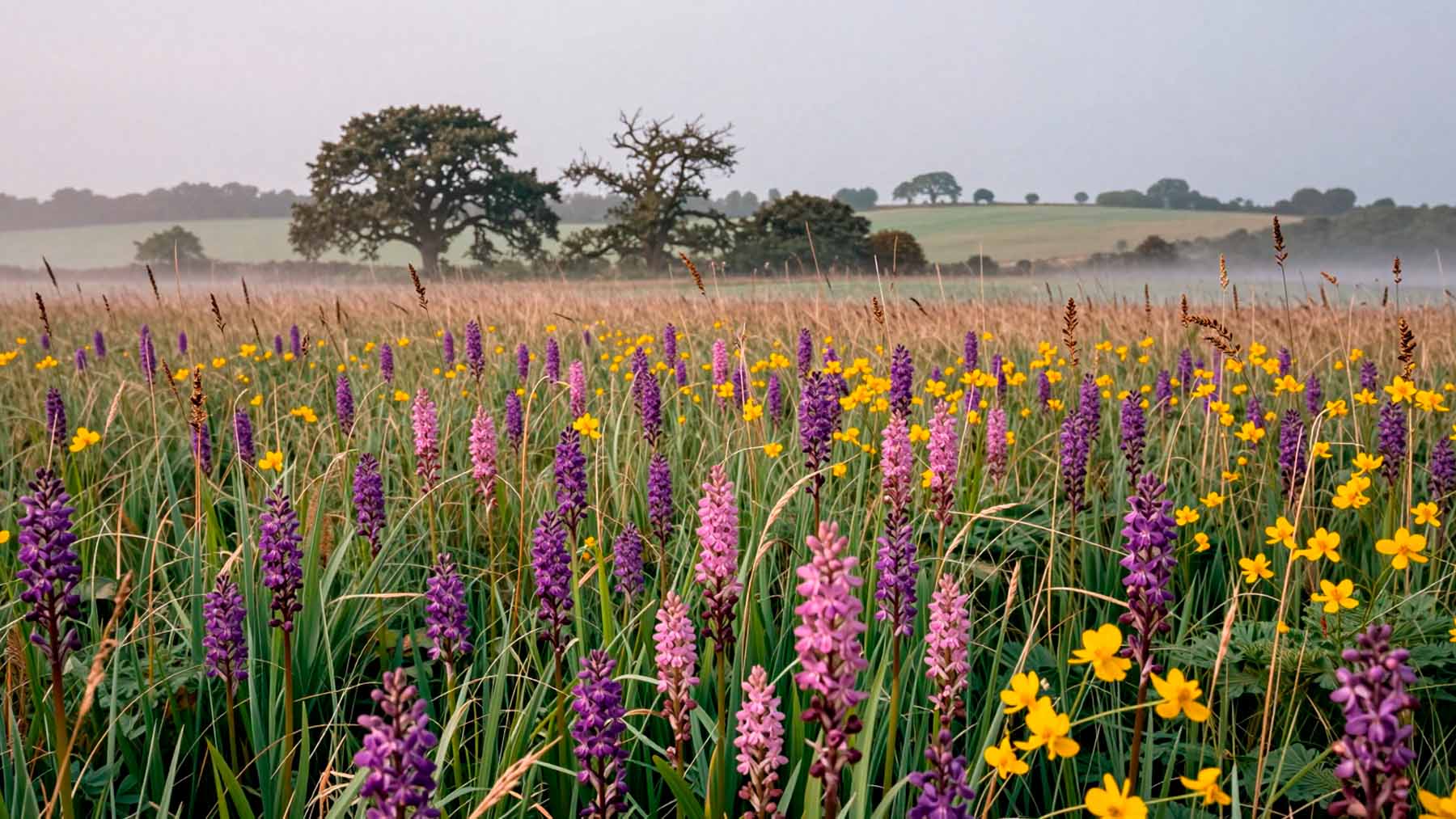
A field in North Norfolk that once grew oilseed rape is now carpeted with thousands of wild orchids and rare wildflowers — and nobody planted a single seed to make it happen.
When farming stopped there in 2005, scientists didn’t intervene. No restoration program was launched, no commercial seed mixes were spread. They simply stepped back. What grew in its place over the following decade has become something locals visit with quiet wonder — and something ecologists are still struggling to fully explain.
A field left behind — and what grew in its place
The two-hectare site sits near Bodham, a small village in North Norfolk. After its final oilseed rape harvest in 2005, the land was quietly retired from farming — partly because it was difficult to drain. No restoration program followed. The only ongoing management was a traditional annual hay cut, the kind of low-intensity practice that has shaped British meadows for centuries.
That was enough.
Within 10 to 15 years, the former arable field had become a species-rich wildflower meadow. Locally rare plants arrived without invitation: southern marsh orchid, yellow rattle, greater tussock-sedge, common centaury. None were seeded. None were coaxed. They simply came.
Eleven years of watching nature work
Starting in 2011, UCL Professor Carl Sayer and collaborator Pete Robinson began documenting what was happening. Every two to three years, they conducted detailed vegetation surveys — recording every plant species across the meadow and tracking changes within permanent survey plots. The study ran until 2022, giving researchers an unusually long window into natural recovery.
The numbers told a clear story. The average number of plant species per survey plot roughly doubled over the study period, rising from around 10 in 2011 to nearly 20 by 2022. Thousands of orchids became established without any human assistance, and yellow rattle populations expanded steadily alongside them. Both species are widely recognized as indicators of successful meadow restoration — their presence signals that a habitat is genuinely recovering, not just greening over.
Related
Long-term ecological studies like this one are rare. They require consistent monitoring across many years, and few researchers — or landowners — commit to that kind of patience.
How did rare plants get there without human help?
That’s the question the researchers can’t fully answer. Their best working explanation is that wildlife played a role. Deer, in particular, may have carried or dispersed seeds from surrounding areas into the field, introducing species that no seed catalog would have supplied.
The implication is significant. Landscapes appear to have an internal logic — a capacity to rebuild complexity when ecological processes are simply allowed to run. You don’t always need to import diversity. Sometimes it finds its own way in.
There’s another advantage to this kind of arrival. Naturally dispersed plants carry the genetic fingerprint of the local environment, already adapted to the soil, the drainage patterns, the microclimate. Commercial seed mixes can’t replicate that. The plants they introduce may be the right species on paper, but they often lack the genetic specificity that makes a meadow truly resilient — and truly local.
Challenging the seed-packet assumption
Conventional habitat restoration has long leaned on a familiar toolkit: commercial seed mixes, soil preparation, targeted intervention. These approaches aren’t wrong, but they carry real costs — financial, logistical, and ecological. The study, published in Restoration Ecology, asks whether they’re always necessary.
Professor Sayer put it directly: “Should we be employing patience over seed packet more often?” It’s a pointed question aimed at a field that has tended to favor action over restraint. The Norfolk meadow suggests that restraint, applied consistently over time, can produce results that rival — and may exceed — what costly interventions achieve.
Related
Natural regeneration won’t work everywhere. Soil condition, surrounding land use, and the availability of seed sources all matter. But where conditions allow, stepping back may be the most effective move available.
Why it matters beyond one Norfolk field
The timing of this research isn’t incidental. Governments across the UK and Europe are actively searching for affordable, scalable ways to restore biodiversity on former farmland. The targets are ambitious; the budgets, often, are not.
Species-rich grasslands do more than look beautiful. They provide critical habitat for pollinators, birds, and mammals, while also strengthening ecosystem resilience. They help landscapes adapt to a changing climate — making meadow restoration a tool that serves conservation and climate goals at once.
The Bodham field is just two hectares. But the principle it demonstrates could apply across far larger areas of degraded agricultural land. If nature-led recovery can deliver genuine biodiversity gains at lower cost and complexity, that changes the calculus of restoration significantly.
What this meadow ultimately asks is a quiet but uncomfortable question: how often have we intervened when we didn’t need to? And how much might we gain — in diversity, in resilience, in the strange abundance of thousands of uninvited orchids — simply by learning to wait?
Read the whole thing?
Get the week’s signal, not the noise
Our sharpest reporting on energy, climate and nature — free, once a week.