
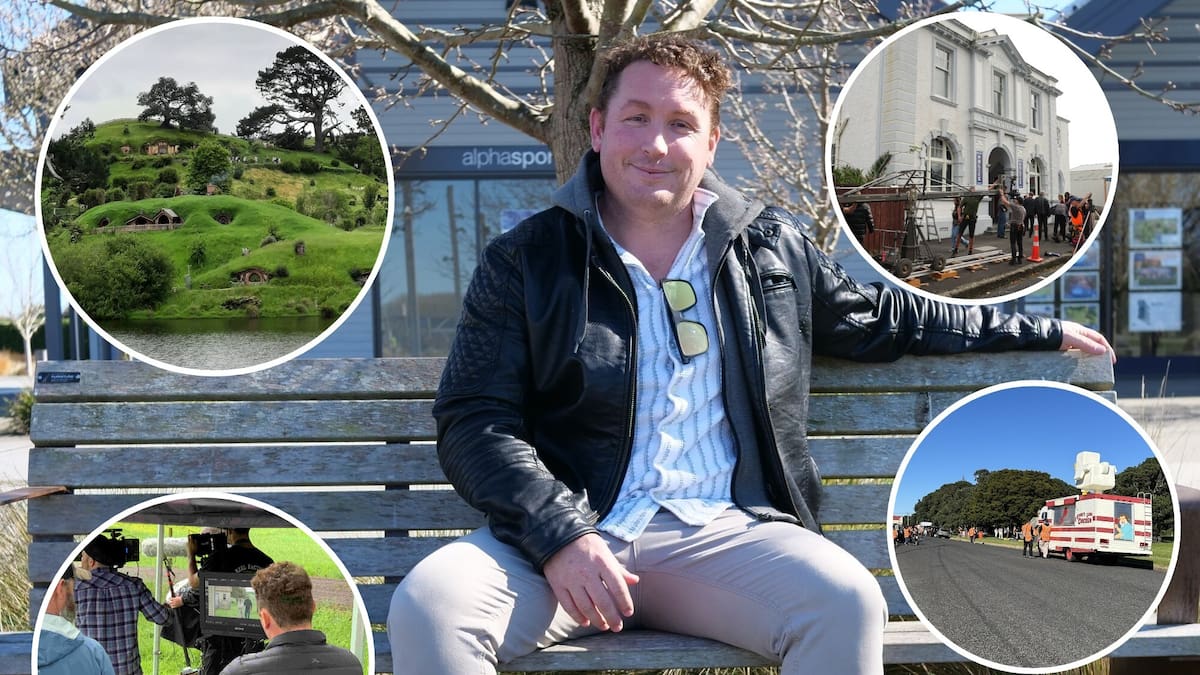
A decade ago, Hicks was making his first film while moving dog kennels and figuring filmmaking out as he went.
Now he has produced the Waikato-shot feature Home Kills, which premiered at the New Zealand International Film Festival, and made his feature, The Tavern.
He never went to film school.
“I think sometimes naivety is a superpower,” Hicks said.
“If I had fully understood how hard it is, maybe I wouldn’t have done it.”
That willingness to have a go is something Hicks said ran through Waikato’s screen community.
“The most beautiful thing about it is everybody’s operating from almost like a pure sense [of filmmaking],” he said.
“There’s not too many politics. There’s not too much ego. Everybody’s just turning up for the love of the game.”
Hicks said the Waikato’s screen community was built on a willingness to have a go. Photo / Tom Eley
In Waikato, a film crew still attracts attention, he said.
It is still a novelty, and Hicks reckons that can be an advantage.
For The Tavern, the team approached Cambridge Raceway hoping to film one horse-racing scene. Instead, they were welcomed in entirely.
Farmers opened their properties, locals became extras, and businesses got involved.
Some were paid little more than a box of Waikato Draught and a bottle of spirits.
But they wanted to see their town on screen.
“That’s the coolest thing about the Cambridge community,” Hicks said.
“I feel any success that The Tavern has had, they’ve had as well.”
When the film toured New Zealand, people who had once drunk at the real Cambridge tavern that inspired it came out to screenings.
The five mates who starred in The Tavern: Dan Sage (Keitz), Stuart Shacklock (Jeremy), Tom Easden (Tomo), Ryan Jackson (Jacko) and Matt Hicks (Matt). Photo / Ruth Gilmour
One man told Hicks he had been the bouncer there in 1972.
“It was so cool to show our town all around the nation,” he said.
That grassroots enthusiasm is now alongside something considerably more professional.
Waikato Screen, the region’s film office, has grown over the past three years and now supports seven of the Waikato region’s nine councils.
Attraction and facilitation manager Erin Griffiths said the scale of change was significant.
“In the past four years, we’ve had more productions filming in the Waikato than we had in the previous 20 years combined,” she said.
Waikato Screen’s role includes helping productions find locations, crew, businesses and services, while navigating the practicalities of filming across the region.
Location manager Peta Sinclair, who recently worked on the international production Minecraft, said having an established film office had made a significant difference.
A production needs more than a beautiful landscape: accommodation, service providers, a unit base and infrastructure capable of supporting large casts and crews, Sinclair said.
Waikato Screen could provide location leads, make introductions and help productions navigate council permissions, logistics and filming requirements, Sinclair said.
Waikato is also becoming an attractive alternative to Auckland, particularly for large international productions that might struggle to operate at scale in the big smoke.
The filming of The Gone, season 2 in Te Aroha. Photo / Supplied
“Waikato Screen has become a major player within the filming process for both international and the local domestic market,” Sinclair said.
“The future is looking extremely bright for the land of Mooloo.”
Hicks puts it more colourfully.
“We’re not the poor cousin of Auckland,” he said.
“I reckon we’re like the hot, rich sister.”
The recent list of productions using the Waikato is hard to ignore.
A Minecraft Movie and its sequel used Huntly, including the town’s streets and power station, while Netflix’s Beyond Goodbye filmed in Raglan.
The region also hosted productions including Chief of War, The Gone, Sweet Tooth, and Don’t Make Me Go.
Earlier productions filmed in Waikato include The Chronicles of Narnia: Prince Caspian and Pete’s Dragon.
A Minecraft Movie Squared, filiming Thames. The movie was spotted filming in multiple locations around Waikato. Photo / Supplied
Recent productions such as Minecraft have given locals a glimpse of what featuring in a movie could mean.
Hicks remembers sitting beside two Huntly councillors at an Auckland preview as Huntly Power Station appeared on screen.
“It’s a real buzz,” he said.
But bringing productions into the region is only half the battle.
The other question is who will make them.
Jack Black was seen waving to a crowd of onlookers from the main street of Thames.
Misty Flicks film festival director Paige Larianova has spent a decade watching Waikato’s filmmaking community develop.
The festival began as a two-hour short-film showcase and has grown into a three-day event featuring workshops, pitching sessions and training programmes.
Larianova said many Waikato-made films found success overseas.
“There are heaps of short films on the festival circuit around the world being made here, and no one even knows about them [locally],” she said.
“Wouldn’t it be cool if people could actually see what local filmmakers are creating?”
Another challenge, she said, was developing the people behind the camera.
“Everyone is trying to be a director, but we need more producers and people who understand the different roles on a film set if we’re going to make bigger productions more often.”
That is also the thinking behind the new Waikato Screen Charitable Trust.
The separate organisation will focus on education, training, mentoring, scholarships, upskilling, cultural storytelling and pathways into film, television and the creative industries, while Waikato Screen concentrates on attracting and facilitating productions.
Lido manager Nigel Corboy. Photo / Tom Eley
At Hamilton’s Lido Cinema, manager Nigel Corboy sees the film community developing from another vantage point.
The independent cinema hosts local premieres, Q&As and screenings for Waikato productions.
“You see a lot of the same people working together, which is great,” he said.
“It’s a small scene, but it’s vibrant.”
Corboy said audiences were also increasingly backing New Zealand-made films.
“It makes me proud to see Kiwis flock to Kiwi films,” he said.
“We really do turn out for these films.”
Meanwhile, for Hicks, Waikato’s film future lies in keeping that community spirit while giving people more opportunities to make ambitious work.
When he decided to make The Tavern, he went to Whangamatā, locked himself in a room for a week and wrote.
No internet. No distractions.
He produced about 200 pages of what he called “absolute garbage”, cut it to 130 pages and eventually took another 40 minutes out during the edit.
The finished film was the realisation of a life dream.
“It was my life dream to make a feature film, and I’d done it,” Hicks said.
“If I died tomorrow, it was great to know that I’d achieved something of significance.”
He is already working on his next film.
His advice to anyone considering entering the industry:
“Just do it.”
Tom Eley is a multimedia journalist at the Waikato Herald. Before joining the Hamilton-based team, he worked for the Weekend Sun and Sunlive. He previously worked as a journalist at Black Press Media in Canada and won a fellowship with the Vancouver Sun.