
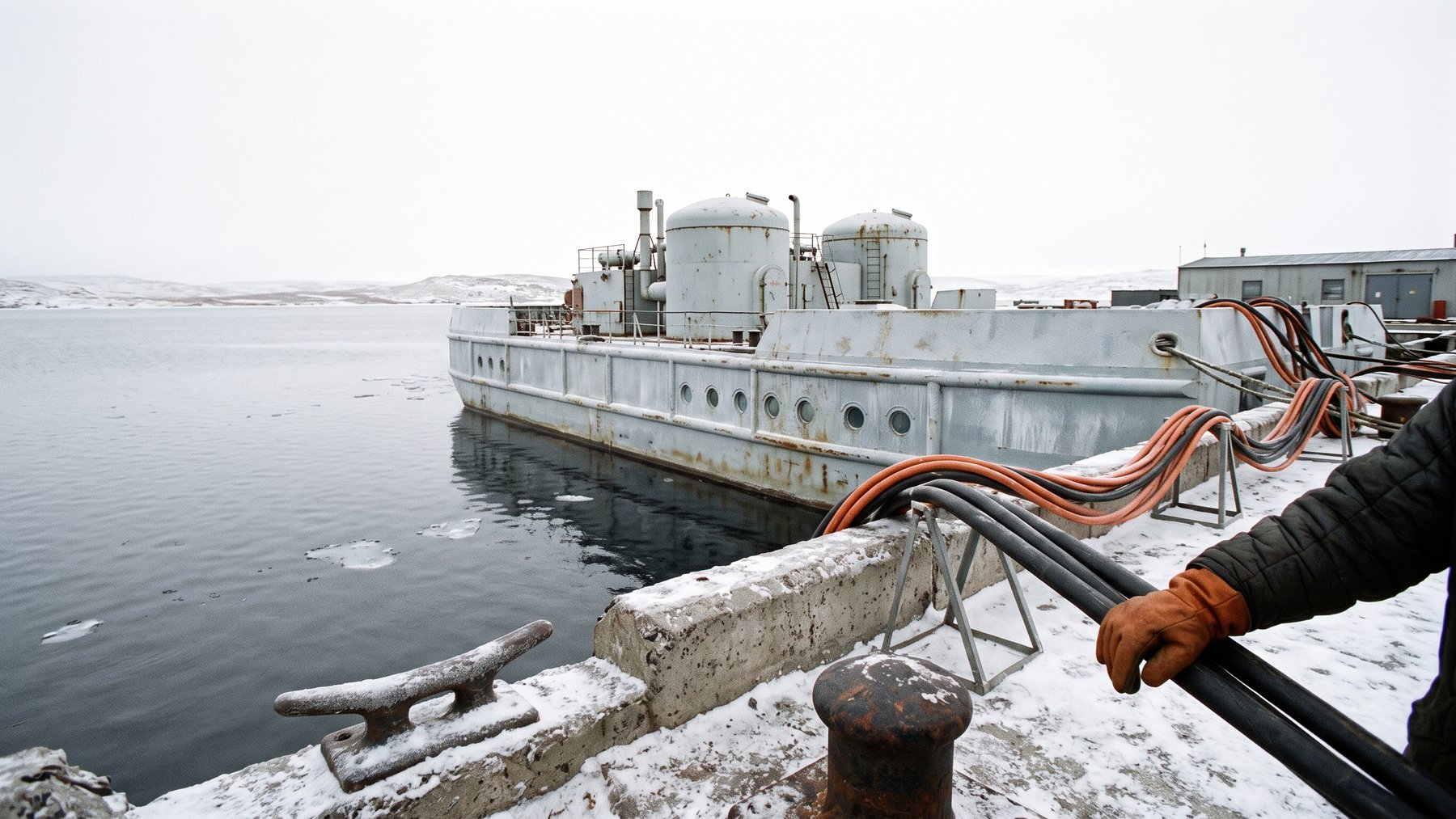
The town of Pevek sits at the very top of Russia, far above the Arctic Circle.
About 5,000 people live there, in one of the most remote port cities on Earth.
A 472 foot barge carrying two nuclear reactors was towed in and moored against the quay.
It has not moved since.
Five years into commercial operation, it crossed a number no floating nuclear plant had reached before: one billion kilowatt hours delivered to the grid.
What the machine does with its leftover heat is the stranger half of the story.
What two reactors do that a land plant cannot
The vessel is 472 feet long and 98 feet wide, and its two KLT-40S reactors have a combined thermal output of 300 MW, which generates about 70 MW of electricity. That is modest by any grid standard. But in the high Arctic, modest output delivered reliably is worth more than enormous output delivered nowhere near the load.
Its operators say the energy generated would be enough to “make a double espresso for everyone on earth.” The line is a boast, but the engineering underneath it is ordinary marine practice: the reactors are similar to those used in a previous generation of nuclear powered icebreakers, packaged into a hull that a tug can move.
Related
Beyond electricity, the plant works as a cogeneration unit, sending waste heat into the town’s district heating system. The same fuel that spins the turbines also keeps apartment blocks warm, with less diesel burned to do it.
What a harbor town at the top of the world actually runs on
Before the barge arrived, the isolated Chaun-Bilibino network leaned on the aging Bilibino nuclear station and on diesel shipped in across thousands of miles. The floating plant was intended to replace Bilibino, which was at the end of its service life. In the Arctic, every gallon of diesel that does not have to travel by ship or ice road is a genuine logistical relief.
The plant now provides about 60 percent of the energy for the western Chukotka region and Chersky in Yakutia, and has been increasing its output each year. That is more than half the light and heat across a scattered, road poor territory, drawn from one moored barge.
It is also providing energy for the development of mining of the Baimskaya ore zone, which makes the barge at once a municipal utility and an industrial power source.
How the fuel cycle and the billion kilowatt hour number connect
Natalia Tarasova, Deputy Director for Human Resources Management at the plant, said “the first fuel campaign in the history of the plant was successfully completed.” Refueling here is not the partial reload of a standard station: the entire core is unloaded and replaced with fresh fuel once every few years. Doing that on a barge, with sea ice closing the lanes for months at a time, is a different problem from a land refuel.
Both reactors have now been reloaded with fresh uranium fuel for the first time since the plant was put into operation, the first of them in late 2023 and early 2024, and the second reload was finished as the billion kilowatt hour figure arrived.
The plant was connected to the grid in December 2019 and entered commercial operation the following May, and it has increased output each year since. For context, a billion kilowatt hours is on the order of what 90,000 American homes use in a year, generated by two small reactors in one of the harshest marine environments on Earth.
The living world the barge sits inside
Pevek harbor is not open ocean. The plant sits on the coast of the East Siberian Sea, on the Chukotka peninsula, feeding a grid that stands apart from the rest of the country. A bay that freezes hard for most of the year is still a living system, and a permanently moored hull sits inside it.
Related
Researchers tracking floating turbines in cold northern seas have described how large moored structures behave as reef analogs, with fouling organisms colonizing submerged surfaces and fish gathering around them. Whether the same pattern forms around this particular hull is an open question rather than a documented finding.
What its cooling water discharge does in a shallow Arctic bay is equally unstudied. The only operating floating reactor in the world is also an unstudied piece of marine furniture, and that gap is worth naming plainly.
What one barge proves and what it still cannot answer
The case for the floating plant rests on a specific situation: a small, isolated population in extreme terrain, too far from any national grid to be wired in conventionally, and too dark through the polar night for solar to carry the load. In that narrow situation it supplies heat and power in a way nothing else deployed there can match.
The honest caveat is scale. The plant has the capacity to power a city of up to 100,000 people, while the town beside it holds about 5,000, with the regional grid and the mining load taking up the balance. Running a large machine below full output, where fuel logistics are extraordinary, is a real trade off rather than a free win.
Rosatom has been exploring four more floating plants, each around 100 MWe and designed for a lifespan of more than 60 years, and the Pevek unit is the only field evidence those designers have. The barge was designed around three twelve year operating cycles, which puts the question of what happens to the hull at the end of them a long way off. That answer will not come from a drawing board. It will come from Pevek.
Read the whole thing?
Get the week’s signal, not the noise
Our sharpest reporting on energy, climate and nature — free, once a week.