
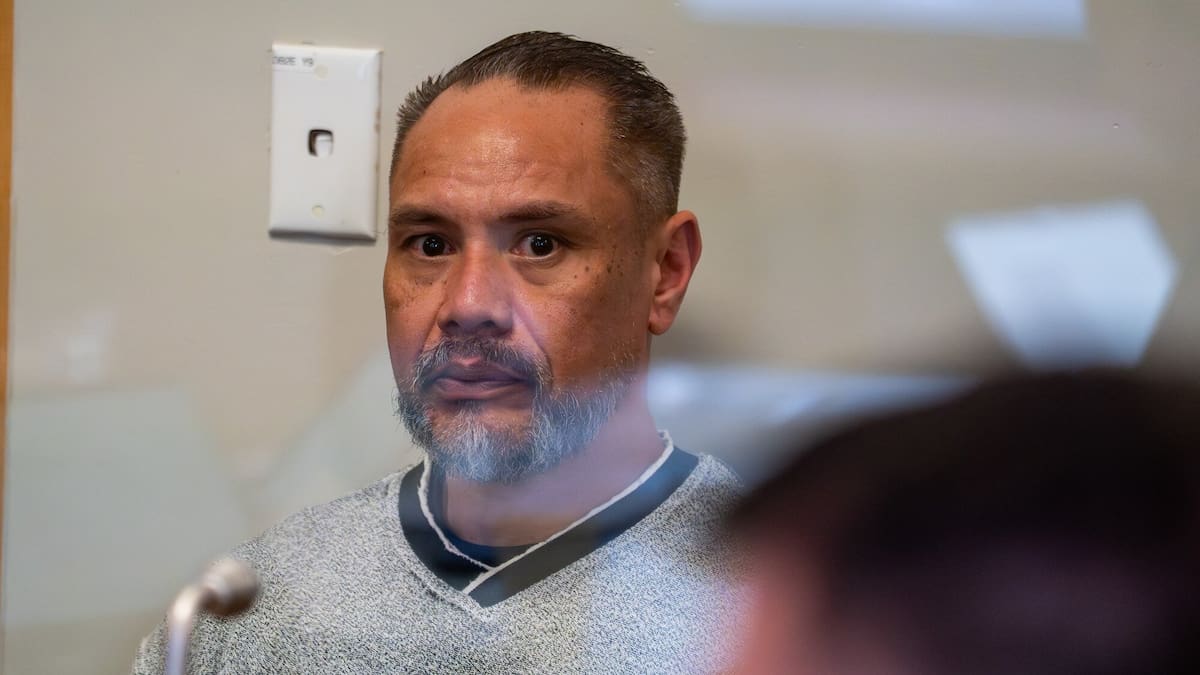
“You deny hearing voices, but … it’s most likely you were suffering from auditory hallucinations,” Judge Lance told the defendant.
Court documents state Su’a and the other man had been casually acquainted when Su’a went to the house around 3pm on a Thursday with a small paring knife in his pocket and a list of grievances.
Parts of the hour-and-a-half confrontation that followed were filmed by the defendant.
“Mr Su’a believed that [the neighbour] frequently hosted gatherings with family and friends,” the agreed summary of facts states. “Mr Su’a believed that he was the subject of discussions at these gatherings where he was ‘harassed, abused and exploited’.”
‘Stay calm’
As soon as the man opened the door to his home, Su’a stepped inside without invitation and started punching him in the head. At some point during the struggle that ensued, the neighbour’s son fell against the glass door with such force that he smashed it, cutting his knee.
The boy’s father, meanwhile, was rendered unconscious after Su’a kneed him in the face while he fell to the ground.
“Mr Su’a told them both [before knocking out the father] to stay calm, that everything will be alright if they just listened and answered the questions he had for them,” court documents state.
Su’a and the neighbour’s son both moved the still-unconscious victim to the living room couch before he instructed the 12-year-old to draw the curtains, then sit beside his father. He began interrogating the man when he revived.
“Mr Su’a asked them why he had been overhearing them talk about him, trying to understand how he had become a person of interest to them,” the summary of fact states.
“What exactly had you overheard us talk about?” the adult victim asked.
“It doesn’t work like that,” Su’a responded, insisting that they knew exactly what he was talking about.
The father said he had to go pick up his daughter from school, expressing worry if she was left alone, but Su’a would not let them leave.
“She’s not coming back here to see this,” he said, instructing the son to call someone else to retrieve her.
The questioning continued, and when the neighbour still couldn’t answer to his satisfaction, Su’a roundhouse kicked him to the head, causing him to lose consciousness for the second time and fall on top of his son.
The defendant’s paranoia deepened when the 12-year-old offered condolences for one of Su’a’s sisters who had died that morning. He asked how they knew about her, his paranoia seeming to deepen, and the boy explained that Su’a had mentioned it himself.
Seven stabs
After the adult victim regained consciousness a second time, Su’a continued his interrogation and again insisted he was being lied to.
The victim apologised profusely and begged him to stop, but instead Su’a showed him another knife he had retrieved from their kitchen. He slowly pushed it into the other man’s leg six times.
“Mr Su’a watched [his] face while pushing the knife in further, until [he] would appear to almost pass out,” documents state. “Mr Su’a resumed questioning [him], asking when they began speaking about him and his family.
“After an extended period of questioning, Mr Su’a became visibly enraged at [the neighbour’s] refusal to elaborate further.”
Talutoe Su’a watched his captive victim’s face as he slowly stabbed him in the leg repeatedly, demanding answers to something the acquaintance could not answer. Photo / Corey Fleming
He kicked the man again after he asked to leave, rendering him unconscious for the third time – this time for over a minute, with the victim unable to speak for several more minutes. He hit the man twice more in the head after he again didn’t give the answers that Su’a wanted.
At one point during the questioning, he threatened that if the man didn’t start giving more forthcoming answers, he would start hurting his son in the same manner.
He also told the boy repeatedly that if he tried to escape, his father’s beatings would only get worse.
“Mr Su’a only ceased his attack … when he realised that [the neighbour’s] condition was deteriorating rapidly, at which point he allowed [the son] to call an ambulance,” documents state.
When police arrived shortly thereafter, he was still there.
Two households beset by grief
The neighbour was hospitalised in critical condition, suffering not only the stab wounds but two brain bleeds, a long-term concussion, a fractured eye socket, cuts above each eye and a hole through his lower lip caused by his teeth.
He was unable to return to work for about a month. More importantly, the man said in court this week as he faced the defendant for a victim impact statement, he was “terrified” he wouldn’t be able to attend his father’s funeral.
Both men had been dealing with grief that week. The victim’s father had died a day before the defendant’s sister.
The victim was able to leave the hospital long enough to attend the funeral in a wheelchair but had to leave early, he recalled.
Since then, he said, his family has had to sell their home – which they had intended to remain in for many years – at a loss because they no longer felt safe there.
While his head injuries have had long-term effects on his quality of life, the worst part for him has been seeing how it has affected his son, he said.
“Knowing he was exposed to that level of danger and fear is something I struggle with every day,” he said, explaining that in a way it was easier for him because much of the time he was dazed or unconscious. “During that time, [he] was the one left having to try to deal with you.
“He was brave, and we are incredibly proud of him.”
‘I can’t forget’
The boy, now 14, said in his own victim impact statement, which was read aloud to Su’a by his father, that the incident was “terrifying” and continues to cause fear and anxiousness.
“I can’t forget no matter how hard I try,” he wrote. “I really thought we might die.”
He recalled Su’a also threatening to send other family members or gang members after the family, causing the fear to continue even after he was incarcerated awaiting trial.
The son has been diagnosed with post-traumatic stress disorder and “carries the emotional weight of something no child should have to witness”, his mother pointed out, describing the impact on the entire family as “profound”.
“We find ourselves jumping at every sound,” she said, recalling one night when the wind blew their gate open with a clang and they were all too afraid to go outside to investigate.
Their children were crying and urging their parents to call police, she said.
‘Nosy’ neighbours
In an interview before his sentencing, Su’a said he now regretted the way he responded to the circumstances but insisted his neighbour had been “gaslighting me over the fence” and “laughing at me behind my back”.
“They knew about my sister dying and it happened that morning,” he added. “It couldn’t have happened without spying. I tried to explain it to police. They said I was having hallucinations.”
He also spoke to a psychologist for a report before his sentencing, explaining that his neighbours had “become nosy”.
He said they would throw tennis balls over the fence then send their children to retrieve them, but he got especially suspicious it was a spying ploy when he found a ball in his garage.
“I would hear them critiquing my lifestyle and standards,” he said. “I thought they might have a camera to be listening through my phone. The more I tried to understand, the more irrational it seemed.”
Judge Simon Lance. Photo / Dean Purcell
The judge was blunt to Su’a.
“This was no doubt, in my view, a situation where you were suffering some mental health difficulties,” he said, to which Su’a initially objected but then partially conceded the spying: “It was an assumption on my part”.
‘Appalling and wrongful’
Su’a faced up to 14 years’ imprisonment for representative charges of kidnapping and wounding with intent to cause grievous bodily harm. He also pleaded guilty to threatening to kill, punishable by up to seven years’ imprisonment, and assaulting a child, which carries a maximum sentence of two years.
Crown prosecutor Sophie-Anne Barry suggested a 10-year starting point for the wounding charge, taking into consideration the extreme violence and serious injuries, the home invasion aspect of Su’a’s offending and the presence of a child. It should then be uplifted by two years for the kidnapping charge to recognise the terror and intimidation Su’a inflicted on the son, she argued.
She said the defence’s suggested discount for Su’a’s schizophrenia should be tempered by the fact the defendant refuses to acknowledge it. She suggested 30% in overall discounts for his guilty plea, remorse and mental health.
The defence argued for 40% in total discounts.
Judge Lance ordered an 11-and-a-half year starting point for all the charges combined, then allowed 35% in discounts, resulting in an end sentence of seven and a half years’ imprisonment.
He noted that although Su’a was not diagnosed with schizophrenia until recently, psychiatric records for him date back to 2002 when he first started experiencing paranoia. In 2017, he was convicted of common assault for an attack on another neighbour.
In a letter he wrote to the court, Su’a acknowledged his behaviour towards the latest victims was “appalling and wrongful” and said he doesn’t want to ever act like that again.
He blamed himself for “bottling up” his grievances, which led to poor decision-making amid what he described as an ongoing conflict between the households.
“I only hope [he] can forgive me,” he said.
Craig Kapitan is an Auckland-based journalist covering courts and justice. He joined the Herald in 2021 and has reported on courts since 2002 in three newsrooms in the US and New Zealand.