
Topline
The full Sturgeon Moon rose around the night-side of the world late on Thursday, Aug. 26, and in the early hours of Friday, Aug. 28, delivering dramatic night-sky scenes as an unusually deep partial lunar eclipse unfolded for observers across much of the Americas, Europe and Africa. It came as northern lights were forecast for northern U.S. states into the weekend, just as NASA prepares to launch the Roman Space Telescope.
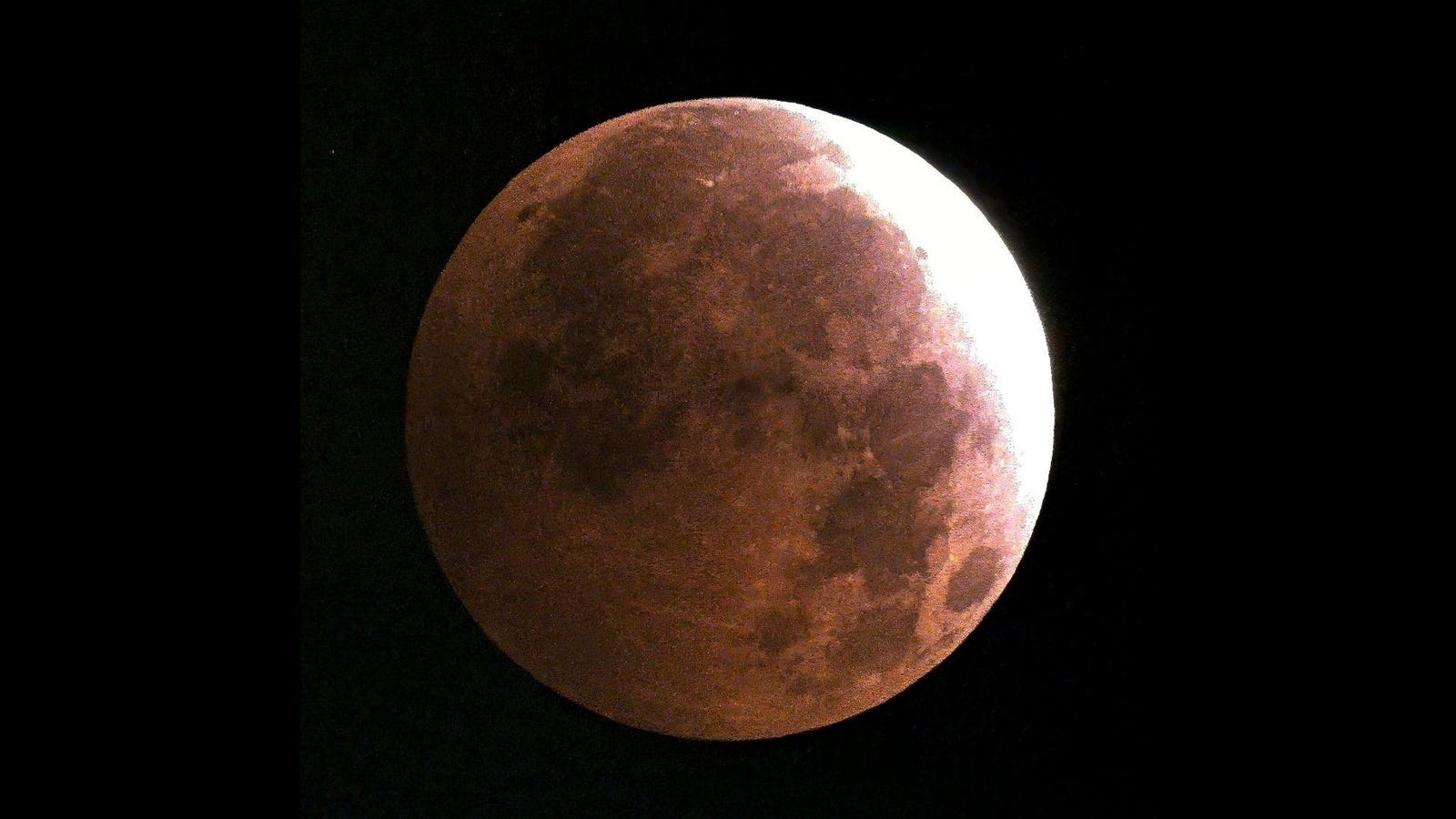
The deep partial lunar eclipse reaches its maximum at 05:12 a.m. BST on Friday, Aug. 28, as 96% of the lunar surface is engulfed by Earth’s shadow. As seen from Cardiff Bay, Wales, U.K.
Jamie Carter & Gill CarterKey Facts
The full Sturgeon Moon reached its exact full phase at 12:18 a.m. EDT on Aug. 28 (04:18 UTC), according to Timeanddate.com. It was the ninth full moon of 2026 and the third full moon of astronomical summer in the Northern Hemisphere.
This full moon coincided with a very deep partial lunar eclipse, with 96% of the moon entering Earth’s shadow. At maximum eclipse, only a 4% sliver of the moon remained in direct sunlight, with the rest taking on a striking copper-red glow as sunlight filtered through Earth’s atmosphere, illuminating the shadowed surface.
The eclipse was visible from North and South America, Europe and Africa. While those in the Americas saw it either side of midnight, viewers in western Europe and western Africa caught the event before moonset in the early morning.
A partial lunar eclipse is seen on Thursday, Aug. 27, 2026, in Louisville, Ky. (AP Photo/Jon Cherry)
Copyright 2026 The Associated Press. All rights reserved.WHY IT’S CALLED THE STURGEON MOON
August’s full moon is traditionally known as the Sturgeon Moon, named by Indigenous peoples of North America for the abundance of sturgeon in lakes and rivers at this time of year. Other names include the green corn moon and grain moon, reflecting late-summer harvest cycles.
A partial lunar eclipse is seen from Calascio, Italy, on August 28th, 2026. A partial lunar eclipse occurs when the Earth moves between the Sun and Moon but the three celestial bodies do not form a straight line in space. (Photo by Lorenzo Di Cola/NurPhoto via Getty Images)
NurPhoto via Getty ImagesA FULL MOON IN EARTH’S SHADOW
During the deep partial lunar eclipse, Earth passed between the sun and the moon, casting its shadow across most of the lunar surface. Although the moon did not become fully eclipsed, its shadowed portion appeared dusky and coppery — a subtle preview of a total “blood moon.”
WASHINGTON, DC – AUGUST 27: A partial lunar eclipse is seen behind the Washington Monument on August 27, 2026 in Washington, DC. The lunar eclipse, named the “almost blood moon,” peaked just after midnight with over 93% to 96% of the Moon covered by Earth’s shadow. (Photo by Kevin Dietsch/Getty Images)
Getty ImagesA Night-Side View
Since Earth’s shadow is much larger than the moon, every lunar eclipse can be seen by an entire hemisphere — the night-side of Earth when the eclipse occurs. Although the entire eclipse lasted 5 hours and 38 minutes, the most dramatic views came around maximum eclipse, when about 96% of the moon’s disk was covered by Earth’s dark umbral shadow.
The moon begins the penumbral stage during a partial lunar eclipse over the Israeli coastal city of Netanya on August 28, 2026. (Photo by JACK GUEZ / AFP via Getty Images)
AFP via Getty ImagesA ‘Blood’ Red Moon?
The exact shade of red — the effect that gives rise to the popular term “Blood Moon” — can vary. The color depends on the amount of dust and clouds in Earth’s atmosphere, which filter sunlight before it reaches the eclipsed moon. An eclipsed moon can look muted copper, orange or deep red.
A partial lunar eclipse setting over Rocca Calascio fortress is seen from Calascio, Italy, on August 28th, 2026. A partial lunar eclipse occurs when the Earth moves between the Sun and Moon but the three celestial bodies do not form a straight line in space. (Photo by Lorenzo Di Cola/NurPhoto via Getty Images)
NurPhoto via Getty ImagesEarth’s Giant Shadow
Skywatchers not only saw the moon change color, but also witnessed the sharp, curved edge of Earth’s shadow steadily advancing across — and later retreating from — the lunar surface. Experienced observers could also see a subtle turquoise band between the bright edge and the reddened portion of the moon. The unusual color is created by sunlight passing through Earth’s ozone-rich stratosphere before reaching the lunar surface.
A partial lunar eclipse is seen on Friday, Aug. 28, 2026, in Cleveland. (AP Photo/Carolyn Kaster)
Copyright 2026 The Associated Press. All rights reserved.Eclipses Never Come Alone
The Sturgeon Moon followed just 16 days after the total solar eclipse on Aug. 12, 2026, the result of the same alignment between sun, moon and Earth — something astronomers call syzygy. From August 2026 through July 2028, Earth will experience three total solar eclipses and three annular “ring of fire” eclipses — an unusually rich sequence not seen in such accessible locations for decades. The next total lunar eclipse is not until New Year’s Eve 2028.
A partial lunar eclipse is seen on Thursday, Aug. 27, 2026, in Louisville, Ky. (AP Photo/Jon Cherry)
Copyright 2026 The Associated Press. All rights reserved.WHAT’S NEXT IN THE NIGHT SKY
The next full moon will be the Harvest Moon on Sept. 26, 2026, followed closely by a run of planetary highlights, including Saturn at opposition on Oct. 4 and several close conjunctions of the moon with bright planets.
Further readingForbesNorthern Lights Forecast: 22 States May See Aurora Friday NightBy Jamie CarterForbesWhere And When To Watch NASA’s Roman Space Telescope Launch This WeekendBy Jamie CarterForbesWhere And When To See Tonight’s ‘Blood Moon’ Lunar Eclipse From Every U.S. StateBy Jamie CarterForbesMissed The Total Solar Eclipse? Now See A ‘Blood Moon’ Across The U.S.By Jamie CarterForbesHow To Photograph Tonight’s ‘Blood Moon’ Eclipse And Northern LightsBy Jamie CarterForbesIt’s Exactly 18 Years Until The Next Total Solar Eclipse In The Contiguous U.S.By Jamie CarterForbesSee A Rare ‘Blood Moon’ Eclipse Beside Saturn: The Night Sky This WeekBy Jamie Carter