
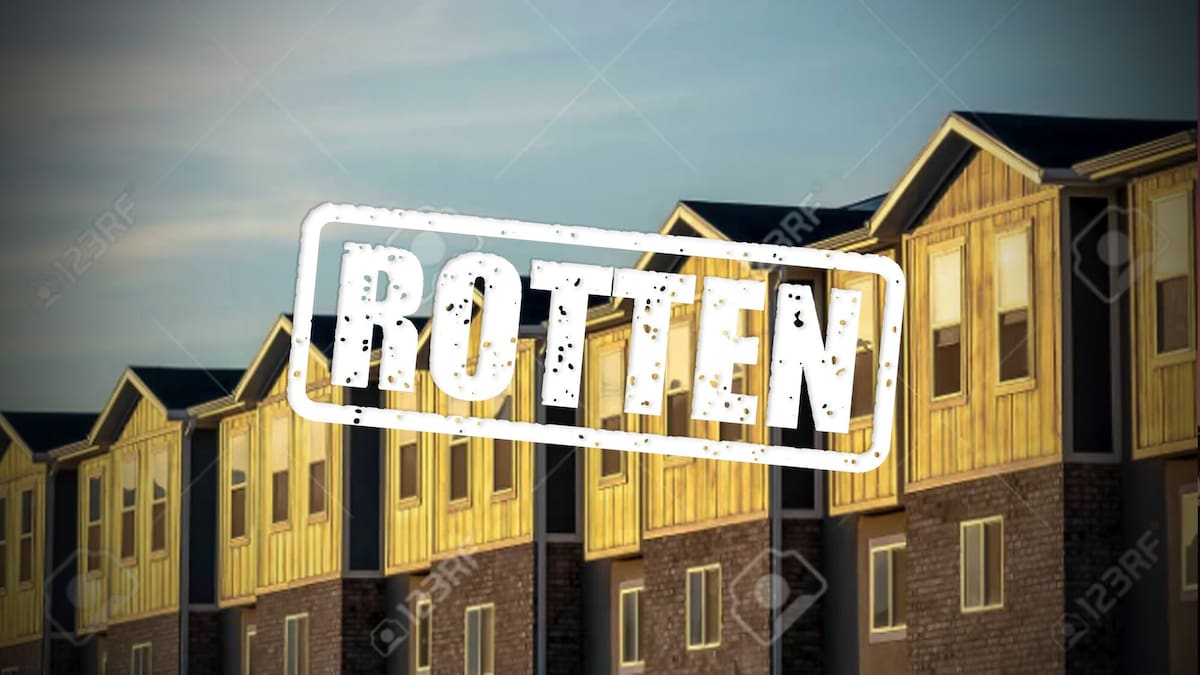
What’s worrying is that now he’s dealing with the distressed owners of new homes, multiplexes and apartments, some of the properties barely five or 10 years old.
Home Owners and Buyers Association co-founders Roger Levie (left) and John Gray. Photo / John Hagen
Back in 2006, Gray and colleague Roger Levie co-founded the Home Owners and Buyers Association (Hobanz), never dreaming they’d still be battling the same issues two decades later.
Both had first-hand experience of owning leaky apartments and dealing with body corporates and owners who either couldn’t agree on what to do or couldn’t afford to fix the problem.
Since then, the pair have advocated for thousands of distressed property owners, lobbied successive governments, talked endlessly with council officials, done media interviews and made a documentary series called A Living Hell: Apartment Disasters. But little has changed.
Ticking time bombs are everywhere; the number of defective apartment blocks and multiplex units in New Zealand is too numerous to list. The quotes to fix them reach eye-watering levels.
Now Gray is dealing with appalling examples of new builds that he knows, at a glance, will fuel a shameful legacy of defective construction that will leave thousands of homeowners in despair in the future.
At times he’s overwhelmed by the number of emails in his inbox, mostly pleas for help from desperate home owners. He’s still dealing with the “long tail” of rot from the era of monolithic cladding and untreated timber framing, decay that took longer to show up in some parts of the country.
Banks won’t lend on properties with weathertight issues.
But now there is a new wave of problems showing up in some, not all, modern-day construction. Quite simply, Gray says, they are defective and they will leak.
The leaky homes issue has plagued New Zealand for decades. Photo / Richard Robinson
“In a lot of these cases we see, it’s not a whoopsy, it’s not a mistake, it’s a wilful decision to build something with timber where there should be steel. Or ‘let’s remove a supporting pillar in the carpark because we can get more cars in’.”
Settlements, if owners can corner those responsible, are usually cloaked in confidentiality clauses so reputations go untarnished.
“And so there are no consequences for them and they go out and do it again.”
Gray warns buyers to look beyond the oak floors and designer kitchens. Instead, pay attention to the outside, he says. Even better, pay for a pre-purchase property inspection report from a qualified surveyor.
And therein lies one of the problems. A professional report is likely to cost $1500 to $2000, and if home buyers miss out on several properties at auction, the cost of those reports adds up.
The risk is that buyers will skip the report, or get a cut-price version from an “expert” who lacks qualifications and experience.
“For the most part, the vast majority of pre-purchase inspectors are not competent and are uninsured and are ripping people off.”
Dr Dirk Stahlhut, director of property and building consultancy Prendos New Zealand, agrees. He says even though he and his colleagues have had years of training to become chartered and registered building surveyors, anyone can call themselves a building surveyor or inspector. There’s no requirement for a licence or formal qualification.
The Herald asked the Ministry of Business, Innovation and Employment (MBIE) if the Government had plans to license pre-purchase inspections. The answer was no. In a statement, the ministry said it was aware of complaints but it regarded pre-purchase inspections as private arrangements between consumers and service providers.
Gray says the “cowboys” in the industry are hard to catch. He knows of one Auckland inspector who has no assets to his name, no indemnity insurance, doesn’t turn up to mediation meetings, doesn’t comply with disclosure requirements and “gives the middle finger to the law courts”.
He uses an example of a disastrous leaky house sale in an affluent area of the eastern suburbs which resulted in two sets of victims: the couple who were forced to take legal action and the elderly original owner who had to sell her property to pay for the mediated settlement.
The couple bought the property based on a report done by an unqualified building inspector, who escaped having to share in the reparation.
“Lots of photos and not much substance,” Gray says of his report. In reality, the house wasn’t fit for sale.
“It was rotten. I could put my finger through it.”
Damp timber and mould in a leaky Auckland apartment block built just six years ago.
The Herald was contacted earlier this year by a man distressed about defects in his new home which was built by a reputable home building company north of Auckland.
The home is part of a new subdivision with several houses built by the same company. It received a Code Compliance Certificate (CCC) from Auckland Council and yet still has a list of issues needing to be fixed, including a non-consented culvert giving access to the owner’s garage.
The Herald has viewed a property inspection report commissioned by the home owner that lists defects including non-compliant waterproofing issues, gaps between weatherboards and window frames, missing structural components, poor workmanship and water pooling in the spouting.
The Herald has chosen not to name the man, aged 33, or the company involved. He says the building company has sent builders to his home several times to try to rectify the problems.
“But why not do it right the first time?” he wants to know.
Stahlhut, too, says Prendos is seeing problems with properties built by home-building companies from Invercargill to north of Auckland.
‘It was a leaker from 20m away’
Gray’s not surprised. This year he agreed to take a first look at a new terrace house in Te Atatū before the young woman buyer got a pre-purchase inspection.
At first glance, he knew what he was looking at.
“It was a leaker from 20 metres away.”
Aucklander John Gray has been advocating for the owners of defective homes and apartments for more than 20 years. Photo / Cameron Pitney.
Inside, the home was beautifully presented, but outside, the metal cladding was buckled with gaps between joins. Gray sent photos to Auckland Council after learning that an inspector had passed the property’s CCC.
The estate agent had assured the woman that the property had a 10-year warranty (under the Building Act 2004). But home owners still need to be able to fund civil legal action, Gray says, and they need to be able to pin down the developer and builder.
Building companies can strip a company of assets, “put it on a shelf” and start a different company to get around the “Phoenix rule”. Or they put assets in one company and another company, without assets, “hires” from the first company.
“People are getting legal advice on this, which just really sickens me.”
Gray is the first to admit there’s no easy fix. Chris Penk – now stripped of his Building and Construction portfolio and replaced by Simon Watts – had a go. He introduced the Building Amendment Bill last month, wanting a fairer liability system to ensure those responsible for botched or shoddy work paid their fair share of compensation.
Ratepayers paying millions for building defects
Currently, under the joint and several liability model, local councils often end up as “the last man standing” and ratepayers are left footing the bill for millions of dollars in reparation.
The new bill would introduce a proportionate liability model so that those responsible for mistakes or poor work will be forced to share in the cost. The bill also requires:
Building and design professionals to hold indemnity insurance Fines to be increased from $10,000 to $20,000Suspension periods increased from 12 months to 24 months Mandatory home warranties for most new builds and major renovations worth $100,000 or more, covering a one-year defect period and a 10-year structural warranty Home warranty providers to be registered with MBIE and meet minimum regulatory requirements
Gray says the bill doesn’t go far enough. For a start, a fine of $20,000 is not nearly enough, not when some of the botched developments are costing owners millions of dollars to put right.
And he has doubts about the one-year and 10-year defect periods. Many of the cases he’s dealing with now relate to properties that are older than 10 years.
A $734m payout
There’s little doubt that to date the reparation burden has fallen largely on local authorities. Before amalgamation, Auckland City Council paid $333.1 million between 2000 and 2009.
Between 2011 and 2025, Auckland Council paid out a staggering $735.4m. The largest amount was $125m paid in 2019. Not included are millions of dollars in legal fees, and staff time, a cost likely to put the amount well over $1 billion.
And the problem’s not going away any time soon. Poor standards show up in the council’s building inspection figures for the past 12 months. Just over 37% of residential buildings failed their final inspections and 36.4% of commercial final inspections failed.
It’s a crisis that has collectively cost the country billions of dollars, including the repair of leaky schools, hospital buildings and retirement villages.
Eastcliffe Retirement Village in Ōrākei is a case in point. Built in the early 2000s, the structure was plagued with weathertight issues from the start. Residents gradually had to move out and now the whole development will be knocked down and replaced with a $700m complex.
Eastcliffe Retirement Village in Ōrākei, built in the early 2000s, has been plagued with weathertight issues. Photo /Doug Sherring
Apart from the distress to the residents, Gray says, think of the waste: resources, labour and the amount of demolished material going into landfill. New Zealand should be building sound new houses, not constantly repairing or demolishing defective ones.
He’s aware of an upmarket apartment complex near Auckland’s downtown waterfront that’s less than five years old and already showing defects. Owners will be faced with millions of dollars in maintenance costs within the next few years.
Both Gray and Levie are convinced the industry needs far tighter regulation. Rather than “tinker around the edges” of the Building Act, Gray says, the Government should consider adopting a ready-made piece of legislation devised by global think tank the International Centre for Building Quality, spearheaded by New Zealand barrister Kim Lovegrove, that promotes best practices in building codes, construction laws and regulations. And it includes hefty penalties for both civil and criminal charges.
Otherwise, New Zealand home owners will continue to be plagued by issues that will ruin their lives. Gray points to one of the country’s worst leaky building disasters, the St Lukes Garden Apartments in Auckland, built between 15 and 23 years ago, and now facing a staggering repair bill of more than $240m divided between 243 owners.
Owners in the St Lukes Garden Apartments in Mt Albert face a $240m bill to fix defects in the complex. Photo / Mike Scott
Ratepayers in Wellington, Christchurch, Tauranga and the Queenstown-Lakes District have also been saddled with millions of dollars in compensation for defective buildings and homes.
Shortcuts and cost-cutting
So why is the problem not going away? Gray says take your pick: not enough regulation and licensing in the industry; not high enough penalties to force “cowboys” out of the mix; incompetent and unqualified pre-purchase building inspectors; buildings constructed to minimum standards; shortcuts taken to meet cut-price contracts; not enough qualified, and preferably independent, oversight on big projects.
MBIE sent a lengthy statement to the Herald, pointing out changes in the proposed Building Amendment Bill, which is not expected to become law until 2028. Home warranty providers will be required to report the number of claims received and the types of defects to MBIE which will provide valuable information about standards in the industry, the statement said.
Although MBIE does not record the number of defective residential units built in the past decade, “concerns about building quality and accountability are among the factors informing ongoing building system reforms”, it said.
The ministry did not directly answer a question from the Herald as to whether it considered the Building Act 2004 and the New Zealand Building Code provided adequate protection for the homeowner against defective builds. It said “ … no regulatory system can completely prevent defective building work from occurring”.
MBIE says it is also exploring further improvements across building and construction trades and professions, including whether supervision, competency and accountability settings are appropriate to support high-quality building work.
“These reforms will also make it harder for poor performers and ‘cowboy’ operators to remain in the market.”
Insurers and home warranty providers would assess risk before providing cover, meaning builders and developers with poor track records would likely face greater scrutiny, higher costs, or difficulty obtaining coverage.
‘One email away from financial disaster’
Levie, who is Hobanz’s CEO (Gray is voluntary), spends much of his time working with the body corporates and owners of defective apartment blocks. He sees first-hand the intolerable toll that rotting and leaky apartments have on owners who have no money to fight or fix, and still have mortgages and body-corporate levies to pay.
Because of high building costs, architects are designing to a minimum standard, not a robust standard, he says. The required long-term maintenance plans aren’t submitted by developers at the time of completion because that would put body corporate fees up.
“They are trying to sell units and keep fees down.”
The result is poorly designed buildings with no consideration of maintenance.
“Very new buildings are failing all over the place.”
As one professional building manager says about owning an apartment in a defective building, “You’re one email away from financial disaster.”
Levie has witnessed some appalling behaviour by body corporate committee members that includes trying to push responsibility for leaky decks back on individual owners; hiding documents about the issues because they don’t want the building to get a bad reputation; and whoever finds out first selling up before the problems become common knowledge.
Stahlhut says in a tight economy, many jobs are won by the lowest bid. That means corners are cut to meet the budget and the hired manpower may not be adequately trained or experienced. In some cases, it comes down to what a builder can get away with.
Dr Dirk Stahlhut, director and consultant with Prendos New Zealand.
His team sees it all: cavities not installed properly, blocked drainage paths, missing or inadequate flashings, basic mistakes that will trap moisture.
“Rather than actually doing it right first time and maybe even targeting excellence.”
New builds are still being signed off with CCC that he knows will cause issues in the future. He’d like to see that change with an increased emphasis on good training and education to improve the industry.
Although the industry is no longer using untreated framing timber, treated timber only buys people a little more time. Eventually, he says, that too will rot.
“It’s just a repeat history, really, of the leaky building crisis.”
Tips for home owners and buyers
Spend time and effort on due diligence. Make a decision based on the head, not the heartAsk builders, contractors and property inspectors if they have adequate insurance which covers 10 years at least Check the credentials of a pre-purchase property inspector who is a member of an organisation like the New Zealand Institute of Building Surveyors or the Royal Institute of Chartered Surveyors.Beware of estate agents who supply a list of inspectors they recommend If buying an apartment, ask to see both the body corporate minutes and the financial records
Jane Phare is a senior journalist based in Auckland. Her roles at the Herald have included assistant editor of NZ Herald, editor of the Weekend Herald, founding editor of Viva, features editor and deputy print editor.
Sign up to The Daily H, a free newsletter curated by our editors and delivered straight to your inbox every weekday.
Tags:
- 80s
- 90s
- and
- another
- apartments
- back
- behind
- being
- blame
- building
- built
- buyers
- change
- coming
- crisis
- decades
- dubbed
- experts
- financial
- for
- heartbreak
- home
- homes
- investigates
- is
- jane
- later
- leaky
- leaving
- legacy
- Misery
- multibilliondollar
- needs
- new
- New Zealand
- News
- NewZealand
- not
- NZ
- of
- over
- phare
- Predict
- ruin
- shameful
- shoddy
- should
- still
- substandard
- trail
- watch
- wave
- what
- why
- yet
- zealands