
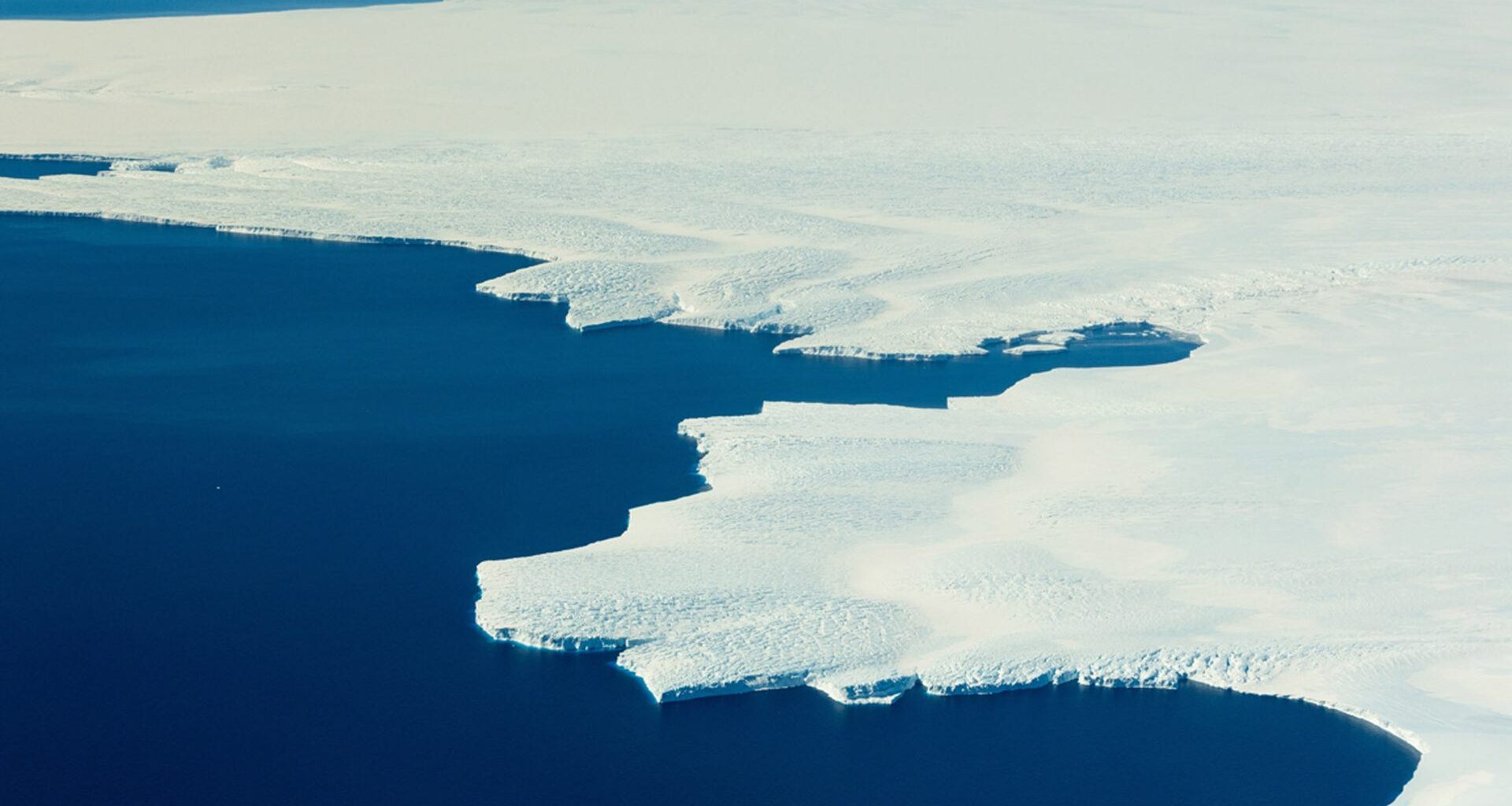
After decades of losses, satellites recorded a massive Antarctic ice gain between 2021 and 2023, but researchers say the reversal was only temporary.
Antarctica is supposed to be losing ice, and for most of the past two decades it has. Then it stopped. Between July 2021 and April 2023, enough snow fell on the eastern half of the continent to cancel out ice losses in the west.
Some people read the pause as a sign that global warming wasn’t melting the ice after all. New research traces that snow to a warm patch of ocean near the equator, thousands of miles away.
The gain was real, but it was also temporary.
Qinghua Ding, a professor of atmospheric and climate science at UC Santa Barbara, worked on the study. It rests on satellite measurements and computer model runs, not on any direct look at the ice.
“The climate system is complex, and ice mass growth over a few years does not necessarily mean a new normal,” Ding told Earth.com.
Snowfall briefly reversed Antarctic losses
Two satellites called GRACE-FO track the ice sheet by measuring small changes in Earth’s gravity from orbit. Between 2003 and 2024, they put Antarctica’s losses at about 155 billion tons (140 billion metric tons) of ice a year.
Over the 22 months starting in July 2021, Antarctica gained roughly 766 billion tons (695 billion metric tons) of ice. It was the largest 22-month gain in the satellite record. That’s about half again as much water as Lake Erie holds.
Queen Mary Land and Wilkes Land, two regions along the East Antarctic coast facing the Indian Ocean, took 68% of that gain. West Antarctica kept losing ice throughout.
East Antarctica holds nearly 80% of the planet’s ice outside the oceans, and snowfall decides its balance far more than sliding glaciers do.
“In the early 2020s, there was an exceptional amount of snowfall over parts of Antarctica,” said Eric Steig, a professor of Earth and space sciences at the University of Washington. “Because Antarctica is so big, it doesn’t take that much extra snow thickness to counter the loss of ice from the edges of the ice sheet.”
A slowdown looked like a reversal.
Tropical heat shifted Antarctic winds
A warm patch of ocean between Indonesia and New Guinea drives an outsized share of the world’s extreme weather. From 2021 to 2023 it ran about 0.9°F (0.5°C) above its average for the previous 20 years.
Warm water there feeds thunderstorms, and the heat they release high in the atmosphere sets off a chain of pressure highs and lows curving south toward the pole. In these three years the chain ended in a stubborn high-pressure zone over East Antarctica, which pulled damp air onto the coast instead of letting it pass.
The source of that extra moisture was the part Ding didn’t expect.
“The most surprising thing is that the increased moisture transport into East Antarctica is not because there is more evaporation over the source region. Rather, changes in the large-scale wind pattern steer more moisture toward East Antarctica,” Ding said.
The winds mostly moved existing water around, he added, so other regions may have received less while the eastern coast received more.
Indian Ocean moisture fed the snowfall
To find where the snow started, the team labeled water vapor in a model by the ocean it evaporated from, splitting the globe into 54 regions.
Three mid-latitude regions around the Indian Ocean supplied 45% of the extra snowfall. Evaporation over them didn’t rise much, which leaves the shifting wind pattern as the main change.
Most of that vapor crossed the Southern Ocean inside atmospheric rivers – narrow filaments of damp air carrying the flow of a large river. A study of Antarctic snowfall showed that the angle they strike the coast at decides how much they drop, and one projection has them doubling by 2100.
Human emissions supplied little of the snow
A warmer atmosphere holds more water and storm tracks are drifting poleward, so some extra Antarctic snow is expected. The team checked what share of this gain that covers.
In 40 model runs driven only by human emissions, precipitation over the snowy sector rose by about 36 billion tons (32.3 billion metric tons) across the event. Satellites and weather records put the real figure near 387 billion tons (351.2 billion metric tons). Human warming, then, accounts for less than a tenth of the extra precipitation.
Speaking to Earth.com, Ding said the two effects can point opposite ways at once. A warming ocean eats at ice shelves from below while a wetter atmosphere piles snow on top. He first suspected this gain was exactly that, and the work changed his mind.
Tropical pattern recurs about once a decade
The warm pool heats up this way roughly once every ten years. Researchers see the rhythm in satellite records, in long model runs, and in an ice core from Law Dome on the East Antarctic coast. Ten years earlier the pattern ran the other way: cooler tropical water, weaker moisture delivery, and a long snowfall deficit.
Asked by Earth.com whether the extra snow is already fading, Ding pointed to a German gravity service that tracks the ice sheet monthly.
“The mass gain from 2021 to 2023 appears to be coming to an end,” he said, putting the turn across 2024 and 2025.
Tropical warming remains unexplained
What sets off a multi-year warm spell in the tropics, and what sustains it, is still unsettled. La Niña, the Indian Ocean Dipole, and the slow Pacific rhythm that turns over every couple of decades all move with it, but none closely enough to be the cause.
How the chain behaves on a hotter planet is a second open question. The next such event could drop more snow than this one did, or less.
Neither answer would change what’s happening at the edges. Warm water keeps thinning the ice shelves at Antarctica’s weak spots, the Totten and Denman glaciers among them. Other teams have tied the same mass-gain years to shrinking sea ice as well.
Ding’s team wants climate models that carry this tropical link properly. One that misses it will keep mistaking a decade-long wobble for a trend. Until then, sea level projections have to treat two good years of snow as weather.
The full study was published in the journal Nature.
—–
Like what you read? Subscribe to our newsletter for engaging articles, exclusive content, and the latest updates.
Check us out on EarthSnap, a free app brought to you by Eric Ralls and Earth.com.
—–