
There were plenty of bloodcurdling moments in Kilby-Henson’s apocalyptic take on Macbeth, which wrapped last week. Auckland Theatre Company (ATC) sold more tickets for that show than any other Shakespeare production in its history.
A ghoulish scene with Mark Mitchinson as the haunted Macbeth.
Set in an underground sewer, with children in gas masks playing the three witches, his interpretation of the “OG thriller” appalled many Shakespeare classicists, much like his 60s-inspired Romeo & Juliet, which ruffled feathers last year.
“More Sunday Horrors than Sunday Theatre,” sniffed one reviewer about the latter, lamenting its lack of swashbuckling sword fights.
Now, the enfant terrible of the Auckland theatre scene is taking on another piece enshrined in the canon, with all the weight of expectation that entails.
Opening next month, Cabaret is a welcome return to the tradition of ATC closing its season programme with a banger. The musical was last staged by the company in 2010, with Amanda Billing and Michael Hurst (who also directed) in the lead roles.
Set in Berlin during the twilight of the Jazz Age as the Nazi Party rises to power, the original Broadway production won eight Tony Awards and inspired Bob Fosse’s 1972 film starring Liza Minnelli as the Kit Kat Club’s cabaret singer Sally Bowles.
(Joel Grey, who won an Academy Award for his portrayal of the gender fluid and increasingly sinister Master of Ceremonies in the movie, is the father of Dirty Dancing’s “Baby”, Jennifer Grey.)
In the 1972 film of Cabaret, Liza Minnelli modelled her look for Sally Bowles on silent-screen actress Louise Brooks. Photo / Getty Images
Almost 60 years after its Broadway premiere, the show has lost none of its cachet. A West End revival, Cabaret at the Kit Kat Club, starred Eddie Redmayne and Hamnet’s Jessie Buckley when it opened five years ago. Bookings are being taken through to September 2027.
For all the musical’s glittery hedonism and risque dance numbers, the story is a chilling warning against political apathy and the danger of ignoring the rise of extremism. Lucky that’s not something we need to worry about today.
Helming two major productions back-to-back is a big ask, but Kilby-Henson has had the world of Macbeth bumping up against Cabaret for months now.
Many of the same team have come across with him, including set and costume designer Dan Williams, lighting designers Filament Eleven 11 and musical director Robin Kelly.
During the development phase for a new project, Kilby-Henson pictures the story unfolding in his mind like a film reel. Visual imagery is such a strong driver in his creative process that he sometimes dreams in movie trailers.
A scene-setting sketch from Kilby-Henson’s production journal for Cabaret.
For each show, he fills an A4 hardback journal with character sketches, production notes and evocative quotes in his arty swirling handwriting.
“The moment I draw the opening image is when I can start really digging into the later ones,” he says. “If I don’t draw it, my head gets stuck and doesn’t move forward.
“The image of the three witches in their gas masks was the first thing that came to me for Macbeth, so for that to get its own applause [when the characters first appear on stage] was really validating to prove to the company that it was a good idea.”
Another of his rituals before rehearsals begin is writing a letter to the cast. While contemplating what to say about Cabaret, he was struck by how its themes of deception, moral corruption and the abuse of power are echoed in Macbeth.
“There’s a quote I put into my Cabaret letter that I feel speaks to the character of Ernst [the charming Berliner who turns out to be a Nazi], where Lady Macbeth says, ‘Look like the innocent flower, but be the serpent under ’t.’
“The subject matter is really potent, so as well as being able to sing and dance beautifully, it’s a great opportunity for the cast to put their actor chops on.”
Ben Kilby-Henson has described art as the flame queer moths like him are often drawn to. “The biggest privilege [growing up] was just being able to be me.” Photo / Jason Dorday
If Kilby-Henson were a character from Shakespeare, he’d be Puck, the mischievous sprite from A Midsummer Night’s Dream. There’s often a doom narrative around queerness, he says, especially for young people, but “tortured artist” has never been part of his life script.
The English village where he was raised by his mum, his nan and his auntie was on the outskirts of Leicester, a gay hub at the time. He went to a performing arts college and brought home his first boyfriend at 14.
Now in his early 40s, he has a “Mummy’s Boy” tattoo running across his collarbones. She’s always been one of his biggest fans.
“The wave I rode on was blissful ignorance,” he says. “The biggest privilege was just being able to be me.”
It was a Kiwi he met in London who lured him to New Zealand, now his adopted home. When that 10-year relationship broke up in 2019, he flew back to the UK for Christmas to decide his next step.
Love was the last thing he was looking for on that trip when he met Jack, a fellow Englishman, on Tinder. Two months later, when Jack came to visit him in Auckland, Kilby-Henson proposed.
They married in 2022 on the balcony of the “Love Nest”, their apartment in Courtville, a beautiful heritage building opposite the High Court.
In one of those quirks of fate, the two had grown up in the same part of Leicestershire. Their mothers, who have since become good friends, are travelling over for the opening night of Cabaret.
Ben Kilby-Henson with his husband, Jack Kilby, who is also from England.
Despite being a drama kid, Kilby-Henson reckons he wasn’t cut out to be an actor – although he did play the Emcee in Cabaret as a teenager.
He likes the collaborative nature of directing, bringing all the elements of a production together to shape a new world on stage.
In the UK, he trained at the Mountview Academy of Theatre Arts in London and spent almost a decade with an arts organisation for at-risk youth, taking six productions a year to the Edinburgh Festival Fringe.
Later projects took him to France and Germany, where he worked with White Horse Theatre, a professional company that performs in schools across Europe.
One of the German towns he toured to was Hamelin, where the legend of the Pied Piper is set. Every Saturday morning, a local school would perform the musical Rats! in the town square. “It was wild,” he says.
Over the past few years, Kilby-Henson has become a feature of the theatre scene in Auckland and Christchurch, where he’s directed several productions for the Court Theatre.
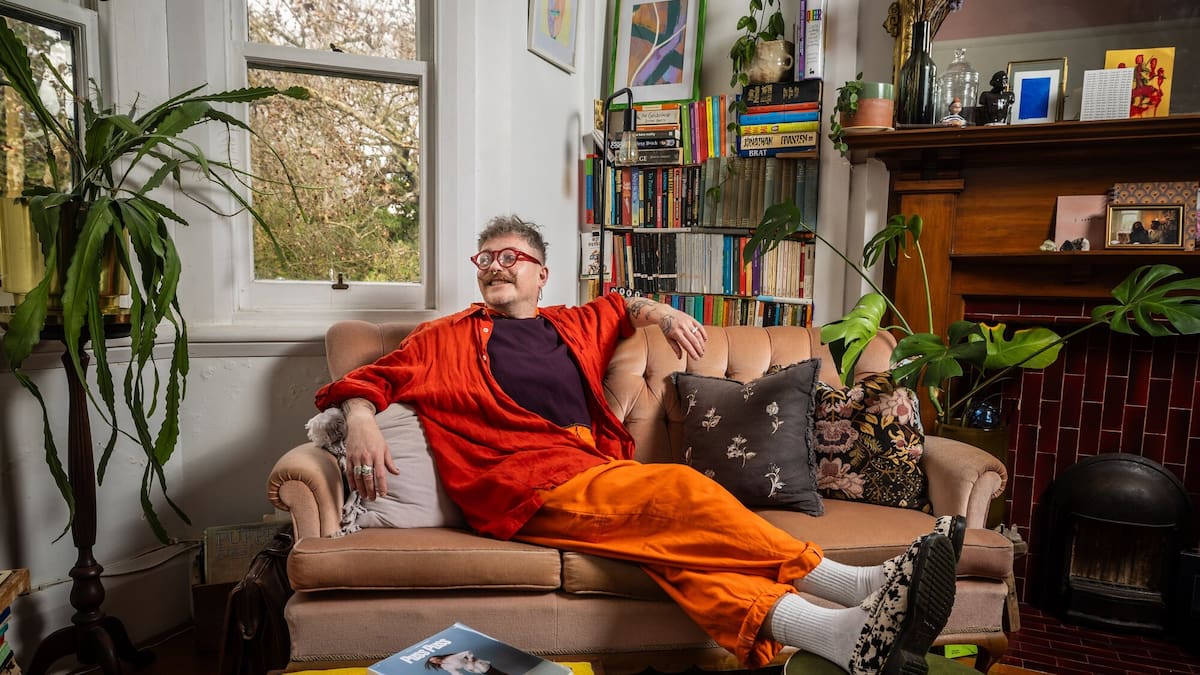
With his stylish outfits and waxed moustache, he’s a walking work of art (one of the outfits he chose for this photo shoot features a restructured Zambesi suit turned inside out to show off the lining).
Sara Wiseman, who was Kilby-Henson’s Lady Macbeth and worked with him on The Effect in 2024, reckons she’d play a paper bag for him if he asked her to.
“There’s no bravado ego with Ben,” she told Canvas, via email. “Never a dictator or micromanager, he’s like the Energiser Bunny; always full of energy and positive reinforcement.
“He welcomes you into a rehearsal space that maintains a deep sense of joy and generous creativity, so you feel truly safe even in your most awkward, icky, raw moments on the floor.”
Sara Wiseman as an unravelling Lady Macbeth. Photo / Andi Crown
Kilby-Henson, who’s a big fan of “Sas” too, is glad the days of the tyrannical theatre director are over.
A gentler soul than his flamboyant appearance might suggest, he hopes his rehearsal rooms are calm spaces where people feel comfortable being vulnerable and taking risks.
“I don’t really get angry in my everyday life, so I’m not very good at it,” he says. “I go down the disappointment road, instead.”
One can only imagine how devastatingly effective that approach is.
Macbeth involved wrangling a 400-year-old text and 38 cast members; directing a musical is more like moving chess pieces around the stage. Cabaret is set in a nightclub, and he and choreographer Kira Josephson have spent hours charting the intricate movement of bentwood chairs.
Nomi Cohen, the production’s Sally Bowles, played Roxie Hart in a production of Chicago in Auckland last year. Matu Ngaropo, the Emcee, toured as George Washington in Hamilton and portrayed Shakespeare himself in the musical &Juliet earlier this year.
Kilby-Henson is artistic manager of The Actors’ Program, an intensive one-year course that accepts only 16 applicants each year. He directed Cohen’s graduation show in 2012 and saw her saucy music quiz in the Speigeltent at the Auckland Arts Festival last year.
“She’s there in a big fluffy fur coat, being loquacious and flamboyant – well, there’s Sally Bowles. So that was a phone call and not an audition.”
Nomi Cohen, centre, plays Sally Bowles in Cabaret, opposite Matu Ngaropo, left, as Emcee.
It’s not uncommon for a director to have the core cast already in mind. Still, he thinks there’s often a misconception that ATC is a closed shop. Open auditions held late last year were attended by more than 150 actors.
The criticism he’s faced from some quarters over his unconventional approach to Shakespeare doesn’t seem to bother him. In the UK, he says, the plays are performed so often that more traditional framings are sneered at.
“Look, I’m not down on classicists at all, but I think it’s important to remember that Shakespeare was also stealing from other places, other stories, other poems and even other writers at times.
“We have to accept that, 400 years later, the way we consume theatre is different.
“Back then, [the script] had to keep repeating the same thing to remind people at the Globe what was going on because they might have popped out to the loo or to buy peanuts or something.
“He wasn’t writing for us to sit down in the dark for a couple of hours with a glass of wine.”
So, how is he planning to make his mark on Cabaret?
A key influence has been the documentary Eldorado: Everything the Nazis Hate, about a queer nightclub in Berlin during the 1920s and 30s that became a Nazi base.
“We’re looking into the people who were diminished by this [fascist] movement,” says Kilby-Henson, who has worked closely with designer Dan Williams to create the show’s aesthetic.
“One thing we knew from the beginning is that we didn’t want frilly black knickers and provocative dress. There have been so many high-school versions, my own included, where it’s almost inappropriate. People are doing it just to wear the stockings.
“We wanted to find a way it could still be sexy and naughty, but not to do with revealing flesh. Dan is doing lots of leather strapping that’s sort of Lederhosen-adjacent; it might be a beautiful, high-fashion corset, but it’s over the top of a shirt.”
The most important moments in a musical are the beginning and the ending, he says.
“The audience will forgive a bad evening if the end is a hit. Blood Brothers is the living example of that. Terrible musical, heartbreaking end. Everyone loves it.”
With Cabaret, he’ll be setting the bar far higher than that.
Cabaret runs from September 22 to October 25 at the ASB Waterfront Theatre (atc.co.nz)
Joanna Wane is a senior lifestyle writer with a focus on social issues and the arts.