
Back to Article List
This gorgeous and lesser-known double star in the constellation Lyra is easy to split and high up in the evening sky.
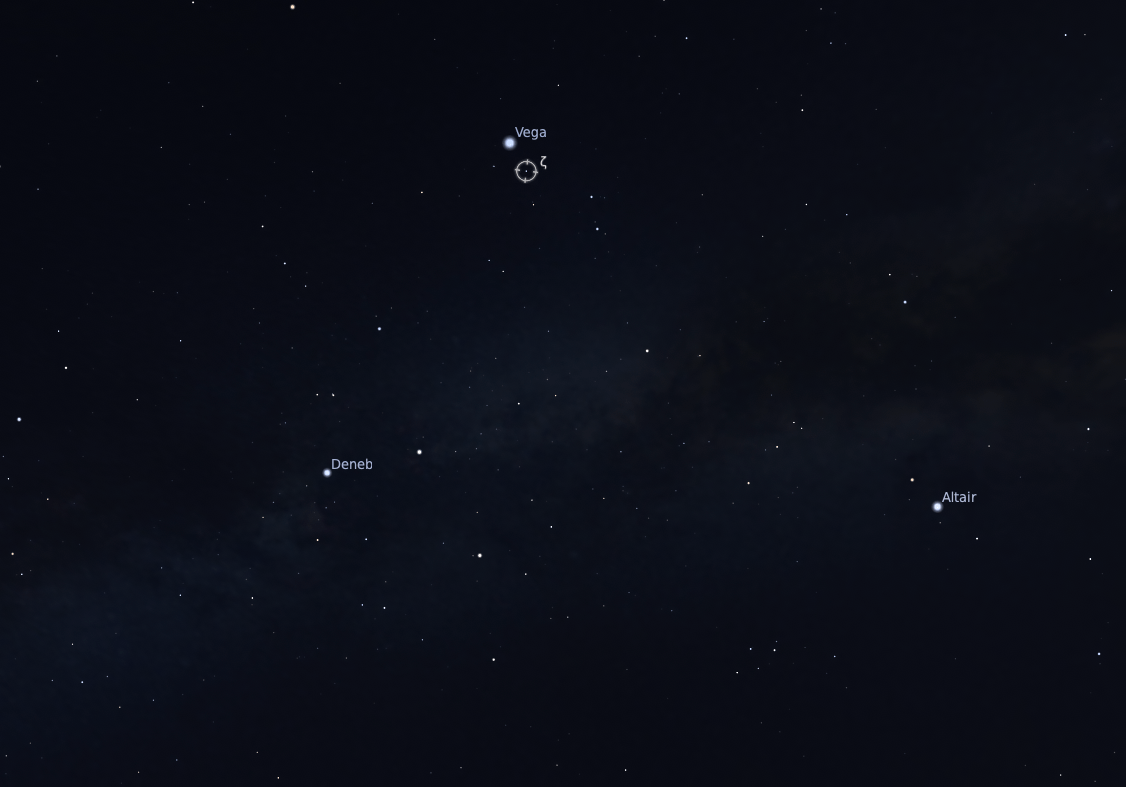
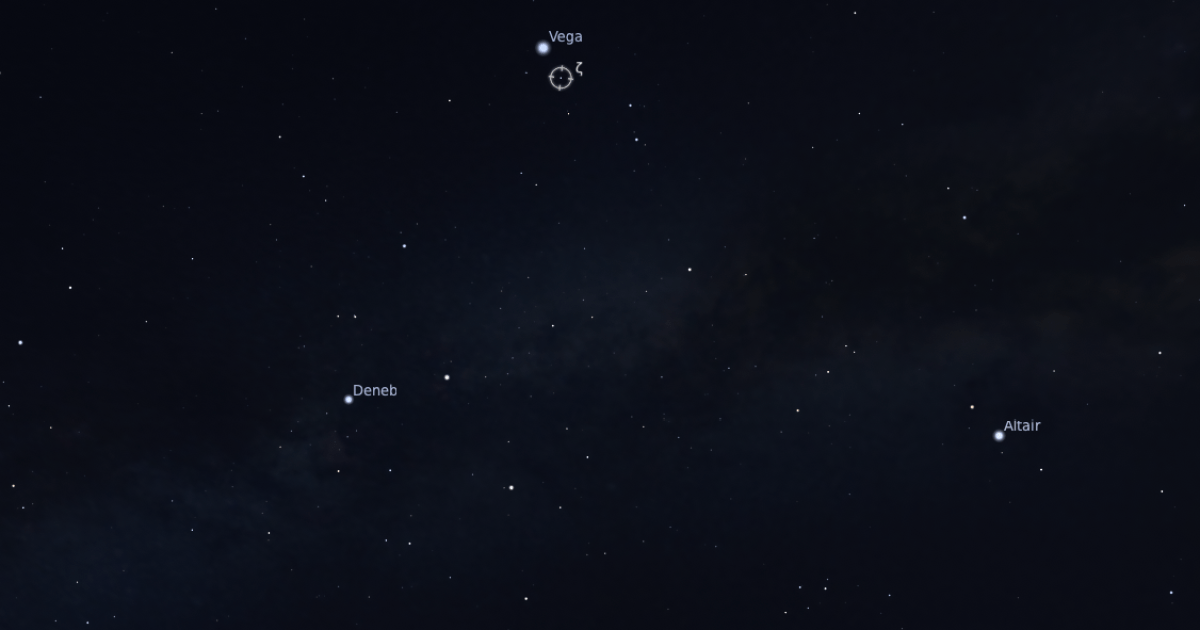
Looking up toward the Summer Triangle in the east around 9 P.M. local daylight time in late August, you’ll find the multiple-star system Zeta Lyrae (marked with the circle) just to the lower right of Vega. Credit: Stellarium
Looking for a sky event this week? Check out our full Sky This Week column.
August 28: Vesta stands still
You may have heard of Epsilon (ε) Lyrae, the famous Double Double star in the constellation Lyra, but it’s not the only fascinating pair this constellation holds. Tonight, let’s check out another multi-star system in the Lyre: Zeta (ζ) Lyr, which astronomers think holds up to seven stars.
Zeta is easy to find in the evening sky, just a short 2° jump southeast from blazing Vega (Alpha [α] Lyr). Collectively, it shines about 4th magnitude, but a telescope will easily break it into two components: The brighter star is magnitude 4.4, while its fainter companion is two magnitudes fainter. They’re separated by roughly 44” on the sky. According to the late stellar expert Jim Kaler, the brighter star is just over twice the Sun’s mass and 31 times as bright. The fainter star is still more massive than our Sun, with a mass 1.7 times solar, and shines about nine times as brightly. Both lie at a distance of 152 light-years.
What about the other stars in the system? The brighter star is a known spectroscopic binary, which means astronomers can tell it’s actually two stars by the way its light shifts as they orbit each other, but they cannot be split in a telescope. The fainter star is likely also a spectroscopic binary, but the signal here is not as clear. The remaining three stars, which are loosely bound to the initial pair if at all, shine between magnitude 10 and 12.5, lie a little ways away, at distances that range from 26” to 1’ away.
Sunrise: 6:25 A.M.
Sunset: 7:36 P.M.
Moonrise: 8:14 P.M.
Moonset: 7:54 A.M.
Moon Phase: Waning gibbous (96%)
*Times for sunrise, sunset, moonrise, and moonset are given in local time from 40° N 90° W. The Moon’s illumination is given at 10 P.M. local time from the same location.
The waxing Moon passes 5° north of Neptune at 9 A.M. EDT on August 30. Although both are well above the horizon overnight and into the early morning, the bright moonlight will make the faint, distant ice giant difficult to see, even with the necessary optical aid (you can’t spot it with the naked eye). You will, however, easily be able to see magnitude 0.4 Saturn, which lies about 10° east (to the left) of Neptune. Both planets, as well as the Moon, are in Pisces, with the region standing highest in the south around 3 A.M. local daylight time.
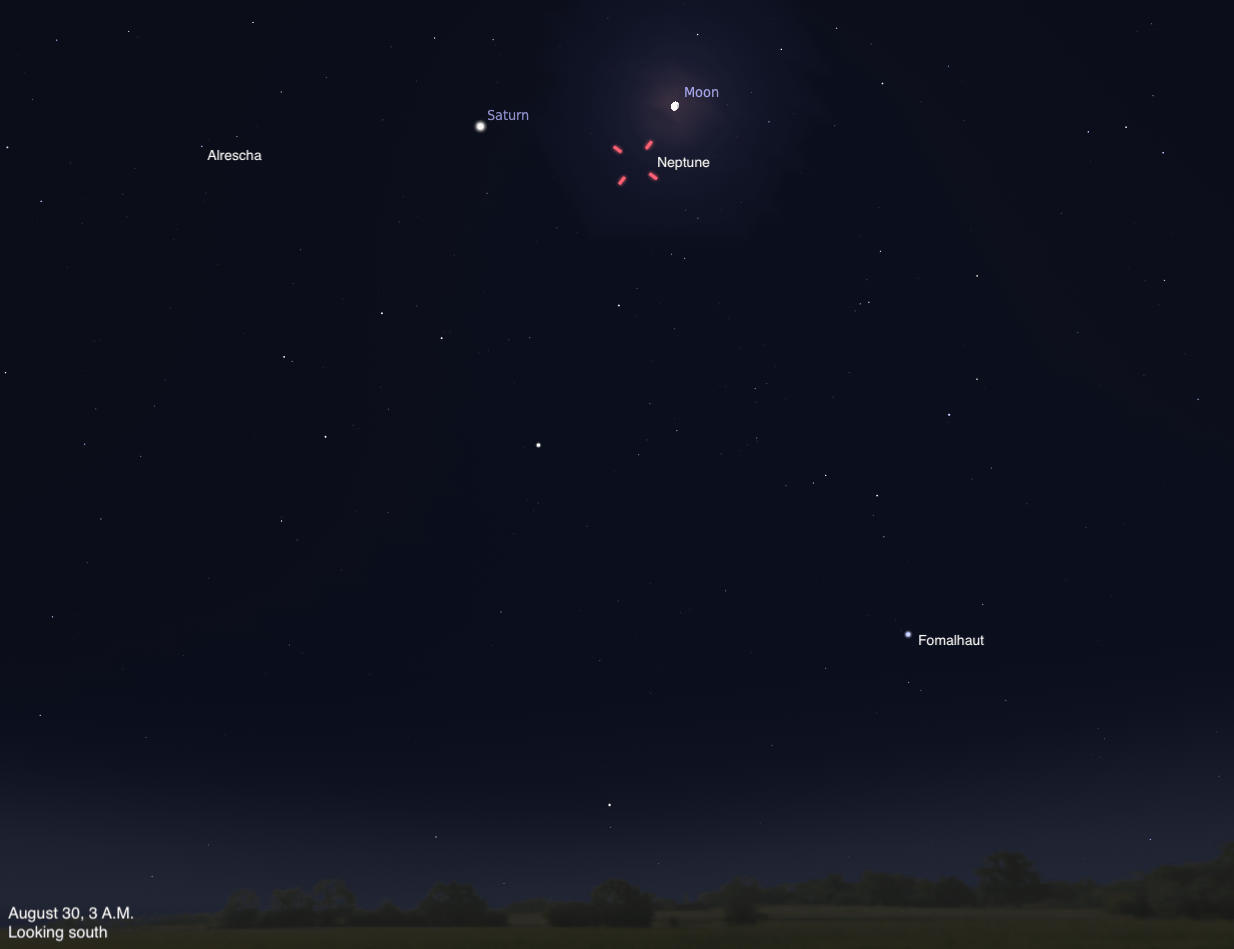
Early on August 30, the Moon shines next to the Circlet asterism of Pisces, with naked-eye Saturn visible nearby. The position of Neptune is marked by the crosshairs — optical aid is necessary to see the ice giant, which may be difficult to spot even then. Credit: Stellarium/USGS/Celestia/Clementine
Early on the 30th, the Moon stands above Neptune and to the right of Saturn. Our satellite is just to the left of the famous Circlet asterism in Pisces, although its faint stars will also be hard to see in the bright moonlight. Saturn is the brightest point of light in this region of the sky, standing roughly in line above the horizon with the Moon to its right and Alrescha, Pisces’ alpha star, about twice as far to its left. Far to the lower right, close to the horizon, is Saturn’s only competitor for brightness: magnitude 1.2 Fomalhaut in Piscis Austrinus.
Alison Klesman is senior editor of Astronomy magazine. She holds a Ph.D. in astronomy and has studied a variety of topics, from minor planets to supermassive black holes.