
The audience wore hoodies with “Push for Cush!” or their local Labour MP’s name emblazoned on them. But it is not this audience Labour needs to convince.
Most candidates in Māori seats have far larger geographical areas to cover for campaigns than candidates in the general electorates do.
There are seven Māori seats covering the country, compared to the 64 general electorates. Tangaere-Manuel spoke about the challenge of driving for ages to remote parts of her Ikaroa-Rāwhiti electorate for debates “in front of 12 of my cousins”.
There are more than 300,000 people on the Māori roll scattered over the country and last election, Te Pāti Māori came out on top.
For Labour, their mana and pride rests on their ability to win back those seats once held by revered stalwarts like Nanaia Mahuta, who lost in 2023 to fresh-faced political newbie Hana-Rāwhiti Maipi-Clarke who has since become a celebrated international figure.
This year, Maipi-Clarke will go up against Labour’s Kingi Kiriona, a kapa haka exponent and broadcaster. When asked what his strategy would be to win the seat, Kiriona, who is No 22 on Labour’s list, said “myself”.
Kingi Kiriona will challenge Hana-Rāwhiti Maipi-Clarke for the Hauraki-Waikato seat at the 2026 general election. Photo / NZME
“I’m not a wasted vote – neither are the people standing here. Our experiences, the support that we have, the skills that we share amongst would not render us a waste to any person or community.”
Kiriona is referencing arguments that a candidate vote for someone who is already likely to enter Parliament on their party’s list is “wasted”.
“What am I going to bring? I am going to bring myself.”
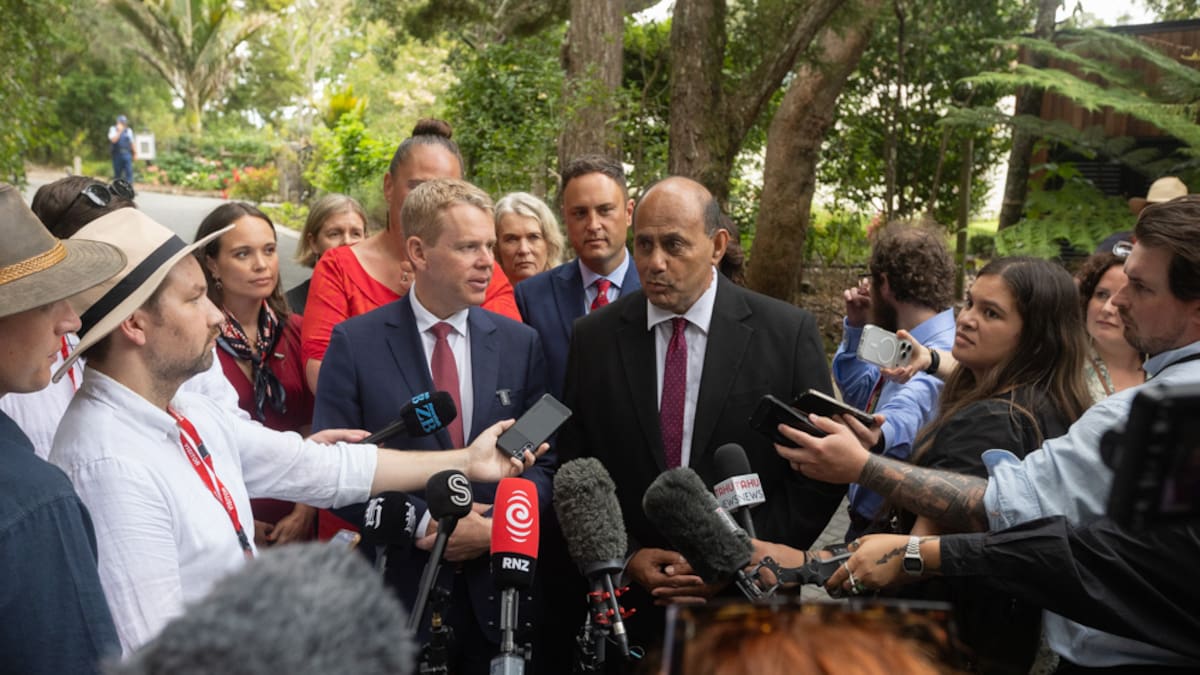
The head of Labour’s Māori caucus Willie Jackson could not contain his upset for the Government, admitting within 40 seconds of taking the podium that he had already “gone off script” as he described the Government as “rotten” and “useless”.
Down south, Mananui Ramsden will contest Te Tai Tonga – the electorate that covers the South Island and parts of Wellington – against Te Pāti Māori’s Lisa Marie Murch and independent and incumbent MP Tākuta Ferris.
Party leader Chris Hipkins revealed Labour would spend the money to save an ancient waka, estimated to be around 550 years old, which sits under sand on the Chatham Islands. The waka is at imminent risk of damage from potential storms or poor weather. Both Ramsden and Ferris have campaigned hard for its regeneration.
Ramsden is not on Labour’s list so the only way he will enter parliament is if he wins the candidate vote.
Ramsden was the kaikōrero for Labour during the pōwhiri at Wainuiomata marae – a role that was once taken up by Peeni Henare, a long-time Labour MP. Henare lost his once long-held Tāmaki Makaurau seat in 2023, and again during the subsequent byelection, to Te Pāti Māori. Henare said he felt the byelection race was “over” once Te Pāti Māori argued that voters would get two for one – meaning if they voted for their candidate, former broadcaster Oriini Kaipara, they would get Henare anyway because he was already an MP.
Current Te Tai Tonga MP Tākuta Ferris and Labour’s candidate for the seat in the 2026 election Mananui Ramsden.
This is a strategy Te Pāti Māori is confident in. During their recent campaign launch on the East Coast, Te Pāti Māori declared they would only campaign for the candidate vote – putting the ultimatum in voter’s hands: if you want Te Pāti Māori in Parliament, vote their candidates in.
For both parties, mana is on the line. Labour wants to win back the seats it lost in 2023 – but as it tries to do that, Te Pāti Māori is readjusting its grip and deploying different strategies to win the hearts of Māori voters.
Hipkins, the party’s leader, said he wanted to “make history” by making this Government “the first one-term National government”. The election is 10 weeks away.
“Everything we do between now and 10 weeks from now matters. Every day, every hour, we have the opportunity to get out there and win more votes. We cannot lose a single hour of that 10-week period.
“It’s going to take all of us to win this election. And then after the election, it is going to take all of us to bring the country together with a clear sense of purpose to drive toward that better future that we know is possible for this amazing place Aotearoa New Zealand.”
Labour has vowed to revive a dedicated Māori trades training scheme – with an annual investment of more than $20 million – if elected because Māori, particularly youth, were unemployed at unacceptably high rates.
The unemployment rate for Māori (10.8%) is nearly double the national rate (5.6%).
The head of Labour’s Māori caucus Willie Jackson speaks flanked by the party’s Māori seat candidates. Photo / Julia Gabel
“We have to do everything we can get this Government out. We campaign with a clear sense of purpose – to win all seven Māori seats, to earn the opportunity to deliver for Māori once again in government.”
Hipkins said the issue keeping him “awake at night” was the unemployment rate among young Māori which was even worse.
“It’s about what comes after that – a good job, a steady income, a place in society, the opportunity to stand on your own two feet and all of the mana that comes with that.”
Julia Gabel is a Wellington-based political reporter. She joined the Herald in 2020 and has most recently focused on data journalism.