
The farm was converted to sheep and beef by Jack Mark in 1964.
It was converted back to a dairy unit by Peter and Megan in 2014.
“It was a small one-person sheep and beef farm, and I love contact with people so it wasn’t really working for me,” Peter said.
“We leased the farm out for eight years, and I enjoyed tutoring for Toi-Ohomai and Primary ITO.”
Immersed daily in dairy information, Peter felt that the farm needed to be made more viable.
He decided on a dairy unit, with Jersey cows as they are lighter on the land and can manage a long walk to the shed.
“Getting finance from the banks for the conversion proved difficult as everyone who came on site said it was too hilly.”
A chance conversation with a BNZ staff member who was selling Peter a motorbike led to the family acquiring finance.
Milking started twice a day in the new 30 ASHB shed with 260 Jersey cows on the 100ha milking platform on the 170ha (127ha effective) property.
“The first year the payout was $3.90 per kg/MS, and the second year it was $4.20 per kg/MS, so the process to manageable debt and profit took a little longer than hoped.”
Now around 275 Jersey cows are milked once a day and average 319kg/MS per cow annually.
A 60m x 30m composting barn that provides shelter and significantly reduces soil damage and nutrient leaching. Photo / Catherine Fry
“What’s lost in production, we gain in cow reproduction, condition score and worker wellbeing.
“I work on the farm, Megan does the books and our daughter Niamh is the farm manager. Contractors do the extra jobs.”
Niamh joins the farm
In 2019, Niamh Mark was working for AsureQuality after finishing a degree in agriculture.
“I came home to help dad after a staff member resigned,” she said.
“During Covid-19, I stayed on through all the lockdowns.
“Towards the end of 2020 I met my now husband, Breno Codognolla, who works in the kiwifruit industry. We live on the farm.”
Niamh was in the running for the New Zealand Dairy Industry Awards 2022 Bay of Plenty Dairy Trainee Award and runner-up in the 2025 Bay of Plenty Farm Manager Award.
During Niamh’s time at the farm, the team have implemented new technology, including contracting in drone technology for precise weed control.
Niamh has had success with equestrian eventing. Photo / Catherine Fry
A virtual fencing system manages their grazing patterns and monitors cow health and behaviour.
“We’re definitely getting more out of our pasture this way, pushing the cows further uphill into new areas,” she said.
“It’s also reduced the workload by half a man-power.”
The judges praised the family’s robust succession planning, saying it provided a transparent, long-term framework for family continuity.
“We are moving the business structure from a partnership to a company to allow future generations to hold shares in Te Ranga Pamu.
“My sisters, Abi and Gwyneth, can all own shares.”
Environmental stewardship
The steep terrain has prompted sophisticated management, including the recent installation of a 60m x 30m composting barn that provides shelter and significantly reduces the risk of soil damage and nutrient leaching.
Solar panels on the cowshed roof reduce environmental impact. Sustainability is deeply integrated into the farm’s structure.
“Over the past four years, we’ve planted over 10,000 native trees on steep, unproductive land, aiming to create a vital wildlife corridor in conjunction with neighbours that could eventually link regional kōkako breeding groups in Kaharoa and Otanewainuku Reserves.”
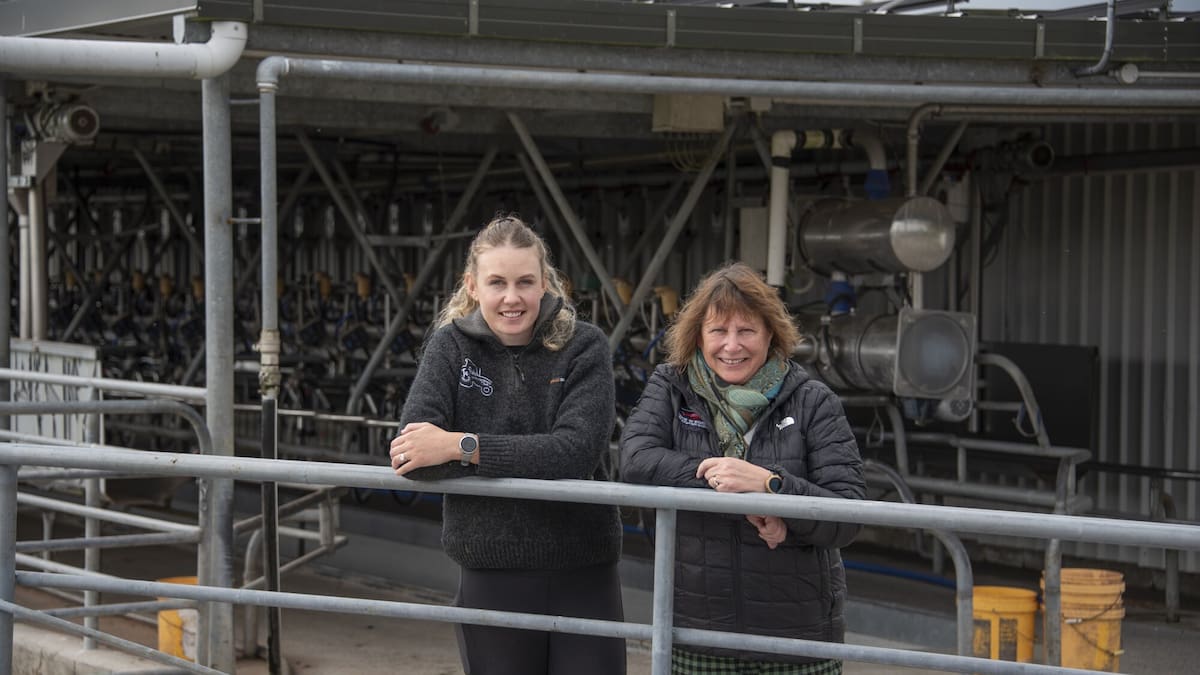
Megan Richards, Niamh Mark and Peter Mark.
The team’s commitment to biodiversity is backed by intensive pest control efforts for possum and rats across the property and neighbouring areas.
Forty hectares of the farm were put under QEII protection in the early 1980s.
A bush classroom has been developed on 0.8ha of native bush, complete with its own glowworm track, and is used by the local primary school.
“A grant-funded specialist environmental teacher.”
The Marks are involved with the Paraiti Catchment Care Group with other like-minded local landowners.
Focusing initially on pest control and native tree planting, they received funding and assistance from BOP Regional Council and other environmental organisations.
The judges said that Te Ranga Pamu dairy farm demonstrates how exemplary leadership can merge profitability with environmental stewardship, ensuring the land looks set to thrive for future generations.