
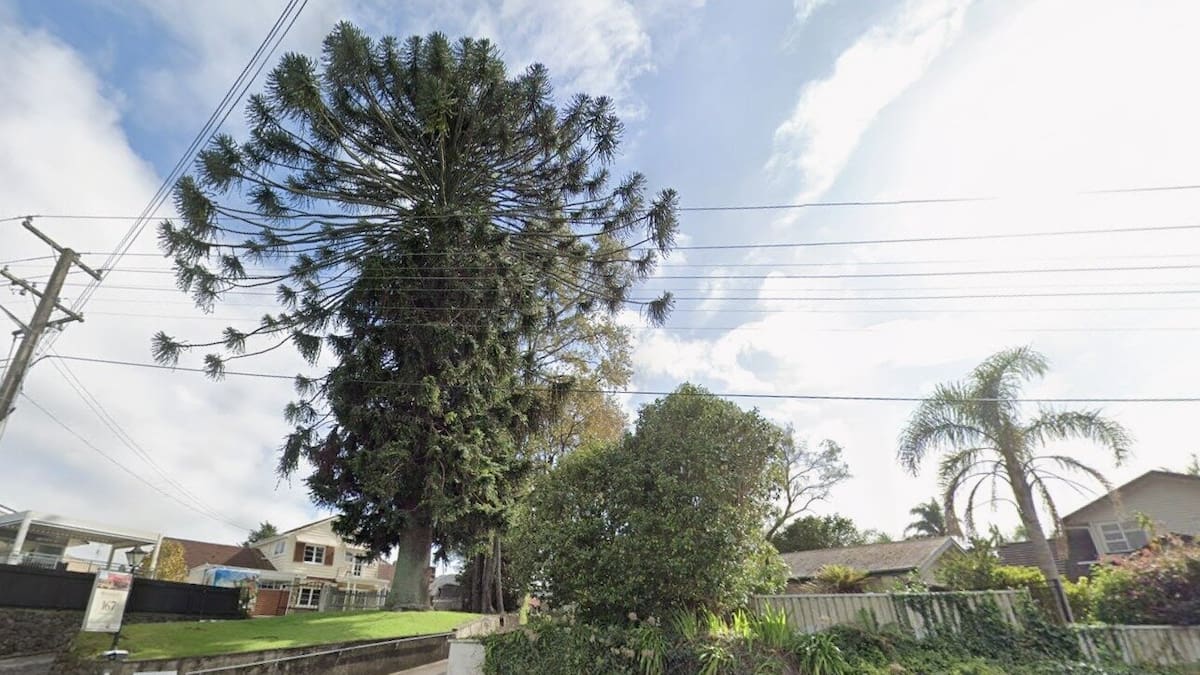
They have asked the council to stay the order while options for retaining the historic tree are explored.
The New Zealand Tree Register estimates it is 146 years old and measured it at more than 26m tall in 2017.
Council chief executive Marty Grenfell made the removal order under Section 330 of the Resource Management Act (RMA).
It comes as the council’s risk management practices are under intense scrutiny after a probe into January’s deadly Mount Maunganui landslide tragedy found systematic failures.
Protocols ‘must be followed’
Green said an August 18 letter from Grenfell referred to a single recent limb failure and acknowledged previous arborist reports described the tree as “generally healthy”.
“To my untrained arborist’s eye, it appears the branch came down during a storm, not because of rot, disease or root instability,” Green said.
He questioned whether the tree had been regularly maintained and said it was not directly over homes or other structures.
Removing a protected tree without resource consent or clear evidence it posed an immediate risk to people or property was unjustified, Green said.
“Even if there were safety concerns, there are protocols that must be followed through the resource consent process.
Avenues resident and Tauranga City Council Urban Design Panel member, Phil Green, has challenged the removal of a protected tree in Otumoetai.
“We need to draw a line in the sand and halt this process until there is clear evidence of an immediate danger that cannot be managed through alternative arboricultural measures.”
He described the removal of a healthy tree listed on the NZ Notable Trees Register as “a serious matter”.
Tauranga had already lost many mature and notable trees and Green said there was a steady decline in the city’s streetscapes.
He questioned whether similar trees at historic property The Elms would face the same fate if branches fell in storms.
In his view, the council should consider alternatives to felling historic trees and be more transparent about decisions affecting them.
Cadwallader said the emergency RMA powers required an “objectively reasonable opinion” that immediate action was necessary to prevent or remedy an emergency, and the response must be limited to what was necessary to address the threat.
A limb off a 150-year-old Bunya Bunya tree limb smashed a fence and fell across a driveway on Grange Rd.
“In our view, evidence of a single branch failure does not, on its own, justify removing the entire tree, particularly when previous arboricultural assessments found it to be generally healthy.”
He said he had asked for the removal to be halted until the council could demonstrate that removal of the entire tree was “proportionate and necessary” to address the identified risk.
‘The tree has to go’
Brownless, who was mayor from 2016 to 2019, owns the Category 2 Historic Place property with the Woodhill Trustee Company.
He said in recent years incidents of the tree’s limbs falling and endangering people had dramatically increased – not only in storms.
Several large branches had fallen since January, including on to power lines, he said.
“One branch smashed a fence, left a branch rammed into the earth and fell against power lines.
“More importantly than property damage, there have been near-miss incidents this year of people walking up the driveways and even on the adjacent footpath.”
Former Tauranga mayor Greg Brownless sought the removal of a 150-year-old Bunya Bunya pine tree on his property for safety reasons.
Brownless said he and two neighbouring property owners had contacted the council several times this year about the tree.
“Initially, the council suggested a resource consent application to remove the tree, but later decided it posed an imminent danger and ordered me to remove it.”
He said the issue was not the tree’s health, but the danger it posed to public safety.
“Sadly, the tree has to go, but it is demonstrably unsafe. These 9m-long branches do pose a serious threat.”
He said the wood was “extremely dense and heavy”.
“Maintenance has been carried out over the years, usually after a branch falls, but there is no way to predict which branch will fall next.”
He said it was taking time to find a contractor able to remove the tree safely, and he would pay the removal bill.
‘Real and imminent risk’
The council’s general manager of operations and infrastructure Reneke van Soest confirmed Grenfell authorised the tree removal using emergency RMA powers.
“Council was satisfied there was a real and imminent risk that further limb failure could cause death, serious injury, or serious property damage.
“That assessment took into account a history of repeated large limb failures, recent photographic evidence of a substantial limb falling through a fence and across a driveway, and the tree’s position over entranceways, a public footpath and the road.”
Van Soest said Brownless raised his safety concerns with the council on April 8, seeking authorisation to remove the tree.
She said he was responsible for arranging its removal.
The council will meet on Tuesday to discuss its next steps in responding to the systemic issues raised in a review by former judge Paul Davison, KC, into the landslide tragedy.