
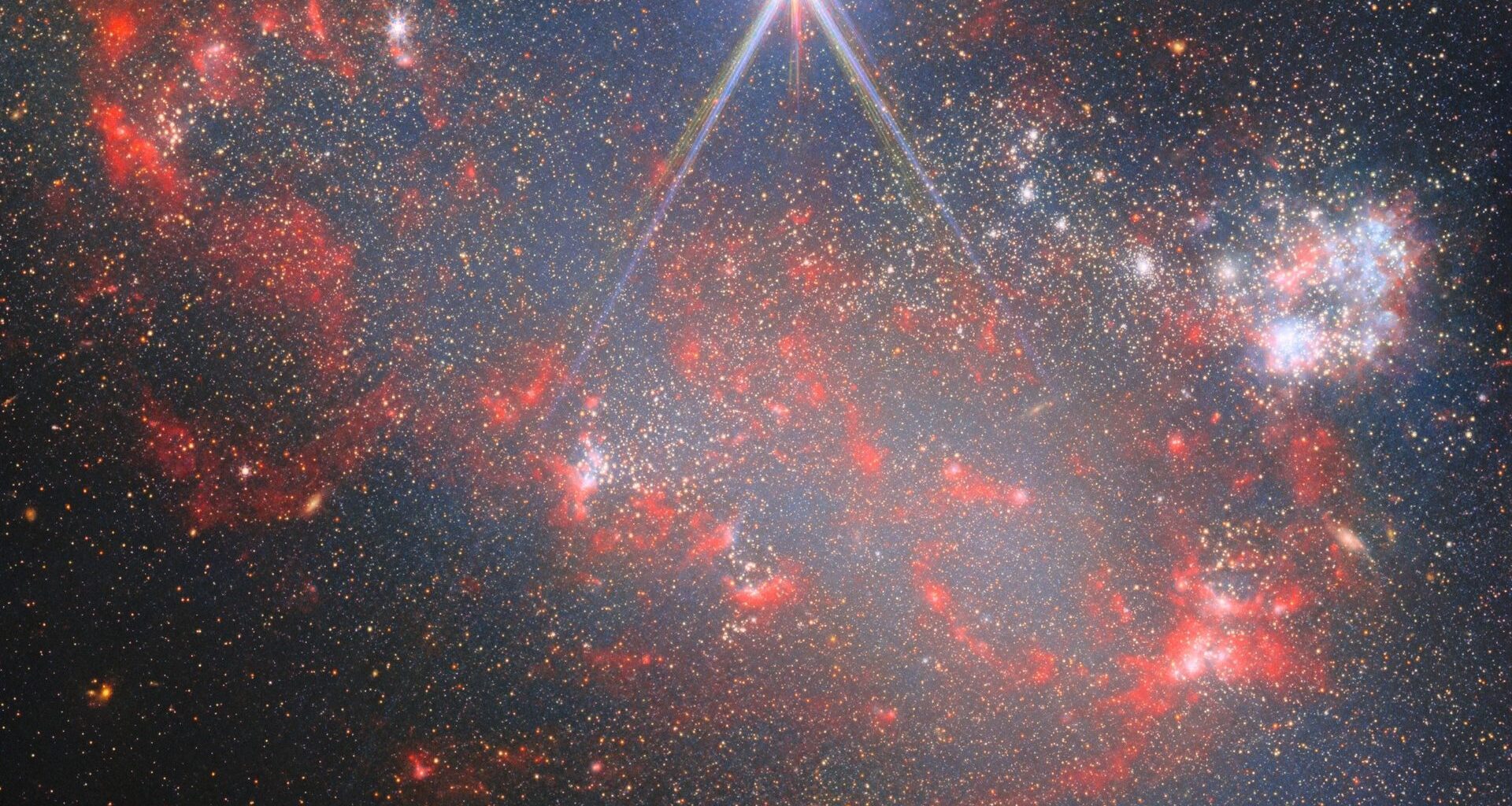
Webb peers into Arp 263, a nearby irregular galaxy still bearing the scars of a violent merger and filled with newly forming stars.
Today’s Image of the Day from the European Space Agency reveals a galaxy still bearing the scars of a violent collision.
Located about 25 million light-years away in the constellation Leo, Arp 263 is an irregular galaxy caught in the strange final phase of a galactic merger.
The James Webb Space Telescope has now peered through its crowded clouds of gas and dust, exposing clusters of newborn stars scattered across a galaxy that has yet to settle down.
A galaxy shaken by a merger
Arp 263, also known as NGC 3239, looks nothing like the orderly spiral galaxies familiar from many space images.
Its stars and gas form an uneven, distorted structure filled with bright clumps of star formation.
Astronomers believe that shape is the aftermath of a collision between galaxies.
Two short, curved tails of stars extend beyond the area shown in Webb’s new image, a telltale sign of past gravitational interactions.
There is another clue inside the galaxy. Arp 263’s stars are oriented differently from its hydrogen gas, while portions of that gas are moving at different speeds.
Together, these features point to a system that was seriously disrupted and has not yet returned to equilibrium.
The missing galaxy
One mystery remains: astronomers cannot see the galaxy that collided with Arp 263.
No nearby companion appears to be interacting with it today.
One possibility is that the missing galaxy was a small dwarf galaxy that had already been completely torn apart and absorbed into Arp 263.
Another possibility is that the companion contained far more mass than its brightness would suggest, leaving behind a remnant that is difficult to detect.
Whatever happened, the encounter left Arp 263 with another hallmark of a galactic collision: widespread formation of new stars.
Webb peers inside
Webb’s Near-Infrared Camera, or NIRCam, provides a particularly revealing look at this activity.
Infrared observations allow Webb to see through some of the material that obscures stars at visible wavelengths.
In Arp 263, that capability reveals numerous stars embedded within the galaxy’s thick concentrations of gas.
Older stars appear alongside regions where new generations are taking shape in clusters.
Dust spread through the galaxy also glows in Webb’s view. Around the star-forming regions, hydrogen gas has been ionized by intense starlight and produces light of its own.
The most active region contains a curved chain of compact star clusters leading toward the galaxy’s largest and brightest star-forming nebula.
Hubble saw a different galaxy
Arp 263 previously appeared in a 2023 image from the NASA/ESA Hubble Space Telescope.
Hubble’s visible-light observations showed bright nebulae nestled among dense clouds of gas.
Webb’s infrared vision now pushes deeper into those same regions, revealing many of the stars and clusters within them.
A particularly bright object in the image does not belong to Arp 263 at all. The star BD+17 2217 sits in our own Milky Way and appears enormous because it is vastly closer to Earth.
Far beyond Arp 263, meanwhile, Webb picks up hundreds of much more distant galaxies, many appearing as tiny orange points.
A galaxy still in turmoil
Arp 263 has attracted attention for a long time. It was first discovered in 1784 and later earned a place in astronomer Halton Arp’s 1966 Atlas of Peculiar Galaxies.
Arp placed it among galaxies characterized by “irregular clumps,” a description that makes considerably more sense with today’s powerful telescopes. Many of those clumps are sites where stars are being born.
Webb’s observations are part of a broader survey of nearby, large star-forming galaxies.
Because these galaxies are relatively close to Earth, astronomers can examine individual stars, clusters, and clouds of interstellar dust in exceptional detail.
Arp 263 offers an especially chaotic laboratory. Its gas remains disturbed, stars continue to form across the galaxy, and the partner responsible for the upheaval has seemingly disappeared.
The galaxy we see today is therefore something of a cosmic aftermath – a system still reorganizing itself long after gravity brought two galaxies together.
Image Credit: ESA/Webb, NASA & CSA, A. Leroy
—–
Like what you read? Subscribe to our newsletter for engaging articles, exclusive content, and the latest updates.
Check us out on EarthSnap, a free app brought to you by Eric Ralls and Earth.com.
—–