
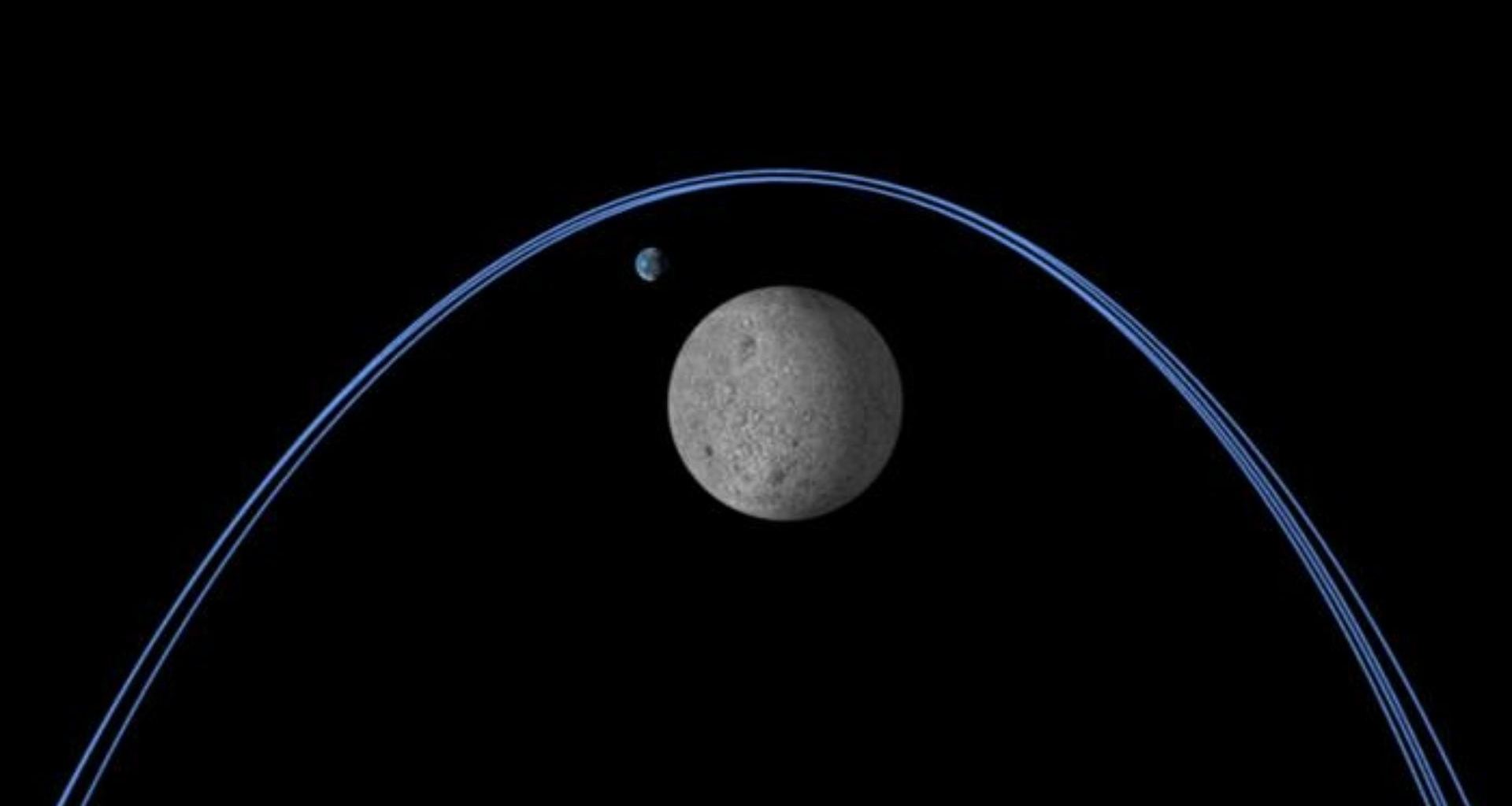
Engineers developed a lunar traffic control system to help spacecraft safely dock, park, and avoid collisions around NASA’s Gateway.
The Moon is getting an airport, and airports run on schedules. A plane taxis, waits its turn, and lands only when a gate opens up.
Spacecraft headed there will soon need that same kind of order, minus the runway, the tower, and anything that ever holds still.
Within the next two decades, NASA’s Gateway is expected to become humanity’s first lunar spaceport. Orion crew capsules, landers, cargo ships, and astronauts will pass through it on their way between Earth, the lunar surface, and eventually farther into deep space. No crackling intercom will ever announce a gate change there.
Instead, every vehicle near Gateway will follow an invisible path shaped by the gravitational pull of Earth and the Moon. Someone has to work out who moves where and when.
That is the job that a team of engineers from Texas A&M University, NASA’s Johnson Space Center, and Purdue University set out to do.
Dr. Diane Davis, an associate professor of space engineering at Texas A&M, led the group that developed the algorithms and operating rules needed to keep multiple spacecraft safely separated around Gateway.
“The future of lunar exploration depends as much on the traffic management as it does on the rocket science,” Davis said.
Earth and Moon shape Gateway’s orbit
Gateway will not circle the Moon the way a satellite circles Earth. It will travel in a near-rectilinear halo orbit, or NRHO, an elongated path shaped by the combined gravity of Earth and the Moon rather than by the Moon alone.
“The Gateway NRHO is a nearly stable and highly elongated orbit around the moon that provides an uninterrupted line of sight for communications to Earth and requires little propellant to maintain,” Davis said.
The orbit swings within 1,000 miles (1,609 kilometers) of the Moon’s north pole before looping nearly 40,000 miles (64,374 kilometers) beyond its south pole. No crewed spacecraft has ever followed a path quite like it.
A lone station can maintain that course with occasional engine burns. Add an arriving Orion capsule, an uncrewed cargo ship, and a lander all trying to dock or park nearby, and keeping every vehicle clear of the others becomes much harder.
“Collisions and serious damages could happen,” Davis said. “To ensure crew safety and mission success, effective traffic management in the NRHO is crucial.”
Spacecraft need somewhere to wait
The fix the team built centers on something they call loitering.
“Loitering in space means maintaining a spacecraft relative to a specific orbit or trajectory without executing an immediate maneuver,” Davis said.
Before docking or leaving, a vehicle may have to wait hours, days, or even weeks for a port to open or another mission to wrap up.
Unlike a plane parked at a gate, nothing near Gateway sits still. Every vehicle keeps drifting under the same gravitational pull that shapes the NRHO itself.
“Every spacecraft is constantly moving,” Davis said. “It’s a Goldilocks zone of keeping ‘parked’ vehicles far enough from each other to be safe, but close enough to their destination so that resources are used efficiently.”
The team built the study around finding that balance. They ran thousands of computer simulations to test ways of keeping vehicles properly spaced. The runs accounted for the kind of navigation errors, thruster imperfections, and small disturbances expected on real Artemis missions.
Modest increases in station-keeping maneuvers, they found, let spacecraft stay noticeably closer to their intended positions while barely changing how much fuel they burned.
“Greater positional accuracy means mission planners can better predict where every spacecraft will be, preserving valuable fuel,” Davis said.
Creating order around the Moon
That predictability offers benefits well beyond fuel savings. It makes docking schedules easier to set, rendezvous operations easier to plan, and crewed and robotic missions safer to conduct.
“Every maneuver has a cost,” Davis said. “Just like air traffic control on Earth, spacecraft need predictable positions and paths to safely coordinate their movements.”
Rather than allowing each spacecraft to drift on its own, the plan calls for visiting vehicles to loiter at set intervals ahead of or behind Gateway.
“Similar to the arrangement of pearls on a string necklace, spacecraft would arrange themselves naturally along the lunar orbit and relative to Gateway,” Davis said.
“Maintaining the loitering vehicle relative to the Gateway enables a closer formation and reduces the risk of vehicles drifting dangerously close together.”
The idea may sound modest. Around the Moon, where fuel is scarce and margins are thin, it is anything but.
“It’s the beginning of a new kind of traffic control,” Davis said. “An exciting frontier in planning the infrastructure for an entire transportation system.”
Real missions will test the system
The team modeled different strategies and fuel costs under realistic error conditions, but the researchers have not tested them in flight. No spacecraft has yet tested this loitering scheme in the actual NRHO.
How the system will perform once real hardware, navigation delays, and a full Artemis flight schedule enter the picture remains an open question. Gateway itself has not yet launched.
Davis brings extensive experience to that challenge. Before joining Texas A&M’s aerospace department in 2026, she spent more than a decade at Johnson Space Center as a principal engineer and mission design lead for Gateway.
She now splits her time between researching cislunar traffic management and training the students who may eventually manage it.
“Nothing excites me more than training and developing future engineers and scientists,” Davis said. “It’s an incredible opportunity, because they’ll be the ones planning lunar missions and managing space traffic for humanity beyond Earth.”
Traveling to the Moon may one day become as routine as flying between two cities. Getting there, however, will not begin with a landing or launch.
It will begin with the equations that determine who waits, who moves, and how traffic continues flowing nearly 240,000 miles (386,242 kilometers) from home.
The full study was published in the journal Acta Astronautica.
—–
Like what you read? Subscribe to our newsletter for engaging articles, exclusive content, and the latest updates.
Check us out on EarthSnap, a free app brought to you by Eric Ralls and Earth.com.
—–