
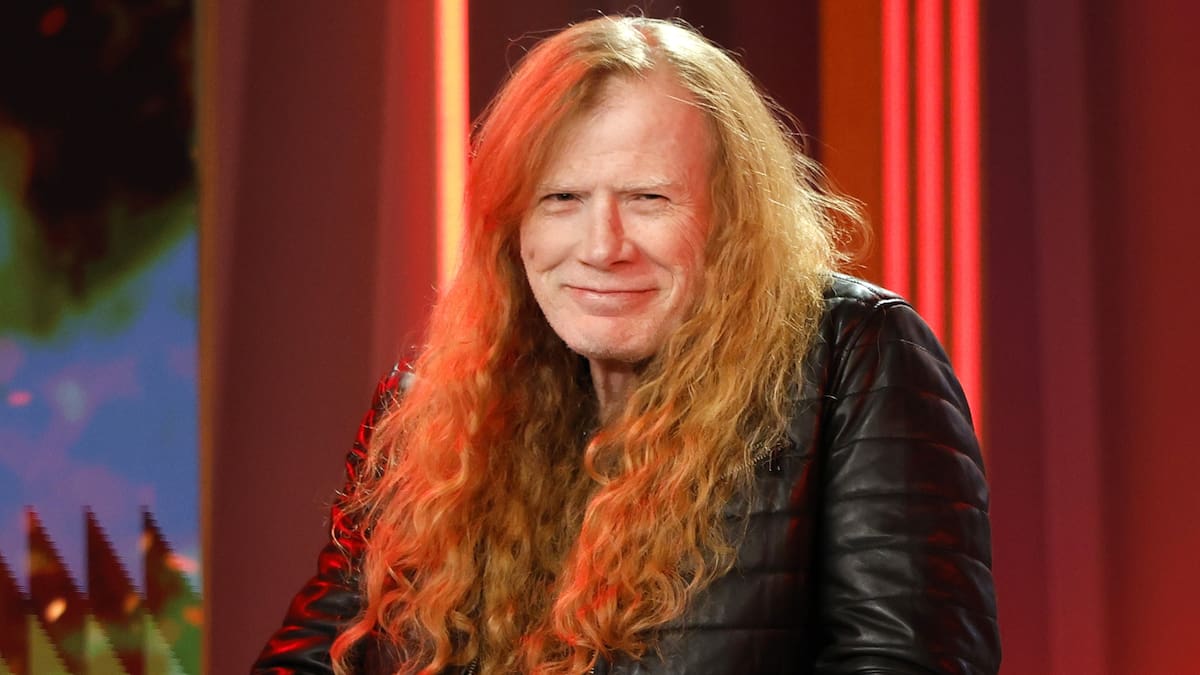
Mustaine is suffering from Dupuytren’s contracture, a hand condition where connective tissue under the palm’s skin thickens and scars, gradually pulling one or more fingers into a bent position.
This, sadly, makes it difficult for Mustaine to pick up and play a guitar.
It’s not the first health challenge Mustaine has faced during his wild decades of metal stardom. This is a man who has already recovered from throat cancer in 2020, as well as a nearly career-ending radial neuropathy arm injury after falling asleep with his arm draped over a chair in early 2002.
But Mustaine brushes off any suggestion of being resilient, saying he actually “didn’t even pay attention to that s***”.
He’s “already faced the reaper” throughout Megadeth’s impressive four-decade run and, despite some setbacks, continued to do what he loves.
Resilience, in his eyes, was just something that was buzzing in the background.
“I get up, I do my job, and if anybody needs my help, I’m there,” he says.
“If anybody gets in my way, I’m probably going to ask nicely for you to move, and if you don’t, then that’s a different story.”
James LoMenzo (from left), Dirk Verbeuren, Dave Mustaine and Teemu Mäntysaari of Megadeth. Photo / Ross Halfin
He and his fellow Megadeth bandmates will bring the noise to New Zealand in November, shredding the stage for the final time when opening for Iron Maiden for two nights at Auckland’s Spark Arena.
Mustaine loves it here, and although he’s been plenty of times, he admits he rarely has time to take it all in.
“I love going to New Zealand because of the majesty and beauty of the island. I would love to spend some time down by the sea, but our schedules never permit that.”
Touring with Iron Maiden is special for Mustaine, who says he idolised the group growing up, and lead singer Bruce Dickinson was supportive towards him during his cancer battle.
“And at one of the last concerts I ever did with Metallica, we played in New York, and [Iron Maiden bassist Steve Harris] had come to watch us. And I thought that was really cool, and I walked out after we played, and I was talking to him, and we had a nice chat,” he says.
While friendly, there’s still an old-school gig code where they tend not to hang out together backstage.
“You want to show some deference to the headliner. If you are a successful band, you know how things work, and it’s proper to show respect to someone like Steve and someone like Bruce.”
Megadeth in 1987, with David Ellefson, Chuck Behler, Jeff Young and Dave Mustaine. Photo / Getty
Mustaine formed Megadeth in Los Angeles in 1983 after he left Metallica and they are often considered part of the Thrash Metal Big Four alongside Metallica, Slayer, and Anthrax.
They’ve produced certified metal hits such as Symphony of Destruction and Tornado of Souls.
Remarkably, Megadeth’s latest album was their first US No 1.
“We made a great record, and we’re going out on top,” Mustaine told NME earlier this year when the album was released, adding that it was going to “smack people upside their earholes”.
Over the years, the band’s trademark has been their impeccable guitar riffs and politically charged lyrics. Songs such as 1992’s Architecture of Aggression and 1986’s Peace Sells touch heavily on political disillusionment and provide a strong critique of wars and political systems of the time.
“If you want to play like me, you’re just going to play my songs. If you want to write like me, you’ve got to go one step deeper,” Mustaine says.
“I always shoot straight with our fans. I don’t talk bulls***. If they want to know the truth, you know, they’re going to get it from me.”
Chris Poland, left, and Dave Mustaine of Megadeth perform onstage at the UIC Pavilion in 1987. Photo / Getty
Mustaine is also proud of how Megadeth’s audiences have evolved and the passion they bring to the band’s shows, day in, day out.
“They’re all different sizes and shapes and colours and ages and languages and backgrounds,” he says.
“And when you see people that aren’t from our genre, like you see people that maybe are from the country music genre or from the punk scene, that kind of stuff is always really gratifying just to have people from other different walks of life come and check out our music.”
Already a bestselling author (Mustaine: A Heavy Metal Memoir was a New York Times bestseller in 2010), Mustaine’s new no-holds-barred book, In My Darkest Hour: A Memoir, is being released in September, promising to further delve into his brushes with the Grim Reaper.
He’s talked publicly for years about staring death in the face, but the gravity of it has only recently hit him.
“When you’re in your 20s, it’s real easy to say, yeah man, I don’t know how long I’m going to live. But when you get a little bit older, you start thinking about reality.”
That reality is his own mortality, coming to terms with the fact he has been through and continues to face serious health challenges.
“I’m certainly surprised I’ve lived this long,” he says.
Dave Mustaine says he’s grateful for the time and memories Megadeth has provided him with. Photo / Ross Halfin
Earlier this year, Mustaine told fans they had made “a lot of friends over the years”, and implored them not to be mad or sad as Megadeth embarked on their final chapter.
Thanking those who stuck with him, he said the band had started a musical style, “a revolution”, and changed the guitar world.
But for now, the metal maestro has no intention of slowing down. The final Megadeth tour started in Alaska and will visit 41 cities in 16 countries.
It also might not be the last we see of Mustaine in the public eye – the singer has said he’d like to expand his screen acting portfolio when Megadeth is laid to rest.
“What do they say? No rest for the wicked. I am so wicked,” the born-again Christian tells me with a laugh.
What: Iron Maiden with special guest Megadeth
Where: Spark Arena, Auckland
When: November 7 and 8
Tickets: Ticketmaster
Mitchell Hageman joined the Herald’s entertainment and lifestyle team in 2024. He previously worked as a multimedia journalist for Hawke’s Bay Today.