
They did just that – even if they were clinging on at the death – to lead from start to finish and square the series in Cape Town with a 33-26 win.
South Africa Lood de Jager is yellow-carded by match referee Angus Gardner. Photo / Shaun Roy, action press, SmartFrame
One-one with two tests remaining in this engrossing series. Everything to play for in Johannesburg and Baltimore.
‘Painful fact for the All Blacks’
Gregor Paul, NZ Herald
The little moments went the way of New Zealand last week, but in test two of Rugby’s Greatest Rivalry series, it was South Africa who knew how to convert pressure into points and how to squeeze the All Blacks into an anxious knot.
They cranked up that big green engine of theirs, sent the troops flying into the contact zones and won the collision warfare, won the contest on the touchline and had the smarter tactical generals who produced the more balanced and test-savvy game management.
The hosts played the better rugby. That’s a painful fact for the All Blacks, but it’s true.
The Boks are so often derided for their devotion to one-dimensional strategies – faintly accused of bringing the game into disrepute for having the temerity to enjoy scrummaging. But in Cape Town, the Boks had a bit of pass-and-catch in their mix, enough certainly to effectively balance their box-kicking, build the pressure and finish their opportunities.
The 33-26 victory has to be credited to Lex Luther mastermind Rassie Erasmus, who switched his starting front row an hour before kickoff and built a game plan around his ever-changing selections that wheedled out some previous unrealised cracks in the All Blacks’ armoury.
The All Blacks never looked totally rattled or harangued, but they were a little bit off for extended periods.
There was nothing obviously broken about their game, but they made a few key, costly errors that deepened the perception that they were battling to cope with the defensive line speed and all-round pressure South Africa were exerting.
‘South African power’
Lynn McConnell, Allblacks.com
South African power applied across 80 intense minutes, and a goalkicking masterclass from wing Cheslin Kolbe, were enough to claim a 33-26 win over the All Blacks at Cape Town and keep the Rugby’s Greatest Rivalry series alive.
South Africa captain Siya Kolisi. Photo / SmartFrame
After losing the first test at Ellis Park, the South African response was everything expected and the All Blacks lacked the assurance they had a week earlier.
Kolbe knocked the All Blacks with his four penalty goals, three of them South Africa’s only points of the second half, and three conversions for 18 points, which proved crucial as the All Blacks outscored South Africa in the try count 4-3.
The All Blacks enjoyed 57% possession while achieving eight line breaks to five and making 154 carries to 104. But those advantages were reduced by determined South African defence. With New Zealand making 246 passes compared [with] 93 by South Africa, the Springboks had to make 188 tackles, missing 39, compared [with] 122 tackles by the All Blacks, with 26 misses.
In contrast, the All Blacks achieved greater parity at the scrum, claiming 100% of their ball, while South Africa managed only 75%.
‘Desperation into elation’
Marc Hinton, Stuff
Desperation turned into elation for Rassie Erasmus and his Springboks as they levelled the Rugby’s Greatest Rivalry series with the All Blacks with a classical, clinical and confrontational display to win 33-26 in Cape Town.
With exactly the response their situation demanded, the Boks came out at the end of a week in which their coach chopped and changed his line-up seemingly on a whim and produced the sort of display that had been beyond their grasp last week in Jo’burg, but they absolutely required this one.
The world champions were physically relentless, both sides of the ball, they were efficient in the All Blacks’ half, collecting three tries in a rollicking first half and then three penalties in a ruthless second spell, and they did just enough to deny a New Zealand side that found its attacking rhythm just a little late.
The All Blacks, who scored two unanswered tries in the second spell and won it 12-9, did give it a shake, with closing-term tries to Leroy Carter and the outstanding Ardie Savea to get within seven points with three minutes remaining. But from there, even with Lood de Jager’s late yellow card, they were always up against it as the Boks defence held firm when it mattered.
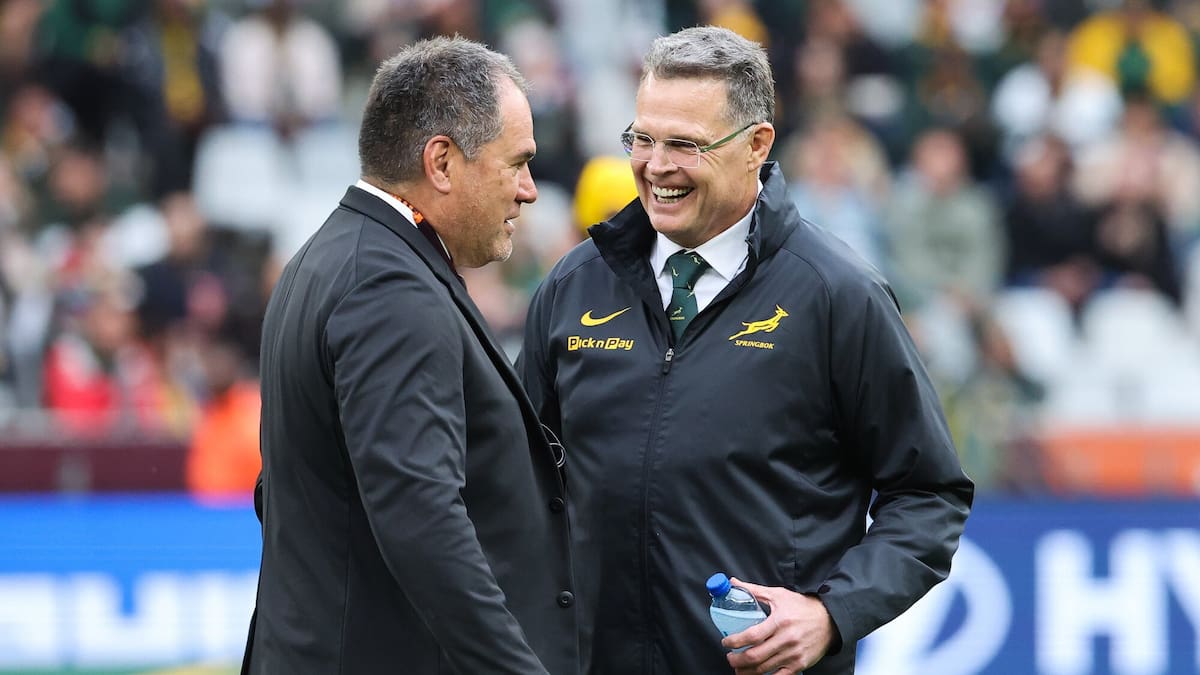
Coaches Dave Rennie (left) and Rassie Erasmus. Photo / Photosport
And a tip of the hat to Erasmus, whose line-up-tinkering went right through to match day, when he changed out his entire front row just an hour before kickoff. His machinations worked and this series is now deliciously poised at 1-1, with two more to come, next week at Johannesburg’s FNB Stadium and the finale in Baltimore in a fortnight.
Rassie Erasmus breaks convention
Patrick McKendry, 1news.co.nz
A test which started with an insanely low flyover of Cape Town’s DHL Stadium by two passenger jets finished with the Springboks surviving a turbulent last few minutes to hold off the All Blacks 33-26 for a win which squared the series.
There is sure to be more said and written about the wisdom of flying so low over a stadium filled with more than 56,000 people – a South African rugby tradition which has surely done its dash.
Fortunately, it appeared to go to plan – such that it was – and, likewise, the Boks will believe they are heading in the right direction after a predictable response to their Johannesburg setback last weekend.
After Boks head coach Rassie Erasmus once again broke convention, if not rugby law, by changing his entire front row minutes before the match kicked off, the home side were far better across the field defensively and, unlike at Ellis Park, converted their pressure into points.
They were outscored four tries to three by the All Blacks, who again had the better of the second half, scoreboard-wise, but struck when they had to and never allowed the visitors the lead.