
By Renuka Sadanandan
Art and architecture and varied influences come into play as Ajantha Ranaweera returns with his exhibition Gaman Maliga
View(s):
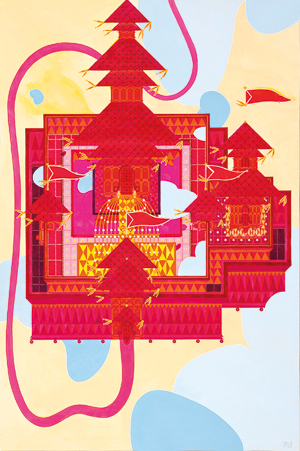
Maligawa in the Sky
Where does one begin? With decolonising knowledge, modern Sri Lankan design, the Rasa theory of aesthetic experience or the Gaman Maliga? Ajantha Ranaweera has thoughts to share on them all as we sit down to talk of his new exhibition.
‘Gaman Maliga’, opened just this week at the Saskia Fernando Gallery on Galle Road, Colombo 3, his first solo exhibition at SFG. Those who have followed his progress will find a more mature artist venturing into a deeper engagement with his subject matter following up in many ways on his two earlier exhibitions: his debut in 2021 ‘The Boy in Paradise’– his own personal experience of loss finding new dimensions of expression in art and ‘The Dance of a Water Garden’ – more political, post-COVID in 2025.
The design foundation that is his training and practice as an architect is clearly visible in the structured lines but there is, as always, in his work, an interplay of the sociopolitical and the metaphysical. Underpinning it all is his fascination with the ‘Rasa theory’ of aesthetic experience – the evoking of unbidden emotion through any art form, be it dance, drama, music or art in the mind of the viewer. First outlined in 2nd Century BC, by the sage Bharata Muni in the Natya Shastra, this Sanskrit treatise further developed over the years by other philosophers and thinkers such as the Kashmiri philosopher Abhinavagupta in the 11th Century has long driven his thought process and propelled his creativity.
It was in the pages of Prof. Gananath Obeyesekere’s book ‘The Doomed King’ released in 2017 that Ajantha came across the ‘gaman maliga’ and grew intrigued by this manifestation of power in Sri Lankan society of yore. Obeyesekere who signed Ajantha’s copy with “more power to your creativity” devotes an entire chapter to the ‘royal circuits’ the King (Sri Vikrama Rajasinha) undertook and the gaman maligas (travelling palaces) that were constructed for this purpose – a vehicle at different times for projecting power, propaganda and even benevolent interactions with his subjects.
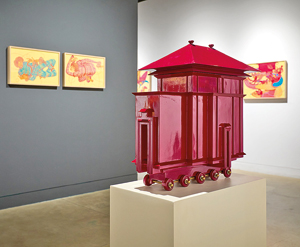
One of the Maligawa installations at the exhibition
There are three installations – ‘maligawas’ at this exhibition which Ajantha spent over a year developing. He initially visualised them in brass but unable to find like-minded craftsmen to execute them to his plan, had to settle for a structure made of wood. The tallest, painted a striking ox-blood red stands a metre high. Inside each is a painting which has to be viewed through the narrow doorway – it is designed to take the imagination into what he envisages could be an infinite space.
He has ambitious plans for the maliga design in other settings seeing endless possibilities to create an experience both within and without. So what we are seeing is just “a small prototype,” he says.
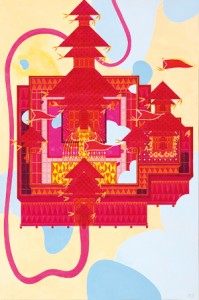
In the paintings on display, the Gaman Maliga is a celestial vehicle – in some a floating castle which transports the ‘boys’ (who figured large in his past exhibitions) to Nandana, the celestial garden. Think Dr. Who’s TARDIS – a time travelling machine, he suggests. The boys are mostly clothed (unlike in the past exhibitions) and there is layer upon layer to decode in the design of their attire and adornment (abararana) which in those days stood for protection, power, identity, status and authority. Drawing from local fabrics, colours radiate in combinations, the brilliant hues of sarees flowing into the frame.
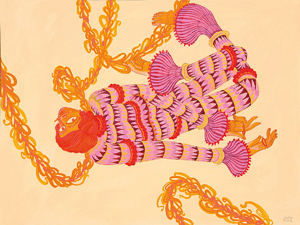
Boy in Nandana
Then there are the gurulas – whimsical glowing creatures again inspired by local mythology which the boys ride and frolic with.
Such are the varied influences that figure in Ajantha’s works, but they all flow from his passion to work around decolonising knowledge and create a distinct identity for modern Sri Lankan design through his art and architecture. Being Sri Lankan and looking within is the path he follows – the way, he firmly believes, to take modern Sri Lankan design to a different plane and stamp its identity on the global scene. The ideas are endless whether from temple murals, architecture, furniture, folklore – all fuelling his vision –contemporary and relevant yet uniquely ours. It’s not about glorifying the past, it’s the growth of a design movement that could encompass many fields and also make sound economic sense, he argues.
With his architect’s mind, he sees few limitations of scale – look at the work of sculptor Anish Kapoor in his designs with Cecil Balmond, he says. His own experiences and association with prominent architects Anjalendran, Philip Weeraratne, Balmond himself, Dan Ameresekere, architect-historian Dr. Shanti Jayewardene and, more recently, designer Asanka de Mel, have been influential.
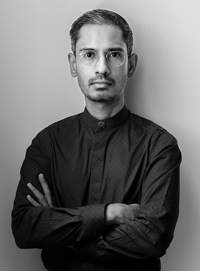
Ajantha Ranaweera
As an artist, it was Shanth Fernando who saw in him that latent spark and opened the door to the Paradise Road Galleries to make his first exhibitions possible. Now it appears he can’t paint fast enough to keep pace with the ideas streaming into his mind.
His creative side is all absorbing, he admits. Unlike popular perception, he sees it not solely a God-given gift but a muscle to be trained, honed and worked on with utmost perseverance to avoid the mire of complacency. And as he opens his notebook – a similar one accompanied him to our first meeting in 2021, the pages crammed with drawings and notes – we glimpse the workings of Ajantha Ranaweera, brimming with detail, precision and grand design.
Ajantha Ranaweera’s Gaman Maliga is on from August 26 to September 15 at the Saskia Fernando Gallery, 138, Galle Road, Colombo 3.
Searching for an ideal partner? Find your soul mate on Hitad.lk, Sri Lanka’s favourite marriage proposals page. With Hitad.lk matrimonial advertisements you have access to thousands of ads from potential suitors who are looking for someone just like you.