

Americans retiring this decade are on track to collect scheduled Social Security benefits totaling 133% of everything they and their employers paid in program taxes, according to a new analysis released Wednesday from the Committee for a Responsible Federal Budget.
Strip out the employer match, and retirees are expected to receive 265% of what they contributed to the system themselves, measured in present-value dollars. The report, which cites data from a 2025 Congressional Budget Office report, found a median-wage retiree in 2027 will collect about $730,000 in lifetime benefits on combined contributions of less than $200,000. Retirees are scheduled to receive all of their contributions, plus interest, plus an additional 33 cents for every $1 they and their employer paid in.
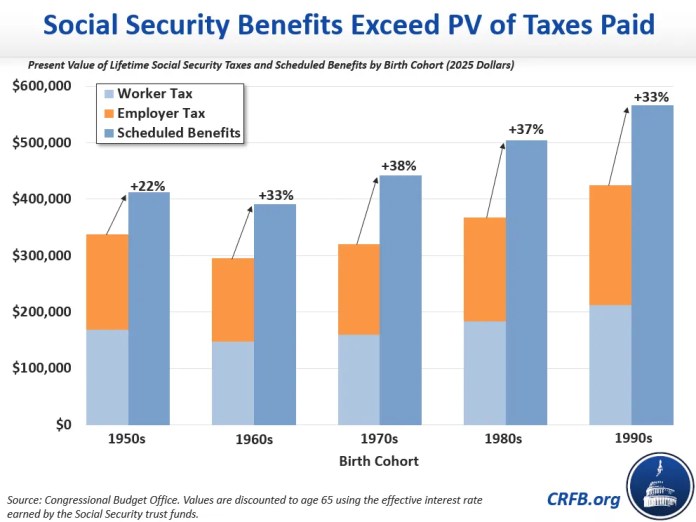 Graphic credit: CRFB
“On a nominal basis, a typical retiree’s scheduled benefits will be almost 4 times as large as total taxes paid and more than 7 times as large as their own taxes paid,” the Wednesday CRFB blog post states.
The analysis also reveals that benefits received outpace total taxes paid after just 6 years of collecting, and outpace the worker’s own direct contributions after only 3 years.
CRFB’s blog post notes that Social Security is currently just 6 years from insolvency, with the trust fund is due to run out in 2032, which would lead to what is currently calculated at an automatic 22% benefit cut absent congressional action to address the issue.
While there is widespread agreement that the issue needs to be tackled, there is no consensus on how to do so.
“One impediment to the enactment of thoughtful solutions is the myth that Social Security benefits directly represent seniors’ hard-earned money that they paid for in full through past payroll tax contributions and thus are entitled to as an unmalleable earned benefit,” CRFB’s blog states. “Although politicians and special interests weaponize this misperception to fight against any changes to the program, it is based on a fundamental misunderstanding of how the program works and of how much it pays out. Fixing the system will require putting this myth to bed.”
The blog notes that Social Security is not structured like a retirement savings account in which workers’ payroll tax contributions are set aside to fund their future benefits. Instead, it operates primarily as a pay-as-you-go social insurance program, with payroll taxes collected from current workers used to pay benefits to current retirees. An individual’s benefits are not directly tied to the amount of payroll taxes paid over a career, but are determined through a formula based on wage history and other factors, including retirement age, years worked and marital status.
That distinction is particularly important as policymakers debate Social Security’s finances. The blog adds that the program’s current benefit formula pays out about 33% more in benefits than workers pay in taxes and, based on the latest Social Security Trustees projections, is expected to cost roughly 35% more than it collects in revenue over the next 75 years. CRFB points out that scheduled benefits therefore exceed both workers’ past contributions and what the program can sustainably finance under current law.
Rather than suggesting current benefits should simply be reduced to match past contributions, CRFB argues that policymakers need to bring Social Security’s future costs and revenues back into balance through changes to benefits, taxes or some combination of the two. With the program facing the projected funding shortfall that could trigger the 22% benefit reduction if Congress fails to act, the organization is urging lawmakers to begin work on trust fund reforms before the financial pressure becomes more immediate.
Report backs up earlier research
A late 2023 Urban Institute report, “Social Security and Medicare Benefits and Taxes: 2023,” also found that lifetime Social Security and Medicare taxes are scheduled to be significantly lower than lifetime Social Security and Medicare benefits for most workers in future decades.
Specifically, the 2023 report found that a single man who earned the average wage ($66,100 in 2023 dollars) every year of his adult life before retiring in 2020 at age 65, would have paid about $466,000 in taxes into the Social Security and Medicare systems, but can expect to receive benefits equal to $640,000—or an additional $174,000—over the course of his retirement.
A single female with average earnings ($66,100 in 2023 dollars) retiring in 2020 at age 65 would pay $466,000 in taxes but is likely collect $722,000 in benefits.
SEE ALSO:
• Social Security Insolvency Could Trigger $500 Average Monthly Benefit Cut by 2032
• 2026 Social Security Trustees Report Moves Insolvency to 2032
• Americans Want Affluent to Foot the Bill for Social Security Fix
• Social Security Taxes vs. Benefits: Americans Take Far More Out Than They Pay In