
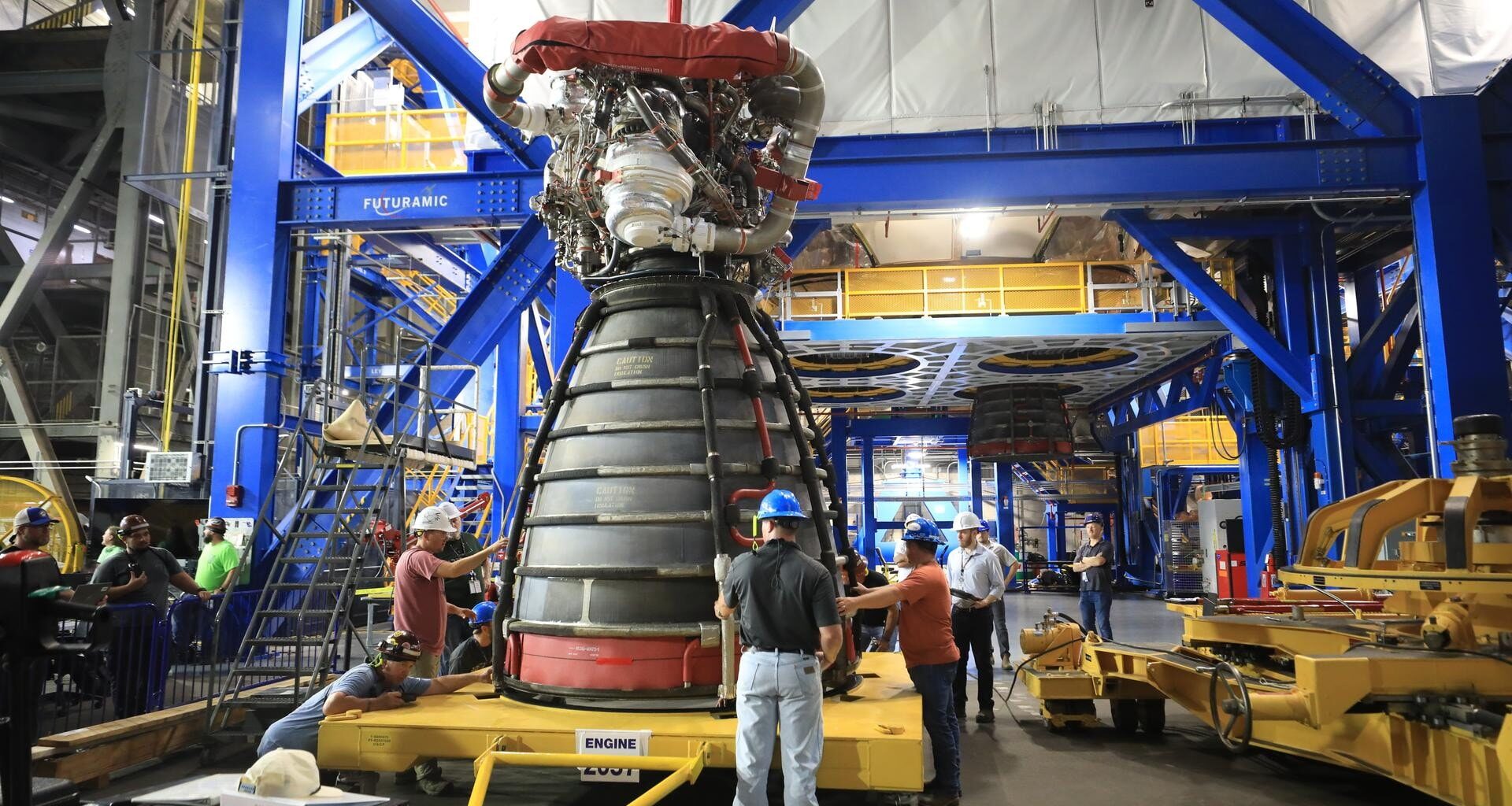
A few months are left until the third mission of the Artemis program, and the second crewed one, will lift off. Not meant to travel to the Moon, but merely to stay in close proximity to Earth to test various technologies needed for the Moon landing, the mission is now in the final stages of preparation. The most recent milestone: the four RS-25 engines of the Space Launch System (SLS) rocket’s core stage are now in the process of being installed.
The RS-25s are the same types of engines that powered the Space Shuttle. Repurposed for the needs of the SLS, each of the four is capable of developing close to 500,000 pounds of thrust, contributing a great deal to the total 8.8 million pounds of thrust needed to get the massive mega rocket off the ground.
Before they can get to do that, though, the engines need to be fitted on the core stage. That’s exactly what’s happening these days at NASA’s Kennedy Space Center in Florida, after the mating of the engine section to the top four-fifths of the SLS core stage earlier this summer.
At the same time, the space agency says teams inside High Bay 2 of the Vehicle Assembly Building (VAB) are busy installing not only the engines themselves, but also the propulsion and electrical systems the stage needs to function properly.

Photo: SpaceX
At launch, the four engines are designed to burn for more than eight minutes, drawing fuel from the stage’s propellant tanks. And they do so with quite the appetite, as they need 1,500 gallons (5,700 liters) each second of the eight minutes to get the job done.
For the needs of the Artemis program, NASA is using both RS-25 engines that have been flown on the Space Shuttle and new ones built after the Shuttle was retired. In the case of the four that will fly the Artemis III mission (serial numbers E2054, E2057, E2048, and E2052), we’re dealing with engines that propelled several previous flights. E2048, for instance, was used on Shuttle Discovery on STS-95 and Shuttle Atlantis during mission STS-129.
As work on fitting the engines is ongoing, NASA’s people are also integrating the twin solid rocket booster motor segments atop the mobile launcher, and they are now about halfway through the process. When it comes to the Orion spacecraft that will house the four astronauts, it recently went through the integration of the crew and service modules, including the umbilical connector, electrical connectors, and fluid lines.
Artemis III will fly four people to space, namely Americans Andre Douglas, Randy Bresnik, and Frank Rubio, and Italian Luca Parmitano. All four, but also their backup, American Bob Hines, are undergoing training that covers Orion systems and operations, science objectives, leadership, and team‑building exercises. Naturally, training with the commercial human landing system, which will be the main objective of the mission, is also covered.
Artemis III was initially supposed to land humans on the surface of the Moon for the first time in more than half of century, but that changed at the beginning of this year, when NASA decided to play it safe – or, more likely, it was pushed to make the decision to restrict the flight to low-Earth orbit as its commercial partners, SpaceX and Blue Origin, are not quite done with their landers.

Photo: Blue Origin
Even so, the mission is described by NASA as one of the most complex it has ever attempted, as it involves the coordinated launch of three different rockets, orbital hookups, and even astronaut transfer from the Orion into one of the landers.
First to launch will be the Blue Moon lander, carried into space by a Blue Origin New Glenn rocket. It will park itself in orbit, awaiting the arrival of the astronauts for up to 30 days. When they arrive, the humans will have to dock along the side of the Blue Moon.
Two of the astronauts, who are yet to be named, will then transfer themselves to the lander, where they will perform all sorts of tests and tasks, targeting system interfaces, software, propulsion, and communications. This is expected to go on for about two days, after which the Orion will detach and make its way to the SpaceX lander.
This one will launch last, on top of the Starship. Unlike the Blue Moon, it’s not fitted with life support systems, so astronauts will not board it. Instead, the Orion will dock to it in a nose-to-nose position , and it’ll stay that way for about a day to run crucial tests.
The Artemis III mission has a planned duration of around two weeks, and at the end, the Orion will go for a splashdown in the Pacific Ocean. Its success is crucial to the Artemis IV mission, which at the time of writing is scheduled to take Americans to the surface of the Moon in 2028.