
This past winter was brutal. By February, it was already going on for too long, and yet the temperature was somehow still dropping. Running outside was nearly impossible, just as running on a treadmill was becoming unbearable, and in the midst of that, after months of dispersed runs, I committed to rebuilding my base to prepare for my first training block of 2026.
Because my fitness wasn’t improving, I started paying close attention to my stats: my heart rate data, my sleep data—and, more specifically, my heart rate variability.
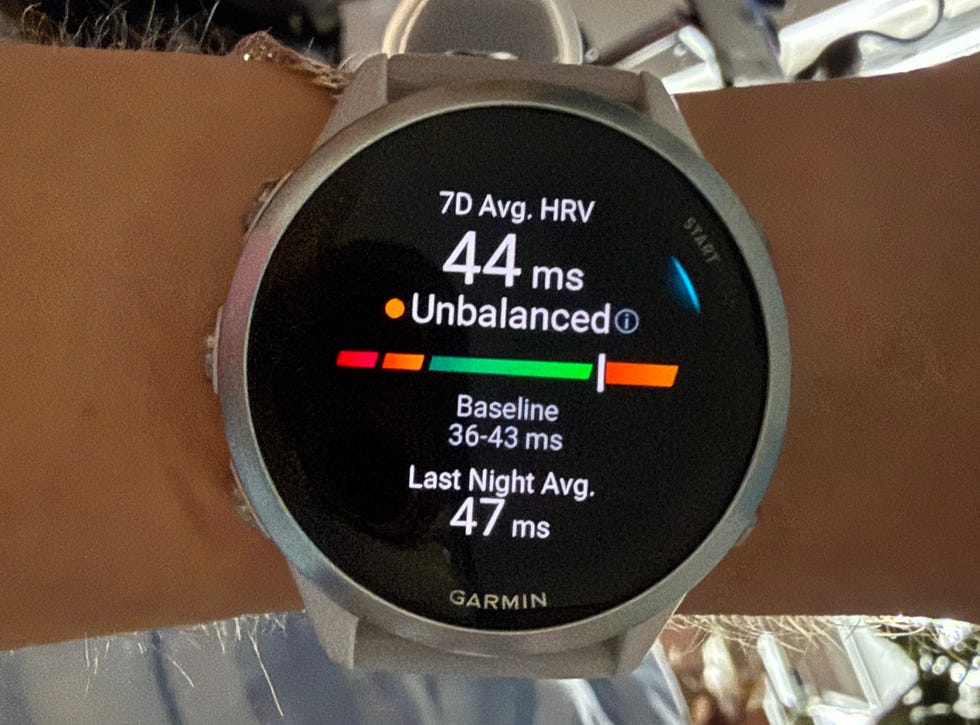
On my Garmin watch, HRV is part of my morning report. Back in February, my score was notoriously unbalanced or outright low, oftentimes below the 34–42 millisecond baseline Garmin established for me. I mentioned it to some coworkers, who shared that their HRV usually hovers around 50; for some men it was even in the 70s. Meanwhile, I was not able to get out of the 30s.
Then, when my HRV stayed around 32 for a stretch of five days, and I was feeling especially crappy, I decided to look more into what exactly this measurement means and if there is a way to improve it.
What Is HRV
HRV measures the amount of time between consecutive heartbeats, and it’s a good indicator for how well your nervous system is balancing stress and recovery. Think of it as your body’s recovery tracker. The normal HRV range for healthy adults is 19–75, according to health.com, and genetics can explain 50 to 60 percent of this difference between individuals. Generally speaking, the higher the number, the better; the lower it is, the more likely you’re stressed, fatigued, or dealing with poor sleep. However, HRV is not only negatively affected by these factors but also by exciting events like getting engaged or a delicious lunch, Harvard Health Publishing states.
How to Measure HRV
The most accurate way to measure HRV is with an electrocardiogram (ECG), but your wearable does a good enough job. Since I wear a Garmin, I reached out to their team to better understand how the manufacturer goes about establishing it. Lead Product Manager Joe Heikes wrote to me that HRV is a very personalized measurement often recalibrated “based on a good chunk of data,” meaning the baseline adjusts in real time. Garmin’s website further specifies that the data is captured in 5-minute windows throughout the night (this metric is best measured during true rest), and the software requires a 3-week calibration period to determine your normal range; then it recalibrates based on 7-day rolling averages against your personal baseline.
You should ideally measure your baseline during low-stress periods like base training, the weeks of recovery postrace, or any other stretch of time where you’re not meticulously increasing intensity, says Tamanna Singh, MD, director of the Sports Cardiology Center and cofounder of the Women’s Integrated Sports and Exercise Care Center at the Cleveland Clinic. During these periods, your sleep, nutrition, and recovery should remain relatively even, which results in a solid reference point. Then, when you start building intensity and mileage during a training cycle, you can analyze significant fluctuations in HRV to determine if you need to make any adjustments to your routine.
When to Worry About HRV
First, you have to distinguish whether you’re having a bad night or a bad training block. “An isolated data point is not particularly helpful because so many things go into your day-to-day,” Singh says. A reason for concern, she adds, would be if the metrics were consistently off for a week or two. “That would be a point where I’d say, let me assess my sleep, my nutrition and hydration, my stress levels, even my training. Am I overtraining? Am I overreaching? Am I inadequately recovering?” Among the reasons for a decline in HRV could be, for example, alcohol consumption.
But since the baseline range is so wide and individual, how do you know if yours is too low or high? “What I usually will counsel my patients on is trusting and learning to communicate with your body,” Singh says. Before you look at the numbers on your wearable, evaluate how you feel. Rested? Energized? Fatigued? Like your skeleton is trying to stage a walkout? Singh recommends tracking your training (this goes for all stats, not just HRV) the old-fashioned way. “Write in a journal, use a training blog, but learn to understand what your body is telling you,” she says. “And if you can lean into that, then you will know something is going on way before your watch or your ring or whatever tech will tell you.” Only then should you look at how the digit on your wearable corresponds with how you feel.
If you’re really worried about your heart—and any related stats—“you’re jacking it up,” Singh says. At that point, “it’s better to get things checked out, either be reassured or undergo more specific testing versus just worrying and not really seeking help.”
The whole winter, but especially in February, I felt scatterbrained, forgetful, and unfocused. I’d feel completely overwhelmed by my to-do list and overcome by waves of sadness out of nowhere, unable to deal with my emotions. At the end of the day, I’d have a hard time falling asleep despite feeling exhausted and then wake up in the middle of the night and not be able to fall back asleep. My crappy HRV was in line with my crappy state. Although I couldn’t quite figure out where it was coming from while I was in the thick of it, I knew I wasn’t doing well, and to give myself a specific, measurable goal to work toward, I decided to focus on improving my HRV.
How to Improve HRV
Lifestyle plays a major role in your HRV, and these are some of the biggest culprits.
Stress: Of course, there is nothing better than being told not to stress when you’re stressed. Which is why having a toolkit of habits that help you relax is so important. My number one active solution is, unsurprisingly, running, but I can only do so much of it, therefore I also have a few non-active ones.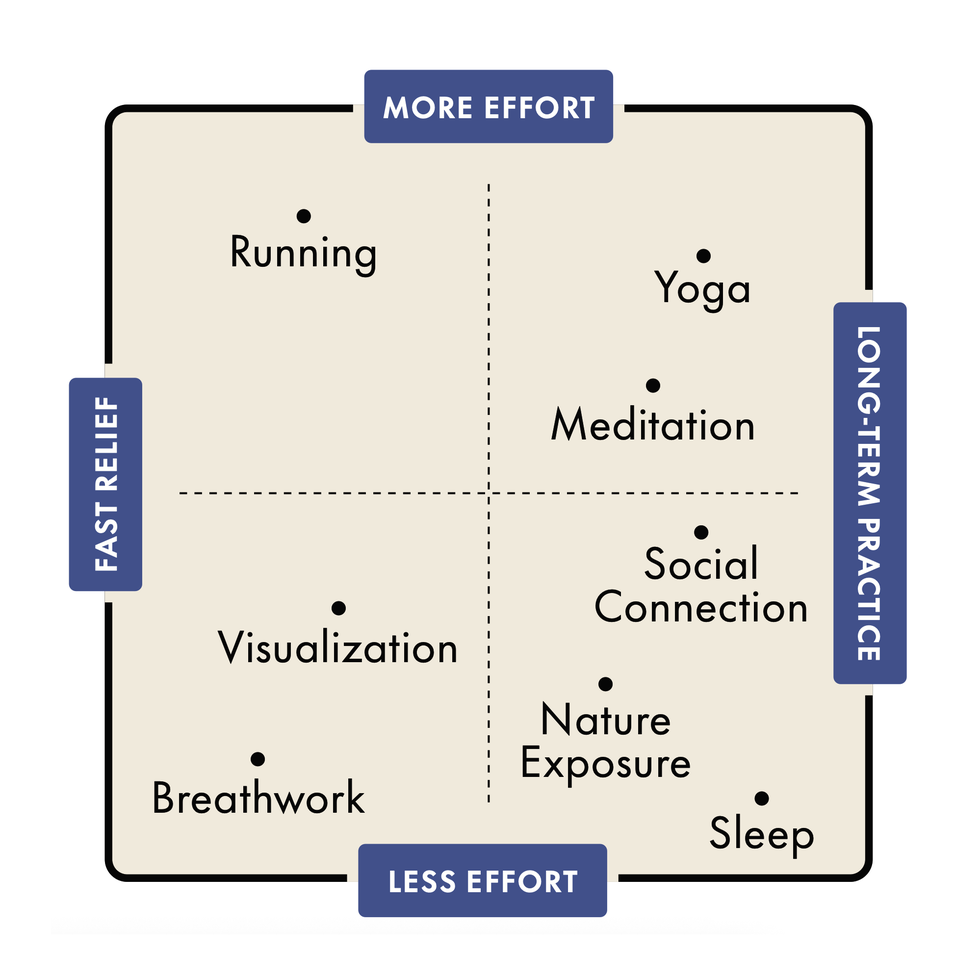 Dehydration: It triggers physical and physiological stress on the body by forcing organs to work harder. When it comes to the heart, dehydration reduces blood volume and increases blood thickness, which makes it beat faster and pump harder to circulate oxygen, according to the Cleveland Clinic.Lack of Rest: Illness, chronic under-recovery, or consistently high training loads can plummet HRV for up to weeks. “The harder your body has to work to deal with that impact, the more likely your HRV will be impacted for a longer period of time,” Singh says. While temporary dips can just be part of living life, sustained downward trends are signals worth paying attention to, so you can reevaluate your training load. Overtraining leads to underperformance, and it’s not worth it.Not Enough Sleep: A 2025 systematic review published in the journal Frontiers in Neurology suggests that poor sleep can lower HRV by activating the body’s fight-or-flight stress system and reducing parasympathetic (rest-and-digest) recovery. The more you train, the more sleep you need. It can be challenging to switch up your sleep schedule and get into a healthier routine, but you should really try to get the recommended 7 to 9 hours per night (from there, you should test how much sleep you specifically actually need). On top of that, as a general rule, Runner’s World recommends adding one minute of sleep for every mile you run per week. Start small; go to bed a few minutes earlier every day, to adjust to the new schedule. Your body will thank you.Bottom Line
Working on increasing my HRV was definitely a weeks-long project, but it gave my analytical mind a measurable outcome to evaluate if I am actually doing better. I saw small improvements here and there, but then, in May, I took a two-week vacation home to the Czech Republic. After my second night there, once I settled the worst of the jet lag, my Garmin told me my HRV was unbalanced again, but this time, in the opposite direction. At 47, it was too high. I am always more relaxed at my parents’ house, where I don’t have to worry about, quite honestly, anything. But I also allowed my body to get as much sleep as it needed each night for the whole two weeks. From there, my HRV started to increase, and my baseline slowly adjusted.
Now looking back, I understand better that throughout winter, I was definitely overtraining, under-recovering, not sleeping enough to bridge the gap—and then stressing about all of it. I’ve started noting how much sleep I need to feel at my best, and for me, it needs to be more than 8 hours, ideally about 8:20; more when I am reaching the peak of my training.
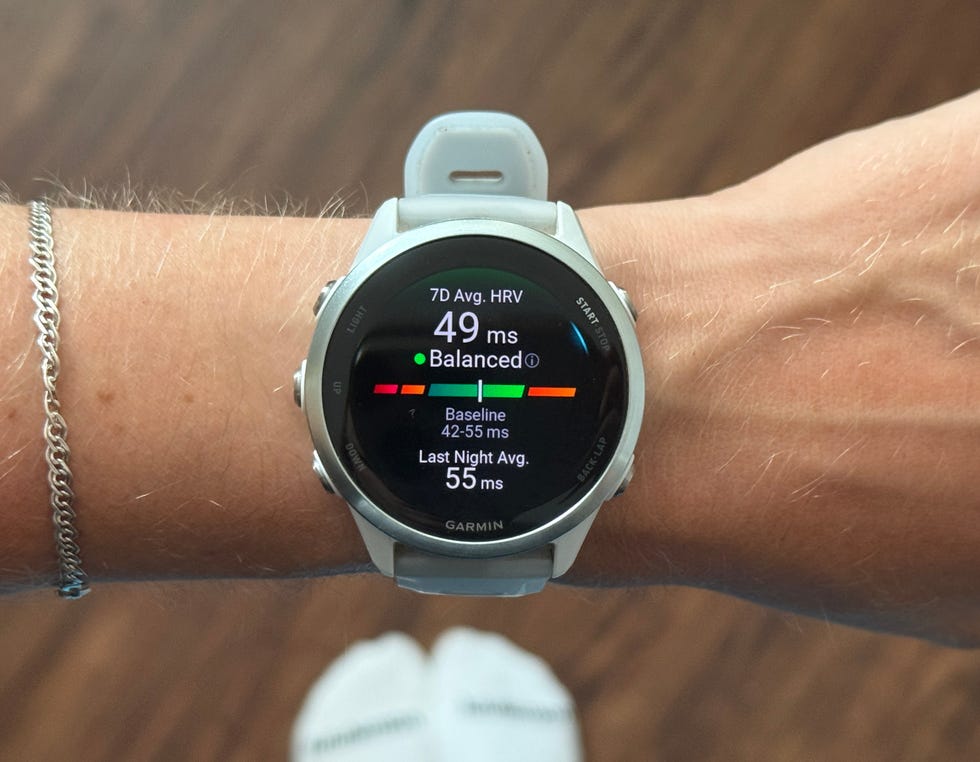
My baseline now starts where it used to end, sitting at 42–55 instead of 34–42, with my HRV hovering in the high 40s most nights, which seems more true and in line with how I feel at my best. May was also when I started training for the SeaWheeze Half Marathon, and I’ve had the best training block to date, which culminated in my PR in the distance.
Every so often, I’d see a lower number in my morning report, which I know to dismiss as just having a day—and if I see my numbers plummet a few times in a row, I know to do a hard reboot on rest and recovery.

Pavlína Černá, an RRCA-certified run coach and cycling enthusiast, has been with Runner’s World, Bicycling, and Popular Mechanics since August 2021. When she doesn’t edit, she writes; when she doesn’t write, she reads or translates. In whatever time she has left, you can find her outside running, riding, or roller-skating to the beat of one of the many audiobooks on her TBL list.