
Luxon also addressed National’s pledge to lower student loan repayments for graduates who stay in New Zealand, saying it was “sending a message [to graduates] that we want to make life easier for you”.
“We’ve got some momentum and you want to be able to encourage young people to say, stay here, there’s no need for you to leave and go off overseas,” he said.
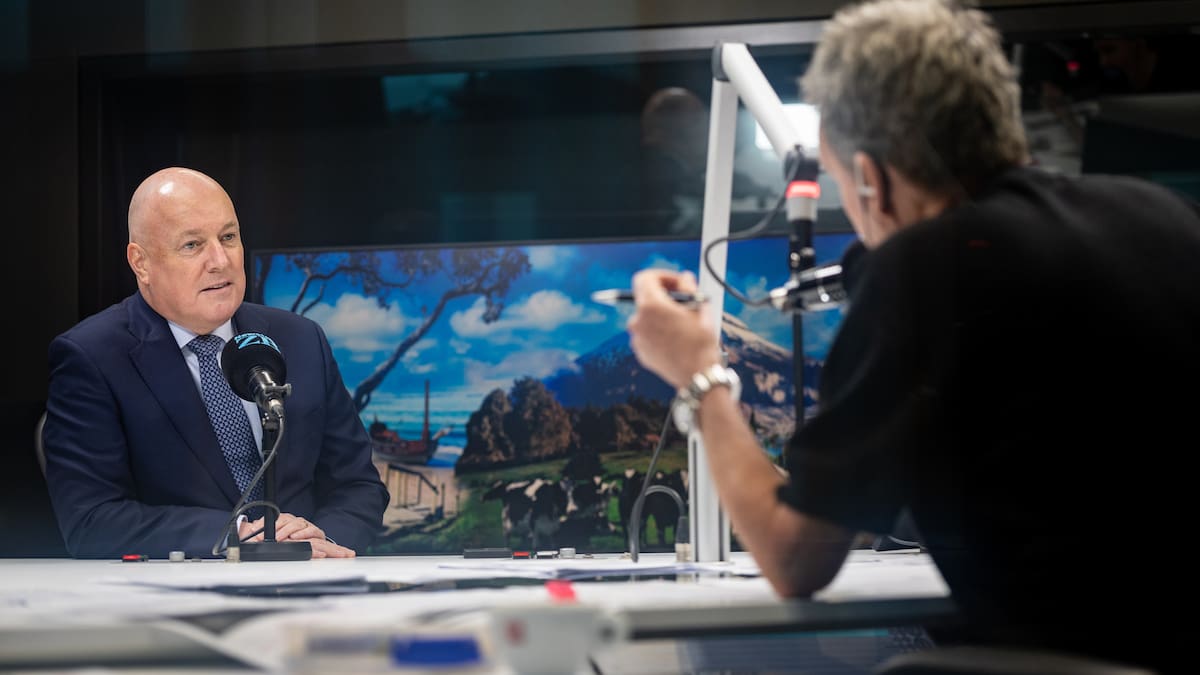
Prime Minister Chris Luxon in studio with Newstalk ZB’s Mike Hosking.
The change in repayments would give people another $1000 in their pocket each year, which over 8-10 years was “a good chunk of a deposit for a house or starting up for a family”.
On the flip side, overseas debt collections on student loans had increased about 28% per year in the past two years, he said.
“Frankly, it’s just not right that we have a heavily subsidised tertiary education system, you take the benefit of that, you go off and decide you’re going to give your effort to another economy and then you’re not going to pay your debt.”
The carrot-and-stick approach would cut compulsory repayments from 12c on the dollar to 10c for graduates who stayed put, while those moving overseas would face higher interest rates and harsher penalties for defaulting.
National’s finance spokeswoman Nicola Willis said on Saturday that the cut in repayments, which apply to every dollar earned above $24,128, would keep talented young graduates in New Zealand and penalise those who left and refused to pay their loan back.
Annual interest rates on overseas-based balances would increase 1 percentage point to 5.6% under National’s plan, with added penalties for sustained default on top of existing late-payment interest rates.
Responding to the announcement, Labour’s tertiary spokesman, Shanan Halbert, said while any loan relief was welcome, National should be judged on its whole record, including raising the repayment rate from 10% to 12% in 2012.
“Of course people should repay what they owe. But the bigger question is why so many young New Zealanders are struggling to get ahead and choosing to build their futures overseas.”
Auckland University vice-chancellor Nic Smith told Hosking this morning that those changes would be “a small step in the right direction” but there was much more to do, including expanding research and development.
“If we can’t retain our young and our talented … then we’re going to end up 10 or 20 years down the track in a real problem. So we’ve got to turn this around,” he said.
“It’s being able to say I’ve got a career that’s going to be exciting, I’m going to be part of a dynamic economy, I’m going to be able to respond to the kinds of opportunities we’re seeing as technology comes across the horizon.”
Luxon with National’s (from left) Greg Fleming, Nicola Willis, Simon Watts, Mahesh Muralidhar, and Penny Simmonds at Rocket Lab yesterday. Photo / Sylvie Whinray
Labour also released new policy on the weekend, promising to reform retirement village repayments if elected. Its plan would require villages to repay residents or their estates within three months if they leave the facilities.
Law changes to be introduced by the current Government will require villages to pay the money back within 12 months.
National has also teased a “surprise” new policy on retirement villages, with Luxon telling a recent public meeting that residents often had “quite punitive settings” for their units.
At the weekend, the Act Party promised to introduce a new fisheries management area in the Hauraki Gulf if re-elected, as well as bringing in new limits on shellfish gathering and banning scallop-dredging in areas that are under pressure.
Today is also the deadline for the Government to formally decide whether to delay next year’s 12c fuel tax hike, and an equivalent increase in road user charges.
Willis last week said the Government would not raise the tax in January, but the decision needed to be formalised.
The topic is on today’s Cabinet meeting agenda.