
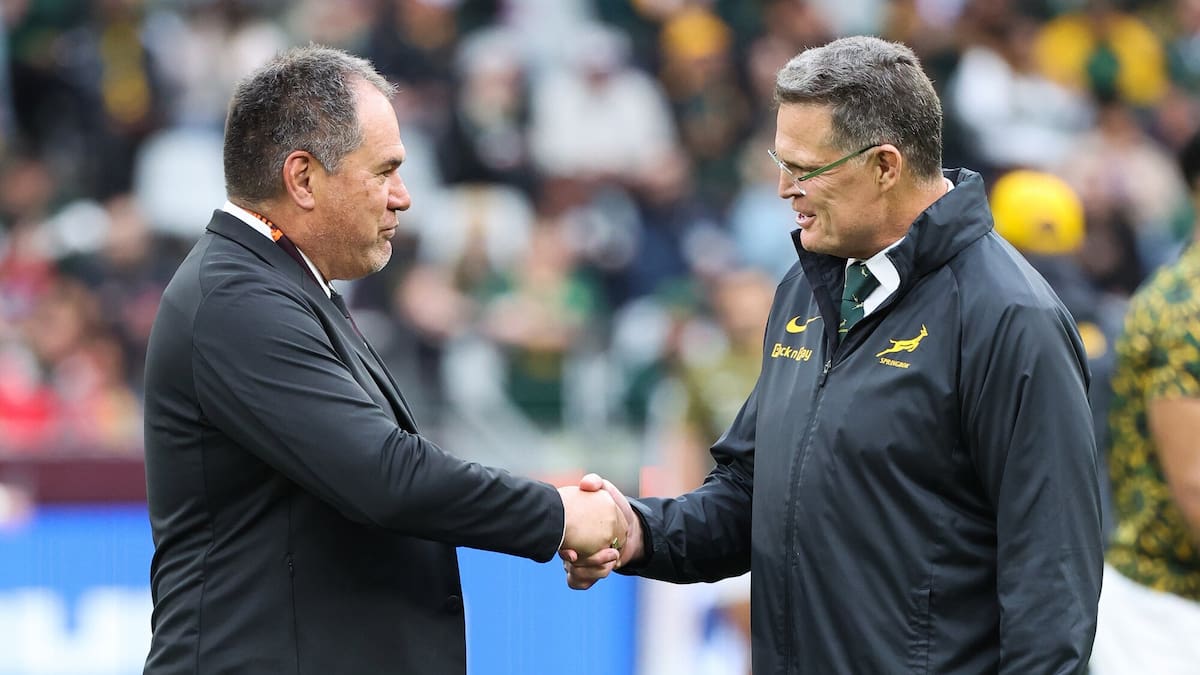
At a World Cup, which is governed by World Rugby, Erasmus would run foul of tournament rules.
World Rugby regulations state that teams can only make changes to their line-ups within 48 hours before a test for genuine medical reasons.
The rules stipulate: “48 hours prior to the kickoff of an international match the participating unions must announce and exchange a list of the 15 players who will start the match and up to eight replacements/substitutions.”
The Rugby’s Greatest Rivalry series is, however, a joint venture between the New Zealand and South African rugby unions. The series has no ties to the Rugby Championship, either, which sidelines any Sanzaar rules that govern that tournament.
This caveat effectively allows Erasmus to exploit the grey areas, and live by his own rules.
The All Blacks gather to face the Springboks in the second test in Cape Town. Photo / SmartFrame
All Blacks coach Dave Rennie brushed off Erasmus’ switching players tactics.
“We stuck with the team we named. It doesn’t worry me at all,” Rennie said. “They named theirs on Monday. It had no bearing on the team we named, so no drama from my perspective. Regardless of who they name on Monday, the game plan is going to be similar.”
In Cape Town, Erasmus’ ploy wasn’t overly influential. He injected prop Ox Nche and hooker Malcolm Marx, who were originally slated to start the match, just before half-time as the Springboks prepared to pack down a scrum 5m out from the All Blacks line.
The Boks won the resulting scrum, with Nche earning a penalty against Tyrel Lomax. They put down another scrum, and Boks captain Siya Kolisi scored.
Otherwise, though, the All Blacks scrum largely held firm to negate Erasmus’ late foxing.
The scrum battle again erupted into a war of words after the Boks’ 33-26 second test victory as Erasmus took great exception to claims that his front row, Nche in particular, is using illegal tactics to take the scrum off centre, walk around and target tighthead prop Lomax.
Erasmus’ agitated rant hasn’t deterred the All Blacks from holding firm on their views, though, with scrum coach Jason Ryan maintaining their position.
“It’s a bit of friendly fire, isn’t it? There’s been some interesting comments made in the media but that’s the pressure of test footy and that’s what it’s about in a way,” Ryan said.
“The direction World Rugby want is really clear – you’ve got to scrum square and not step left. That’s what we’ve been working on. We’ve had some rewards for that, and some we haven’t. We’ll keep focusing on what we need to do to keep square.
“We’ve got to concentrate on what we need to get better on. Second tests are always that little bit harder. Everyone knows that bit more about each other. They probably found out a couple more things about us and got the right end of the score.”
As for the late changes, Ryan echoed Rennie’s views.
“I’m not sure if it’s dirty pool. Traditionally, when we’ve played South Africa, if a team is named at the start of the week it often changes. We’ve got to prepare the best we can for who might be there and who might not be.
“The example with the front row boys: they kept the same ones, they just reversed them with starting and finishing. We’d prepared either way round. That’s up to them how they want to do that.”
Unlike the first test, where the Boks savoured supreme dominance for 50 minutes, the scrums were largely a non-factor in the second test result. On this occasion, the All Blacks’ shaky lineout proved much more problematic.
As this series sits outside World Rugby’s official jurisdiction, though, more Erasmus antics are certain.
Liam Napier is a Senior Sports Journalist and Rugby Correspondent for the New Zealand Herald. He is a co-host of the Rugby Direct podcast.
Listen to Elliott Smith’s live commentary on Newstalk ZB Sport and iHeartRadio, or join the Alternative Commentary Collective on iHeartRadio and Radio Hauraki.