
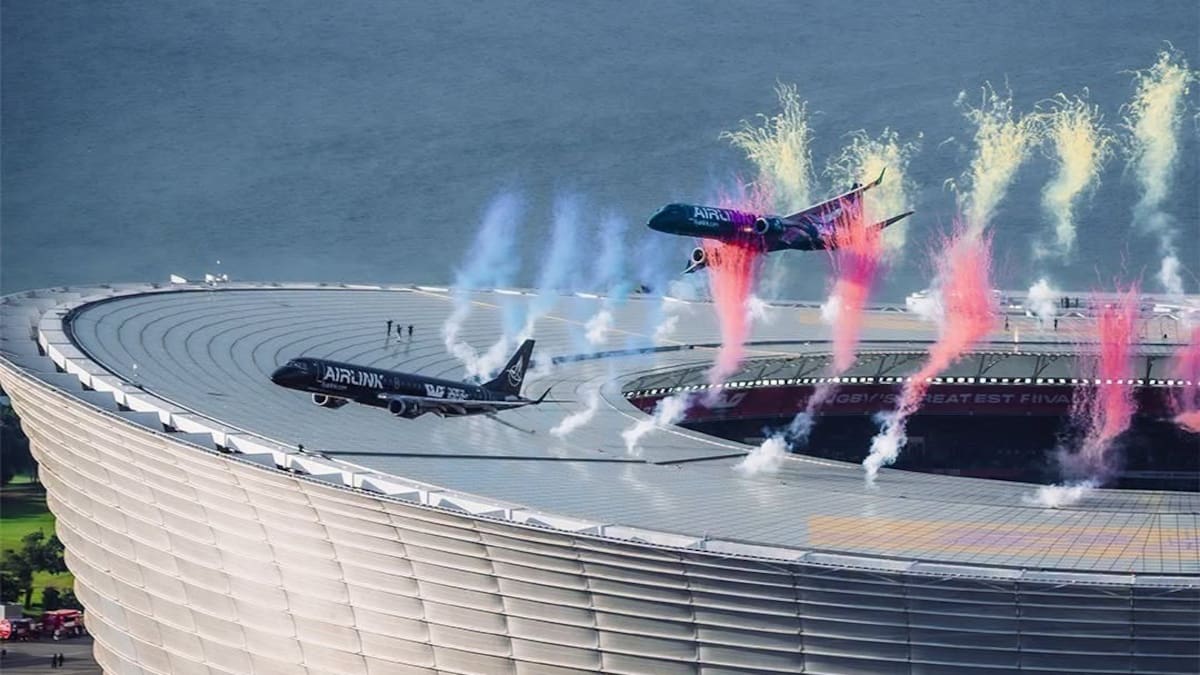
The flyover has led to a polarised debate about the safety margins involved and whether they were breached.
The airline, Airlink, has insisted that the flyover met safety standards and protocols agreed earlier with South African aviation officials.
But in an updated statement overnight, Airlink said it had now voluntarily offered flight data to the SACAA.
“Airlink, on its own initiative, has volunteered these data sets to the South African Civil Aviation Authority (SACAA) so it can independently review and verify that the flypast was in accordance with the flight authorisation,” according to a statement issued by spokesman Linden Birns.
The jets’ “black boxes” will have recorded critical data such as speed and altitude.
Birns told South African news website IOL that the airline would not comment further at this stage.
“While Airlink appreciates the interest and concern, it will refrain from making any further comments while the SACAA reviews the flight data.”
A SACAA spokesman told the NZ Herald that a media statement would be issued in “due course” and once “all processes are complete”.
Some observers have praised the pilots’ skills, calling it a classic example of precision flying, while others believe they were a hair’s breadth away from an unfathomable disaster.
“[The] safety margins in this stunt were insufficient. The aircraft were too low,” New Zealand pilot Vaughn Davis wrote on social media.
“Paradoxically, the crowd will have had a better view and seen the aircraft for longer if they’d been higher.
“Despite the airline’s statement, this won’t have been the planned and authorised altitude. If there’s a flyover at the next match, see if it’s as low.”
Davis is a former Air Force Hercules pilot who holds an Air Transport Pilot’s Licence, C and D category instructor ratings, instrument rating, low level aerobatic rating, and a formation lead qualification.
Airlink’s comments
In an earlier statement, Airlink noted “the concerns expressed in various social media and online forums regarding yesterday’s formation flyby over Cape Town’s DHL Stadium”.
“The flight demanded careful planning and rehearsal, as it required navigating at low altitude, at around 150 knots [278km/h],” Airlink said.
“The South African Civil Aviation Authority and Air Traffic Navigation Services provided valuable guidance, approval and support to ensure a safe flyby.
“The two aircraft were flown by highly experienced crew, with each comprised of three senior captains operating in the roles of commander, co-pilot and safety/technical officer.
“The flight data recorded by both aircraft confirms that the flights were performed within the SACAA’s approved and rehearsed safety altitude and speed limits for the flypast.”
One of the two Airlink aircraft involved in the flyover in Cape Town was struck by pyrotechnics.
In a statement, a NZ Rugby spokesman acknowledged the flyover tradition but did not say whether the All Blacks would seek any future assurances.
“Flyovers before test matches in South Africa are a long-standing tradition that fans look forward to, including the two aircraft that flew at low altitude over Cape Town Stadium ahead of the match against South Africa,” he said.
“NZR is aware that flyovers will take place prior to matches. These flyovers are organised locally and are not something NZR arranges or has oversight of.
“NZR is not involved in the operational detail of these particular flights, or in the local civil aviation rules and approval processes that govern them.”
The rules
A flyover during the All Blacks v South Africa second test match in Cape Town has sparked a safety debate. Photo / action press
South African aviation officials would have had to give special dispensation for the flyover – the country’s flight safety rules say no aircraft should be flown over built-up areas or over an open-air assembly of people below 1000ft (304m).
Davis told the Herald that minimum safe heights for visual flying over built-up areas were set out in each country’s civil aviation rules.
“In New Zealand, for example, aircraft need to be 1000 feet above and 600 metres away from cities, crowds and so on. That said, aviation events such as air shows and planned flyovers can be authorised to fly closer and lower if safety margins are in place.”
Vaughn Davis (left) in his 1953 DHC-1 Chipmunk plane — with former RAF pilot Bill Macleod in 2025. Photo / Mike Tweed
But he also added: “There’s a saying in aviation that ‘you can’t break the record for low flying – you can only equal it’.”
The NZ CAA responds
New Zealand’s CAA said it would not be appropriate for it to comment on the Cape Town flyover as it was “subject to South African aviation requirements and oversight”.
“In New Zealand, Civil Aviation Rule 91.311 requires an aircraft flying under visual flight rules over a congested area of a city, town or settlement, or an open-air assembly of people, to remain at least 1000 feet above the surface or any obstacle within a horizontal radius of 600 metres,” a CAA spokeswoman said.
“Different minimum-height provisions apply in other areas, and there are specified exceptions.
“There are separate provisions for aviation events under Rule 91.703. Where an aviation event requires authorisation from the director of Civil Aviation, the organiser must provide an event plan covering matters including the flying programme, the site, spectator safety controls and emergency services.”
Editor-at-Large Shayne Currie is one of New Zealand’s most experienced senior journalists and media leaders. He has held executive and senior editorial roles at NZME including Managing Editor, NZ Herald Editor and Herald on Sunday Editor and is a former aviation reporter.