
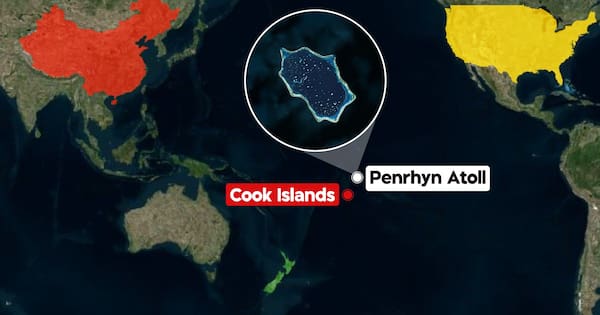
The United States has thrown down the gauntlet in the Pacific revealing it’s to develop a deep sea port on a former military base in the Cook Islands – with New Zealand playing a core role and contributing to the cost.
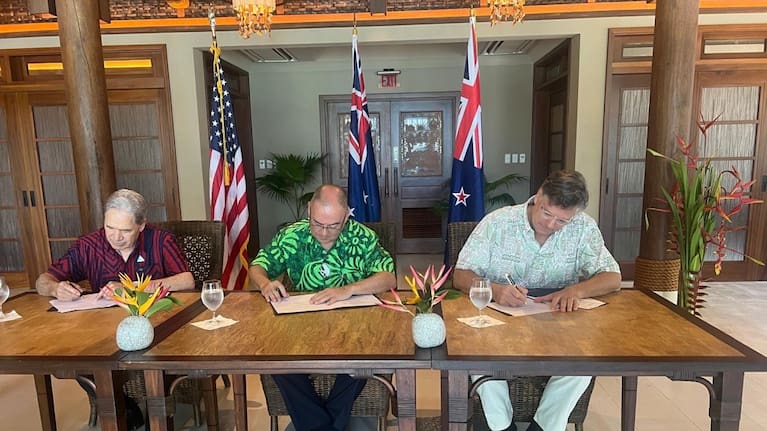
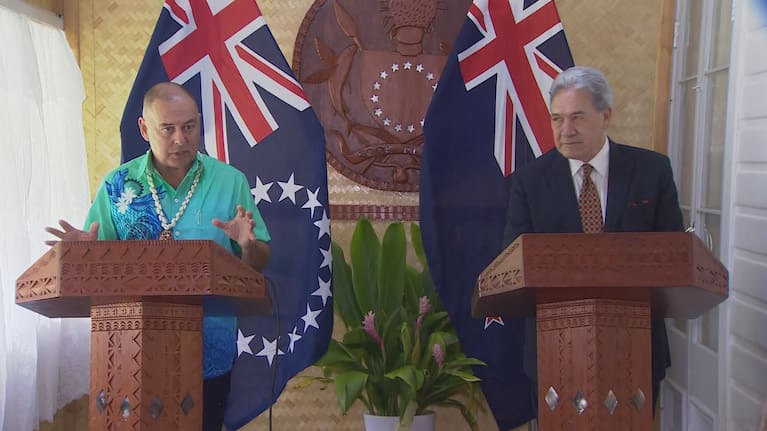
Alongside Cook Islands Prime Minister Mark Brown and New Zealand’s Foreign Minister, US Deputy Secretary of State Christopher Landau has announced the US$60 million (NZ$101 million) port development on the atoll of Penrhyn – once home to a World War II military base.
The move, announced at the Pacific Islands Forum in Palau, comes as geoplitical tensions rise in the Pacific, with the US and China both exerting their influence.
In an exclusive interview with 1News, Peters called the partnership to build the major port a “landmark decision”, describing it as “a seminal moment that we are back in the game looking after our part of the world”.
He said it’s the first time in years that New Zealand has partnered up with the US in such a significant project.
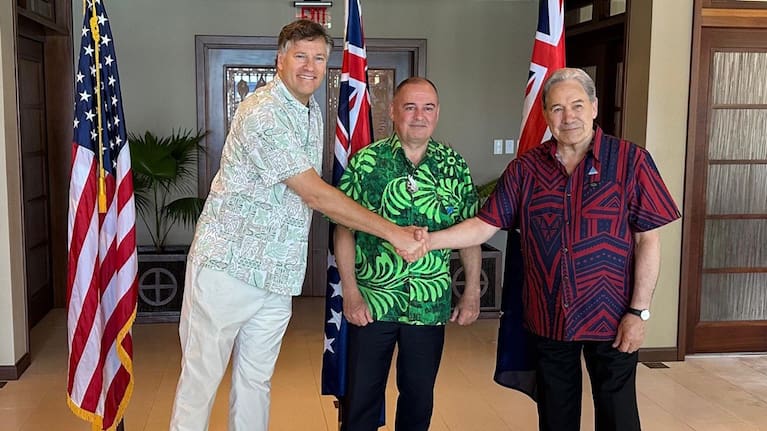
Washington is putting in US$50 million and New Zealand, which will manage the building of the port, US$10 million.
Penrhyn is of strategic interest to the United States because of its location – while it already has military bases on Guam and the Marshall Islands and interests in territory American Samoa, the northern Cook Islands atoll opens access to a different and valuable part of the Pacific.
It is also an international port of entry and its deep lagoon will allow in large vessels.
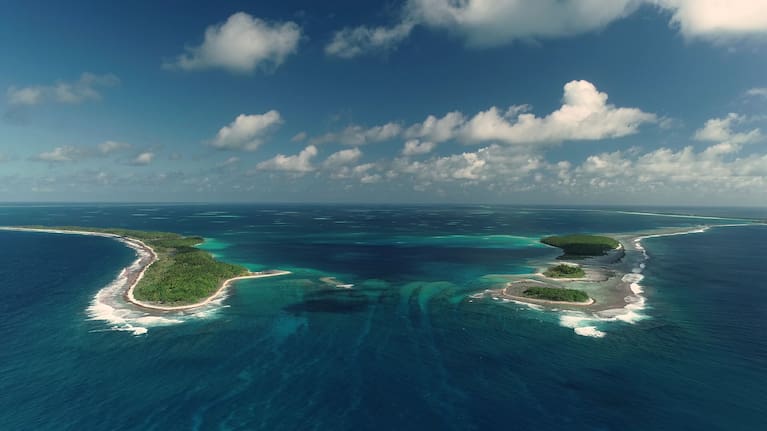
Peters said once the port is built “there will be so many reasons to use it”, including for fishing, transportation and countering transnational crime and the war on drugs.
Penrhyn’s new port will be for the Cook Islands to manage.
Defence role for NZ

But New Zealand is responsible for the defence of the Cook Islands and, according to a recently signed Defence and Security Declaration, NZ’s military has access to the Cooks’ exclusive economic zone to “fulfil defence mandates and uphold shared security commitments”. The port investment could potentially provide military access.
Deputy Secretary Landau says the project underscores the US’ strong commitment to its Pacific partners.
“Through transformational infrastructure initiatives such as this we are making the United States and our partners safer, stronger and more prosperous,” he said.
Cook Islands Prime Minister Mark Brown said the port will be a “lifeline” for Penrhyn, “allowing for safer landings, better access to services and strong connections between our Pa Enua and the world”.
He said it complements the Cook Islands’ own priorities to improve transportation and shipping investments.
Beijing’s view
It is significant the announcement takes place at the Pacific Islands Forum, which has been overshadowed with allegations of foreign interference from China. This new partnership is sure to anger Beijing which had its own designs on the Cook Islands.
Last year the Cook Islands signed a number of secret deals with China, infuriating New Zealand which was not consulted as it is constitutionally required to be on issues of security. But the fractured relationship was healed in April with the shoring up of defence and security, essentially sidelining China.
Last week at a realm country meeting with NZ Prime Minister Christopher Luxon, Cook Islands PM Brown reinforced that, saying: “When the call goes out, the Cook Islands will always respond as we’ve done since World War I when it comes to those sorts of security issues.”
While he doesn’t name China, Peters told 1News the port development is a “lesson I hope for others to take a hard look at what’s going on here as opposed to chequebook diplomacy”.
“What’s going on here is for the advancement of the Cook Islands people. There is a big difference between serious investment in the local interests and chequebook diplomacy for international purposes.”
He said there are those who imagine a benign strategic environment but “we are not living in heaven here we have to face reality”.
“The reality is we have to always be on alert, ever on alert, hopefully never ever having to use your defensive capabilities but that is the purpose of defence so that you never have to use it,” he said.
Rich in resources
Deep sea mining also plays a major role in the US wanting to invest in Penrhyn.
Deputy Secretary Landau said it “builds on the Critical Minerals Framework the United States and the Cook Islands agreed to earlier this year”.
There’s big business involved and battlelines have already been laid down. That business is polymetallic nodules found at the bottom of the ocean, rich in cobalt, nickel, titanium and other critical minerals used for power grids, weapons systems, smartphones and electric batteries.
It’s estimated the Cook Islands has 6.7 billion tonnes of these resources in its 2,000,000 sq km exclusive economic zone and, while there’s currently no commercial mining, three companies have been granted exploration licences.
The Cook Islands people are divided over deep sea mining, with many concerned about potential serious environmental impacts while others are excited about potential economic benefits.
The United States and China have both made no secret they want in on the action –given the scramble for resources and metals tied to economic stability and national security.
Both countries have signed agreements for deep sea mining cooperation with the Cook Islands – China in February last year in a Comprehensive Strategic Partnership, and a few months later the US pledging to advance scientific research and the development of seabed minerals resources.
Penrhyn is well suited to support this and today’s deal catapults the US ahead of the competition in a move that will upset Beijing as it finds itself edged out.
Two weeks ago, Jared Novelly – US Ambassador to New Zealand, Samoa, the Cook Islands and Niue – visited Rarotonga. He told media that seabed exploration in the Cook Islands was at the top of his priority list.
His visit coincided with the return of NOAA (US government agency the National Oceanic and Atmospheric Administration) ship Okeanos Explorer, which had completed a deep sea and mapping expedition.
At a welcome ceremony at Rarotonga’s Avatiu Wharf, Prime Minister Brown – who has described the precious metals as “golden apples” – was clear the economic benefits for the country were worth pursuing.
“Ships are made for the sea and in some ways those sentiments also apply to a people in the nation,” he said. “We can choose to stay safe and not venture out but that is not us, we come from a line of voyagers and navigators.”
Novelly said the NOAA expedition had made one thing clear: “When we combine the Cook Islands’ proud tradition of navigation with modern American scientific tools, we can go farther and deeper together.”
Cook Islanders have, until now, been unaware of a major strategic port being planned for their country or what this means on a domestic, economic and even geopolitical landscape. They are about to find out.