
Previous studies showed that mice lacking the DNA repair protein OGG1 develop weaker muscles. In a new study published in the Journal of Biological Chemistry, researchers found that increasing OGG1 had the opposite effect: mice with more OGG1 ran longer and built endurance more effectively than mice with normal levels.
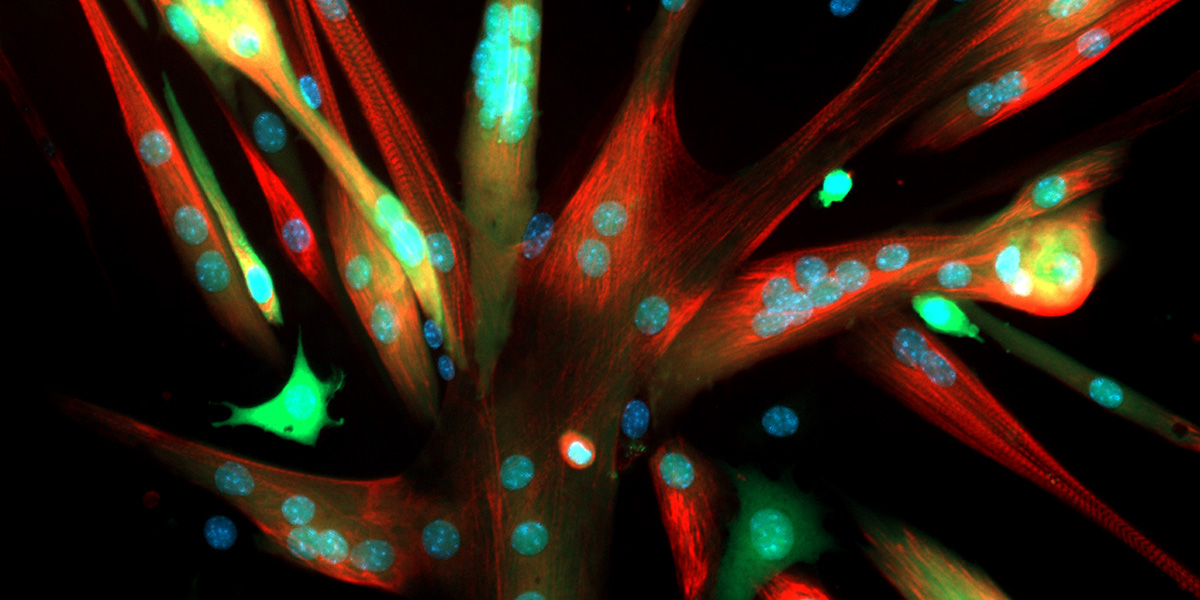
Kevin A. Murach, University of Kentucky, via NIH Flickr
Immunofluorescence microscopy image of muscle cells, showing nuclei in blue and muscle fibers in red.
As people age, muscle strength declines, sometimes progressing to sarcopenia. Because muscle contraction requires large amounts of energy, muscle relies heavily on mitochondria, where reactive oxygen species can damage DNA. OGG1 helps repair this damage, preserving mitochondrial function under metabolic stress.
Mitochondrial DNA damage increases with age, and loss of OGG1 leads to weaker muscles. Bhavya Blaze, first author and graduate student at Rutgers University, wondered whether boosting mitochondrial OGG1 could improve muscle performance in aging mice.
Blaze found that young and middle-aged mice with increased OGG1 ran longer and developed greater endurance than age-matched mice with normal OGG1 levels. Blaze said, “Some mice even ran for up to 1.5 hours.”
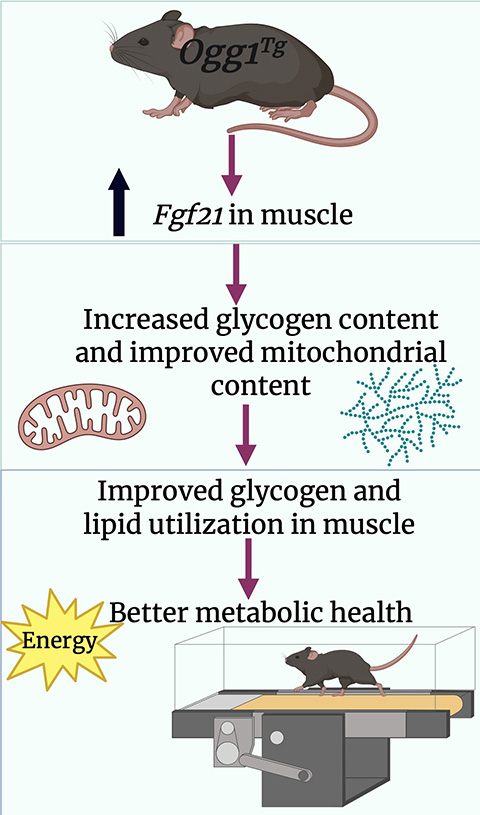
Glycogen is a major fuel source during exercise. Blaze discovered that before exercise, mice with increased OGG1 had more glycogen stored in their calf muscle than normal mice. During exercise, mice with more OGG1 used stored glycogen more efficiently, helping sustain endurance.
Bhavya Blaze
Mice with increased OGG1 and FGF21 optimize energy production in the mitochondria, leading to mice with better metabolic health.
Blaze also examined FGF21, a stress-response hormone involved in metabolism and muscle protection. Muscle tissue from mice with more OGG1 contained more than 1,000 times more FGF21 than tissue from normal mice.
“That was huge,” Blaze said. “The first time, I thought, ‘Okay, did I make a mistake?’ So, I repeated 10–15 different sets of samples, and it was always huge.”
Together, the findings suggest OGG1 and FGF21 help optimize muscle energy production, preserve muscle function and increase endurance.
Because mitochondria produce most of a muscle cell’s energy, Blaze visualized mitochondria using transmission electron microscopy, or TEM. She said the “biggest surprise was that the mice had supernatural mitochondria.”
Mice with more OGG1 had both more and larger mitochondria. These animals showed increased mitochondrial DNA, respiratory components and mitochondrial biogenesis.
Still, more work is required to determine whether these “supernatural mitochondria” produce more energy than normal mitochondria, potentially explaining the mice’s greater endurance.
Although therapeutic applications remain distant, the findings identify OGG1 as a potential target for treating sarcopenia and other forms of age-related muscle decline. This study also reveals an unexpected link between DNA repair and metabolism, warranting further study.
“People always think that DNA repair is relevant only to protect from cancer by fixing cancer-causing mutations,” Blaze said. “But, this paper shows that DNA repair has a much broader role; it actively shapes tissues and cells metabolically.”