
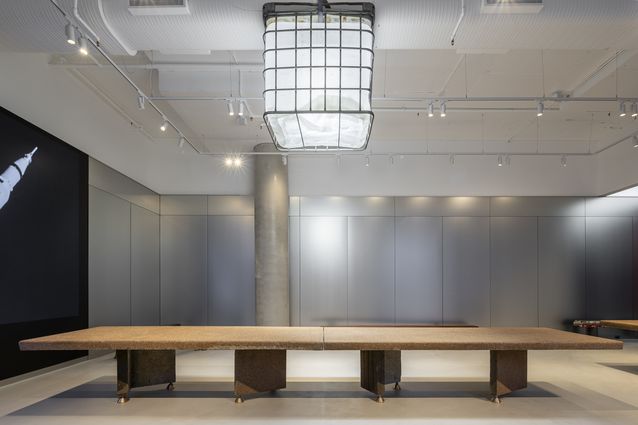
Sydney-based artist and designer Mike Hewson has produced a series of collectible tables and chairs using a rare series of pre-cast panels dating from the late 1960s and rumoured to be part of the Sydney Opera House materials. Hewson is best known for designing surreal, imagination-provoking playspaces that dramatise risk and integrate secondhand materials. Hewson sourced the panels for the recently released furniture collection while gathering material for his major show The Key’s Under the Mat at the Art Gallery of New South Wales. Continuing his approach of repurposing and transforming discarded and abandoned materials from the built environment, these latest works prompt reflection on the histories of materials, architecture and place.
Landscape Australia editor Emily Wong chats with Hewson about the concept behind the collection.
Emily Wong: You’ve called the collection The Opera House Table. What’s the relationship of the materials to the Sydney Opera House exactly?
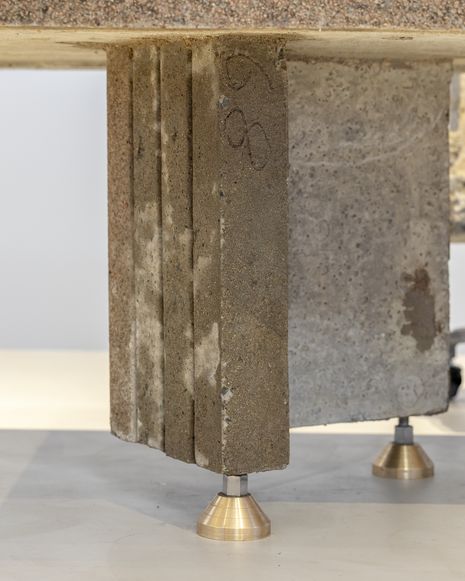
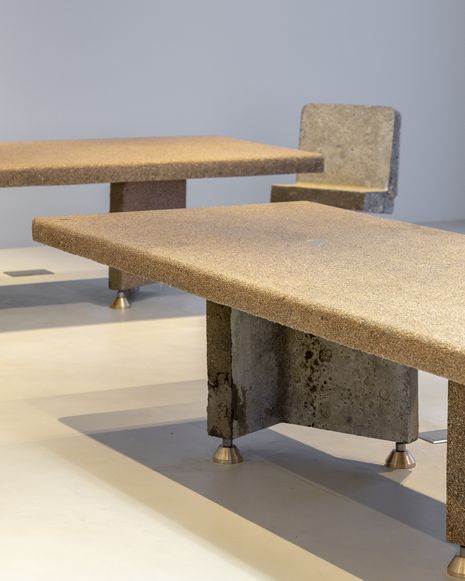
Mike Hewson: The material is not verified Sydney Opera House material, but it’s rumoured to be. They’re pre-cast panels, likely made in central Sydney in the 1960s, that have markings and are very similar to the materials found in the forecourt of the Sydney Opera House. A lot of the panels have the date of when they were poured carved into them. The single table in the exhibition, for instance, has 15 April, 1968 carved into the side.
When the Sydney Opera House was built, I believe everything was poured on site at Circular Quay. There was a concrete batching plant and a pre-cast casting yard and rail-mounted assembly cranes that they used to take the parts out into position, and then, from what I understand, there was an engineer who was involved, in the ‘80s, with the design of the lower concourse space [where the Opera Bar now sits], and so a bunch of panels in the forecourt would have had been removed during that construction work.
EW: The pieces have a distinct gravity to them – they feel serious, solemn, weighty, while also retro-futuristic. How do they relate to their historical context?
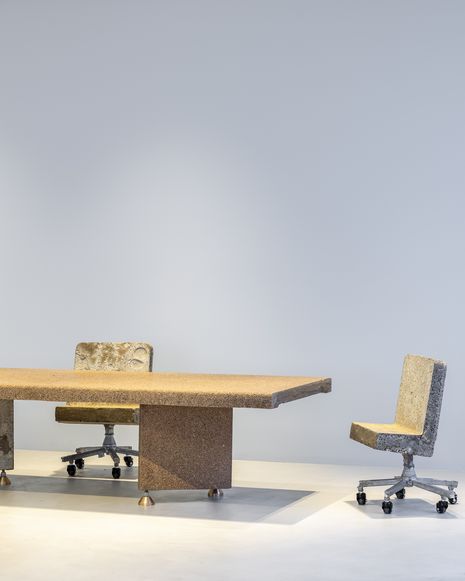
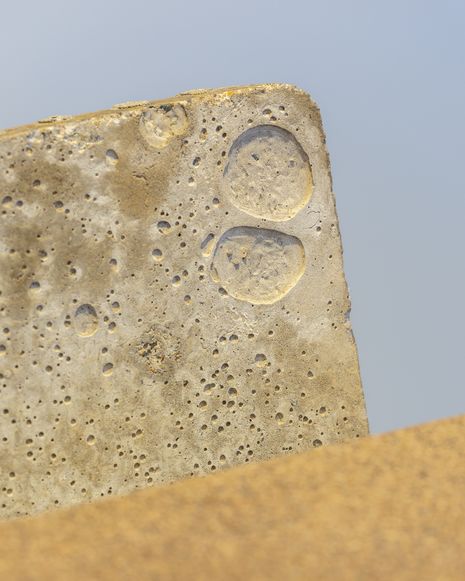
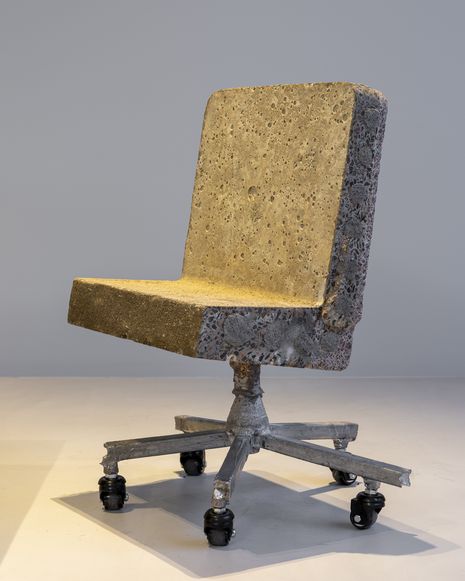
MH: The collection includes a set of chairs made from offcuts of panels that were split down the middle. The underside of the pre-cast panels has a moon-like texture which adds to the feeling like they’re from a different era. The 1960s was the era of the space race, and a very different period to today, and now we are seemingly back in a kind of space race, some 60 years later, with a return to an interest in modernism. The materials feel somewhat ancient and also a little bit post-apocalyptic, so the tables and chairs are maybe a sort of post-apocalyptic future object.
View gallery
EW: You’re an artist moving into furniture design. What’s drawn you to this space?
MH: Collectible design is becoming more and more popular around the world and artists have a long history of attempting to do furniture as sculpture. Designing parks and playgrounds led me to thinking about seating, and then more generally about hospitality needs, which brought me to tables, which then got me thinking more broadly about furniture. The dining table is an anchor object for the home, and something that people can be really particular about. I thought it would be interesting to work with those needs and create a powerful life for the panels, which are quite amazing objects. The panels are 3m x 1.17m, which is almost the perfect proportion for a table, if you have the share plates in the middle and cutlery on either side.
View gallery
View gallery
EW: Working with significant materials feels like a big responsibility – and challenge. How do you do justice to their history and uniqueness?
MH: My approach is about trying to be true to the actual material itself – what life did that material have? What’s happened to it? And, what could be next?
Part of the process is that if something’s not telling you what it is, you just wait until it does. A slightly crude analogy would be like a parent waiting to observe a child’s interests, rather than making them do something. I’m waiting for the material’s implicit curiosities to show themselves, and then I go with that. It can take a long time to get to a move, and sometimes it’s a very simple move, but it’s about going with what the particular qualities of something tells you.
[The panels] are very distinctive. And even if people can’t quite put their finger on where they know them from, they feel familiar. And they anchor this project in the material history of Sydney.
View gallery
With the tables and chairs, I wanted to enable the fullest range of possible uses, so I’ve put marine coatings on the rebars and used stainless steel fixings and bronze feet. So, they can also live outdoors.
EW: You work a lot with second-hand materials, employing strategies of re-use. What appeal do these materials have to you?
MH: Sometimes you come across these historically significant materials that are quite either irregular or difficult to use, difficult to specify into public space easily, so they just end up being left for a long time. It’s hard to give them away because they’re rare, and you also can’t sell them because often governments own them, but they also can’t spec them into projects either.
The pre-cast panels here are very distinctive, very limited and special in their nature. They have their own presence and energy, far beyond anything I could simply make today from scratch. I wanted to use the most minimal strokes to reveal this.
I want the materials to have as cherished a life as possible and furniture seems like a great avenue for that with these everyday domestic, sometimes even public, objects that you sit at, or on, and touch in a very intimate setting can have a much longer appreciated life.
View gallery
EW: What else will you be making with the stash?
MH: I’ve got plans for a couple more tables and am also planning on creating a steam room using the material in the floor of the structure. To build that, I’m using an old wine vat that looks like a little Russian spaceship.
EW: You have a particular skill in integrating seemingly different things – materials, parts – to make coherent objects.
MH: There’s something quite endearing about these objects that kind of push back on you. You touch them and they touch you back. Sometimes the consumer is so dominant that they just get what they want, so it’s nice when objects have a little bit of inconvenience about them, when they’re not fully accommodating but have a personality of their own.
The Opera House Table is showing at Gallery Twenty Twenty until 8 September 2026.
Read Bede Brennan’s review of Mike Hewson’s playground, Rocks on Wheels, here.
Listen to Mike Hewson discuss designing for play in cities, here.