
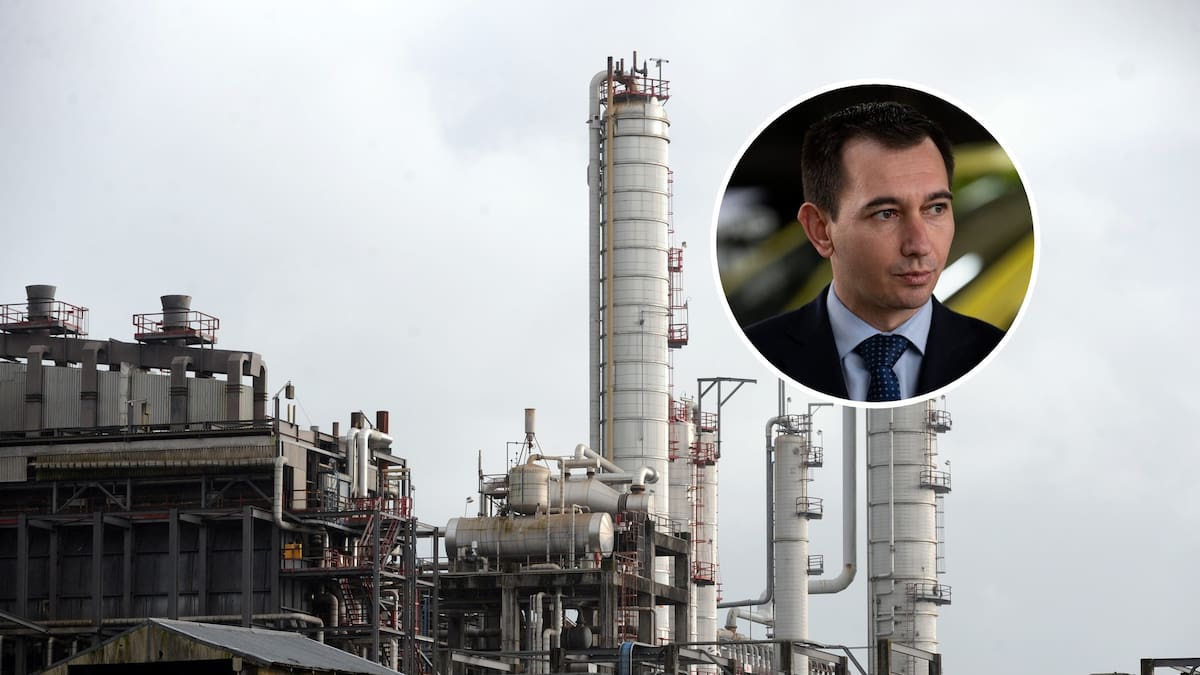
The Government said the new $1 billion import facility to be built in Taranaki could open as early as next year and would save millions of dollars in power bills. Households will have to pay a levy ($2-4 per megawatt-hour), but the Government insists in the long run, they will be better off.
The LNG terminal project is in procurement. If the business case stacked up as “value for money” for taxpayers, it would go ahead, Willis said.
“I am really sorry for the hundreds of people in Taranaki who will be affected by Methanex’s decision today. Each of those workers has a family, a livelihood, a community that is disrupted.”
Methanex consumed about 37% of New Zealand’s gas production and about 95% of its production is exported to customers in the Asia Pacific region.
The company said it had struck a deal to sell substantially all of its New Zealand natural gas contractual entitlements, starting in the first quarter of 2027 and continuing through to the end of the decade when the entitlements expire.
Willis attributed the closure to the “fateful and stupid” decision by Labour to halt oil and gas exploration.
“New Zealand First needs to hold themselves accountable for their role in that decision. That is ultimately the stupid decision that has led to aftershocks in the economy that we are still feeling today and that the workers at the Methanex plant are still experiencing,” she said.
“This is an issue of a gas shortage and ultimately that is outside the Government’s control.”
Green Party co-leader Chlöe Swarbrick said the closure meant New Zealand now had far more gas available, which “fundamentally disrupts” the viability of a proceeding with an LNG terminal.
Green Party co-leaders Chlöe Swarbrick (left) and Marama Davidson pictured in March 2025. Photo / Mark Mitchell
“The Government’s argument for the LNG facility is now absolutely wafer-thin. Economic fundamentals have drastically changed, and any responsible government would go back to the drawing board on a cost benefit scenario.
“What we now know is we have gas supplies that are freed up until the end of the decade so a responsible government would be actively taking steps to actually help industry transition because at the end of the day with gas, we are still ultimately talking about a finite resource.”
Labour leader Chris Hipkins said the Government’s case for the LNG facility “never stacked up”.
“The Government should admit they have got this wrong and not throw potentially billions of dollars at a project that will be a failure.”
Hipkins rejected there was a connection between Labour’s oil and gas ban and the closure of Methanex.
“New Zealand hasn’t had a significant find of new oil and gas for over 20 years. The oil and gas ban didn’t change that reality. It was only in place for a couple of years of that time.
“The oil and gas ban hasn’t been in place under this Government and they still haven’t found more gas. The reality is they spent 20 years looking for gas, drilling holes that didn’t have gas at the bottom of them.”
Energy Minister Simeon Brown said the 37% gas supply that has been freed up with the closure of Methanex would not be enough in the long term to counter the country’s dry years.
Energy Minister Simeon Brown (from left) with RMA Reform Minister Chris Bishop and Prime Minister Christopher Luxon. Photo / Mark Mitchell
He said there was “a significant lack” of back-up energy in New Zealand.
“We need 12PJ [petajoules] over a three-month period to make sure we have the back-up energy that we need, that is why we are procuring an LNG terminal.”
Former Energy Minister Simon Watts said Methanex’s closure was “inevitable” after the ban.
“At some point, it was going to run out.”
Watts was the Energy Minister when the LNG terminal was announced. His portfolios now include revenue, climate change and local government.
“It is simply the sad reality for those individuals working in that sector.”
Julia Gabel is a Wellington-based political reporter. She joined the Herald in 2020 and has most recently focused on data journalism.