
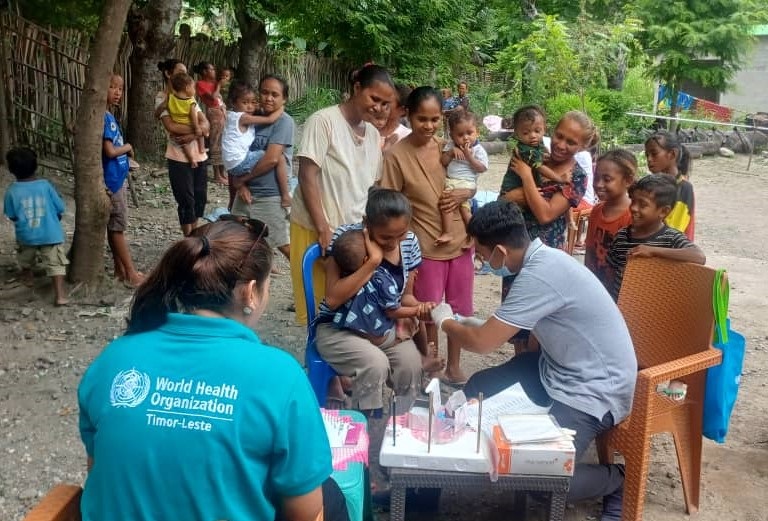
The World Health Organization (WHO) has validated Timor-Leste as having eliminated trachoma as a public health problem. Trachoma is the world’s leading infectious cause of blindness. Timor-Leste was the last country in WHO’s South-East Asia Region with suspected endemic trachoma. With this validation, trachoma has been eliminated as a public health problem throughout the region.
“I congratulate Timor-Leste on this important achievement. By combining sound planning, careful field investigation and modern surveillance, the country has shown how science and strong health systems can protect people from preventable blindness,” said Dr Tedros Adhanom Ghebreyesus, WHO Director-General. “The elimination of trachoma from the South-East Asia Region is a significant step towards our global target of eliminating trachoma worldwide by 2030.”
WHO’s validation follows a rigorous, multi-year process to determine whether trachoma poses a public health problem in the country and to document the health system’s capacity to detect, investigate and manage cases that occur in the future. A series of investigations between 2015 and 2017 examined children on Atauro Island, screened patients attending eye clinics across the country and conducted targeted house-to-house searches. No trachoma was found.
Timor-Leste subsequently generated further evidence through various studies. In a 2025 survey, 4949 samples from children aged 1–5 years were analyzed covering all 13 municipalities. Testing found no evidence of transmission at a level requiring trachoma-specific public health intervention.
“Timor-Leste has once again demonstrated that strong national leadership, high-quality evidence and integrated health services can deliver lasting public health gains,” said Dr Nilesh Buddha, Officer-in-Charge, WHO South-East Asia Regional Office. “The country’s approach also shows the value of integrating surveillance across diseases so that limited resources produce the greatest possible benefit for communities.”
Like other countries validated by WHO, Timor-Leste will maintain capacity to identify and manage individual cases of trichiasis and other eye diseases through its eye care system. Specialized services, including trichiasis surgery, are available through the National Eye Centre at Hospital Nacional Guido Valadares in Dili and outreach to municipalities. Broader national programmes continue to expand access to safe water, sanitation and hygiene. Trachoma surveillance will be integrated within existing national disease and neglected tropical disease surveillance platforms.
“Timor-Leste’s elimination of trachoma as a public health problem, officially validated by WHO, is a source of immense national pride. This achievement was made possible by sustained national commitment and the collective efforts of our health workers, communities and partners, to whom we extend our deepest gratitude,” said Dr Élia A. dos Reis Amaral, SH, Minister of Health, Government of Timor-Leste. “It renews our resolve to advance universal health coverage and build an equitable and resilient health system that reaches and protects every person, wherever they live. We call on the global health community to deepen cooperation and solidarity so that every country and every community can overcome preventable diseases and secure a healthier future for generations to come.”
“Timor-Leste’s validation for the elimination of trachoma as a public health problem is a remarkable achievement and testament to the country’s unwavering commitment to ending preventable diseases,” said Dr Arvind Mathur, WHO Representative to Timor-Leste. “It reflects strong national leadership, dedicated health workers, sustained community engagement, and robust, high-quality integrated surveillance and public health action. WHO is honored to have partnered with the Ministry of Health and people in this journey and will continue to support in sustaining these gains and advancing its inspiring multi-disease elimination agenda.”
The evidence underpinning the validation was generated through the leadership of the Ministry of Health, with support from WHO and eye-health and research partners, including the Royal Australasian College of Surgeons, The Fred Hollows Foundation, Menzies School of Health Research, the London School of Hygiene & Tropical Medicine, the Kirby Institute at UNSW Sydney, Lions Clubs International Foundation and the International Agency for the Prevention of Blindness.
Notes for editors
Trachoma, caused by the bacterium Chlamydia trachomatis, spreads through contact with eye and nasal discharge from infected individuals. Repeated infections can lead to scarring of the inner eyelid, causing the eyelashes to turn inward (trichiasis), which can ultimately result in blindness. The disease is strongly associated with poverty and inequities in access to basic services, including water, sanitation and hygiene and health care, and it remains endemic in some of the world’s most vulnerable communities.
Other countries validated by WHO as having eliminated trachoma as a public health problem are: Algeria, Australia, Benin, Burundi, Cambodia, China, Egypt, El Salvador, Fiji, Gambia, Ghana, India, Iraq, Islamic Republic of Iran, Lao People’s Democratic Republic, Libya, Malawi, Mali, Mauritania, Mexico, Morocco, Myanmar, Nepal, Oman, Pakistan, Papua New Guinea, Saudi Arabia, Senegal, Togo, Tunisia, Vanuatu and Viet Nam.
Timor-Leste is the fourth country in the WHO South-East Asia Region and the 33rd country worldwide to achieve this milestone. WHO validation applies only to countries where trachoma was known or suspected to be a public health problem. The South-East Asia Region’s other Member States have no history of endemic trachoma and were never suspected of it as a public health problem, so they do not require validation. Timor-Leste was the last country in the Region where the disease was suspected, which is why its validation means trachoma is no longer a public health problem anywhere in WHO’s South-East Asia Region.
Neglected tropical diseases such as trachoma are associated with devastating health, social and economic consequences. Their burden is mainly experienced in impoverished communities. Public health targets for the control, elimination and eradication of these conditions were defined in the road map for neglected tropical diseases 2021-2030. As of September 2026, 64 countries have eliminated at least one NTD globally, including eight countries in the WHO South-East Asia Region.