
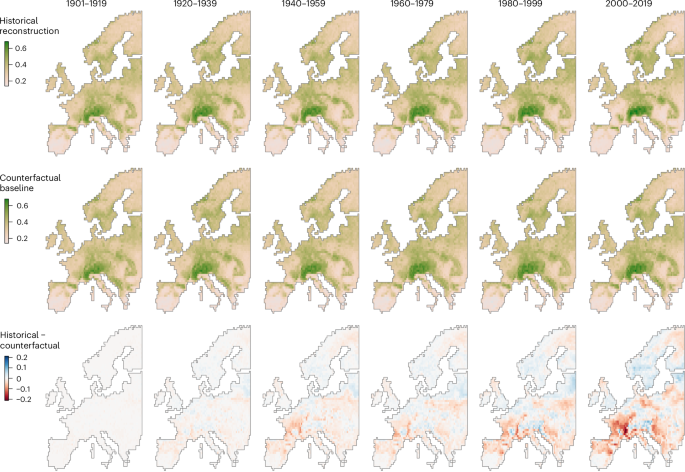
IPBES Global Assessment Report on Biodiversity and Ecosystem Services of the Intergovernmental Science-Policy Platform on Biodiversity and Ecosystem Services (IPBES Secretariat, 2019).
Jaureguiberry, P. et al. The direct drivers of recent global anthropogenic biodiversity loss. Sci. Adv. 8, eabm9982 (2022).
Newbold, T. Future effects of climate and land-use change on terrestrial vertebrate community diversity under different scenarios. Proc. R. Soc. B 285, 20180792 (2018).
Pereira, H. M. et al. Global trends and scenarios for terrestrial biodiversity and ecosystem services from 1900 to 2050. Science 384, 458–465 (2024).
Urban, M. C. Accelerating extinction risk from climate change. Science 348, 571–573 (2015).
Warren, R., Price, J., Graham, E., Forstenhaeusler, N. & VanDerWal, J. The projected effect on insects, vertebrates, and plants of limiting global warming to 1.5 °C rather than 2 °C. Science 360, 791–795 (2018).
Forster, P. M. et al. Indicators of Global Climate Change 2024: annual update of key indicators of the state of the climate system and human influence. Earth Syst. Sci. Data 17, 2641–2680 (2025).
IPCC Climate Change 2023: Synthesis Report Contribution of Working Groups I, II and III to the Sixth Assessment Report of the Intergovernmental Panel on Climate Change (IPCC, 2023).
Burton, C. et al. Global burned area increasingly explained by climate change. Nat. Clim. Change 14, 1186–1192 (2024).
Gudmundsson, L. et al. Globally observed trends in mean and extreme river flow attributed to climate change. Science 371, 1159–1162 (2021).
Lange, S. et al. Projecting exposure to extreme climate impact events across six event categories and three spatial scales. Earth’s Future 8, e2020EF001616 (2020).
Díaz, S. et al. Pervasive human-driven decline of life on Earth points to the need for transformative change. Science 366, eaax3100 (2019).
Pecl, G. T. et al. Biodiversity redistribution under climate change: Impacts on ecosystems and human well-being. Science 355, eaai9214 (2017).
Dangles, O. & Casas, J. Ecosystem services provided by insects for achieving sustainable development goals. Ecosyst. Serv. 35, 109–115 (2019).
John, A. et al. Adapting to climate extremes: Implications for insect populations and sustainable solutions. J. Nat. Conserv. 79, 126602 (2024).
Hallmann, C. A. et al. More than 75 percent decline over 27 years in total flying insect biomass in protected areas. PLoS ONE 12, e0185809 (2017).
Sánchez-Bayo, F. & Wyckhuys, K. A. G. Worldwide decline of the entomofauna: a review of its drivers. Biol. Conserv. 232, 8–27 (2019).
Klein, A.-M. et al. Importance of pollinators in changing landscapes for world crops. Proc. R. Soc. B 274, 303–313 (2007).
Ollerton, J., Winfree, R. & Tarrant, S. How many flowering plants are pollinated by animals? Oikos 120, 321–326 (2011).
O’Neil, B. et al. Key risks across sectors and regions. in Climate Change 2022: Impacts, Adaptation and Vulnerability (eds Pörtner, H.-O. et al.) 2411–2538 https://doi.org/10.1017/9781009325844.025 (Cambridge Univ. Press, 2022).
Mengel, M., Treu, S., Lange, S. & Frieler, K. ATTRICI v1.1 – counterfactual climate for impact attribution. Geosci. Model Dev. 14, 5269–5284 (2021).
Ghisbain, G. Are bumblebees relevant models for understanding wild bee decline? Front Conserv. Sci. 2, 752213 (2021).
Ghisbain, G. et al. Projected decline in European bumblebee populations in the twenty-first century. Nature 628, 337–341 (2024).
Rasmont, P., Ghisbain, G. & Terzo, M. Bumblebees of Europe and Neighbouring Regions (NAP éditions, 2021).
Cameron, S. A. & Sadd, B. M. Global trends in bumble bee health. Annu. Rev. Entomol. 65, 209–232 (2020).
Drossart, M. et al. Belgian Red List of Bees (Presses universitaires de l’Université de Mons, 2019).
Michez, D. et al. European Red List of Bees – Measuring the pulse of European biodiversity. (European Commission, 2026).
Reemer, M. Basisrapport voor de Rode Lijst Bijen (EIS Kenniscentrum Insecten, 2018).
Martinet, B. et al. Global effects of extreme temperatures on wild bumblebees. Conserv. Biol. 35, 1507–1518 (2021).
Rasmont, P. et al. Climatic risk and distribution atlas of European bumblebees. BioRisk 10, 246 (2015).
Cucchi, M. et al. WFDE5: bias-adjusted ERA5 reanalysis data for impact studies. Earth Syst. Sci. Data 12, 2097–2120 (2020).
Biogeographical regions. European Environment Agency https://www.eea.europa.eu/en/datahub/datahubitem-view/11db8d14-f167-4cd5-9205-95638dfd9618 (2016).
European State of the Climate 2025 (Copernicus Climate Change Service & World Meteorological Organization, 2026) https://doi.org/10.24381/zy93-sb27
Kerr, J. T. et al. Climate change impacts on bumblebees converge across continents. Science 349, 177–180 (2015).
Soroye, P., Newbold, T. & Kerr, J. Climate change contributes to widespread declines among bumble bees across continents. Science 367, 685–688 (2020).
Cos, J. et al. The Mediterranean climate change hotspot in the CMIP5 and CMIP6 projections. Earth Syst. Dyn. 13, 321–340 (2022).
Cramer, W. et al. Climate change and interconnected risks to sustainable development in the Mediterranean. Nat. Clim. Change 8, 972–980 (2018).
Haris, A., Józan, Z., Roller, L., Šima, P. & Tóth, S. Changes in population densities and species richness of pollinators in the Carpathian Basin during the last 50 years (Hymenoptera, Diptera, Lepidoptera). Diversity 16, 328 (2024).
Haris, A. et al. Climate change influences on central European insect fauna over the last 50 years: Mediterranean influx and non-native species. Ecologies 6, 16 (2025).
Rasmont, P. & Iserbyt, S. The bumblebees scarcity syndrome: are heat waves leading to local extinctions of bumblebees (Hymenoptera: Apidae: Bombus)? Ann. Soc. Entomol. Fr. 48, 275–280 (2012).
Ali, E. et al. Mediterranean Region. in Climate Change 2022: Impacts, Adaptation and Vulnerability 2233–2272 https://doi.org/10.1017/9781009325844.021 (IPCC, Cambridge Univ. Press, 2022).
Fan, Y., Liu, W., Zhang, P., Chen, R. & Li, L. North Atlantic Oscillation contributes to the subpolar North Atlantic cooling in the past century. Clim. Dyn. 61, 5199–5215 (2023).
Ollerton, J., Erenler, H., Edwards, M. & Crockett, R. Extinctions of aculeate pollinators in Britain and the role of large-scale agricultural changes. Science 346, 1360–1362 (2014).
Duchenne, F. et al. Long-term effects of global change on occupancy and flight period of wild bees in Belgium. Glob. Change Biol. 26, 6753–6766 (2020).
Biella, P. et al. Distribution patterns of the cold adapted bumblebee Bombus alpinus in the Alps and hints of an uphill shift (Insecta: Hymenoptera: Apidae). J. Insect Conserv. 21, 357–366 (2017).
Marshall, L. et al. Bumblebees moving up: shifts in elevation ranges in the Pyrenees over 115 years. Proc. R. Soc. B 287, 20202201 (2020).
Devictor, V. et al. Differences in the climatic debts of birds and butterflies at a continental scale. Nat. Clim. Change 2, 121–124 (2012).
Biella, P. et al. Climate tracking by mountain bumblebees across a century: distribution retreats, small refugia and elevational shifts. Glob. Ecol. Conserv. 54, e03163 (2024).
Schumacher, D. L. et al. Exacerbated summer European warming not captured by climate models neglecting long-term aerosol changes. Commun. Earth Environ. 5, 182 (2024).
Vautard, R. et al. Heat extremes in Western Europe increasing faster than simulated due to atmospheric circulation trends. Nat. Commun. 14, 6803 (2023).
Martinet, B., Lecocq, T., Smet, J. & Rasmont, P. A protocol to assess insect resistance to heat waves, applied to bumblebees (Bombus Latreille, 1802). PLoS ONE 10, e0118591 (2015).
Oyen, K. J., Giri, S. & Dillon, M. E. Altitudinal variation in bumble bee (Bombus) critical thermal limits. J. Therm. Biol. 59, 52–57 (2016).
Frommer, U. Blütenbesuch, Phänologie und Habitat-Ansprüche bei Bombus (Cullumanobombus) semenoviellus Skorikov, 1910 (Hymenoptera: Apidae: Bombini) mit einem Erstnachweis für Hessen und Anmerkungen zur Ausbreitung in Europa und Deutschland. Mitt. Int. Entomol. Ver. 41, 99–126 (2018).
Martinet, B. et al. Forward to the north: two Euro-Mediterranean bumblebee species now cross the Arctic Circle. Ann. Soc. Entomol. Fr. 51, 303–309 (2015).
Crowther, L. P., Hein, P.-L. & Bourke, A. F. G. Habitat and forage associations of a naturally colonising insect pollinator, the tree bumblebee Bombus hypnorum. PLoS ONE 9, e107568 (2014).
Ghisbain, G., Gérard, M., Wood, T. J., Hines, H. M. & Michez, D. Expanding insect pollinators in the Anthropocene. Biol. Rev. 96, 2755–2770 (2021).
Prŷs-Jones, O. Preadaptation to the vertical: an extra dimension to the natural history and nesting habits of the Tree Bumble Bee, Bombus (Pyrobombus) hypnorum. J. Apic. Res. 58, 643–659 (2019).
Kerr, J. T. et al. Effects of microclimate variation on insect persistence under global change. Nat. Rev. Biodivers. 1, 532–542 (2025).
Goulson, D., Nicholls, E., Botías, C. & Rotheray, E. L. Bee declines driven by combined stress from parasites, pesticides, and lack of flowers. Science 347, 1255957 (2015).
Phillips, B. B. et al. Drought reduces floral resources for pollinators. Glob. Change Biol. 24, 3226–3235 (2018).
Settele, J., Bishop, J. & Potts, S. G. Climate change impacts on pollination. Nat. Plants 2, 16092 (2016).
Li, D., Belitz, M., Campbell, L. & Guralnick, R. Extreme weather events have strong but different impacts on plant and insect phenology. Nat. Clim. Change 15, 321–328 (2025).
Ogilvie, J. E. et al. Interannual bumble bee abundance is driven by indirect climate effects on floral resource phenology. Ecol. Lett. 20, 1507–1515 (2017).
Verheyen, J. & Stoks, R. Current and future daily temperature fluctuations make a pesticide more toxic: contrasting effects on life history and physiology. Environ. Pollut. 248, 209–218 (2019).
Yang, Y. et al. Climate change exacerbates the environmental impacts of agriculture. Science 385, eadn3747 (2024).
Mantyka-Pringle, C. S. et al. Climate change modifies risk of global biodiversity loss due to land-cover change. Biol. Conserv. 187, 103–111 (2015).
Proesmans, W. et al. Pathways for novel epidemiology: plant–pollinator–pathogen networks and global change. Trends Ecol. Evol. 36, 623–636 (2021).
Shepherd, T. G. Atmospheric circulation as a source of uncertainty in climate change projections. Nat. Geosci. 7, 703–708 (2014).
Frieler, K. et al. Scenario setup and forcing data for impact model evaluation and impact attribution within the third round of the Inter-Sectoral Impact Model Intercomparison Project (ISIMIP3a). Geosci. Model Dev. 17, 1–51 (2024).
Sentil, A. et al. Synthesised database of wild bee and hoverfly records in Europe. Sci. Data 13, 227 (2026).
Sentil, A. et al. European Bee and Hovefly Database (EBHD). Zenodo https://doi.org/10.5281/zenodo.17107215 (2025).
Erazo, D. et al. Contribution of climate change to the spatial expansion of West Nile virus in Europe. Nat. Commun. 15, 1196 (2024).
Hurtt, G. C. et al. Harmonization of global land use change and management for the period 850–2100 (LUH2) for CMIP6. Geosci. Model Dev. 13, 5425–5464 (2020).
Hijmans, R. J., Phillips, S., Leathwick, J. & Elith, J. dismo: species distribution modeling. R version 1.3-16 https://cran.r-project.org/web/packages/dismo/index.html (2023).
Elith, J., Leathwick, J. R. & Hastie, T. A working guide to boosted regression trees. J. Anim. Ecol. 77, 802–813 (2008).
Fourcade, Y., Engler, J. O., Rödder, D. & Secondi, J. Mapping species distributions with MAXENT using a geographically biased sample of presence data: a performance assessment of methods for correcting sampling bias. PLoS ONE 9, e97122 (2014).
Phillips, S. J. et al. Sample selection bias and presence-only distribution models: implications for background and pseudo-absence data. Ecol. Appl. 19, 181–197 (2009).
Randin, C. F. et al. Are niche-based species distribution models transferable in space? J. Biogeogr. 33, 1689–1703 (2006).
Valavi, R., Elith, J., Lahoz-Monfort, J. J. & Guillera-Arroita, G. blockCV: an R package for generating spatially or environmentally separated folds for k-fold cross-validation of species distribution models. Methods Ecol. Evol. 10, 225–232 (2019).
Jiménez-Valverde, A. Insights into the area under the receiver operating characteristic curve (AUC) as a discrimination measure in species distribution modelling. Glob. Ecol. Biogeogr. 21, 498–507 (2012).
Lobo, J. M., Jiménez-Valverde, A. & Real, R. AUC: a misleading measure of the performance of predictive distribution models. Glob. Ecol. Biogeogr. 17, 145–151 (2008).
Li, W. & Guo, Q. How to assess the prediction accuracy of species presence–absence models without absence data? Ecography 36, 788–799 (2013).
Boyce, M. S., Vernier, P. R., Nielsen, S. E. & Schmiegelow, F. K. A. Evaluating resource selection functions. Ecol. Model. 157, 281–300 (2002).
Hirzel, A. H., Le Lay, G., Helfer, V., Randin, C. & Guisan, A. Evaluating the ability of habitat suitability models to predict species presences. Ecol. Model. 199, 142–152 (2006).
De Tandt, B. et al. Declines in European bumblebee habitat suitability attributable to climate change. Zenodo https://doi.org/10.5281/zenodo.21620753 (2026).