
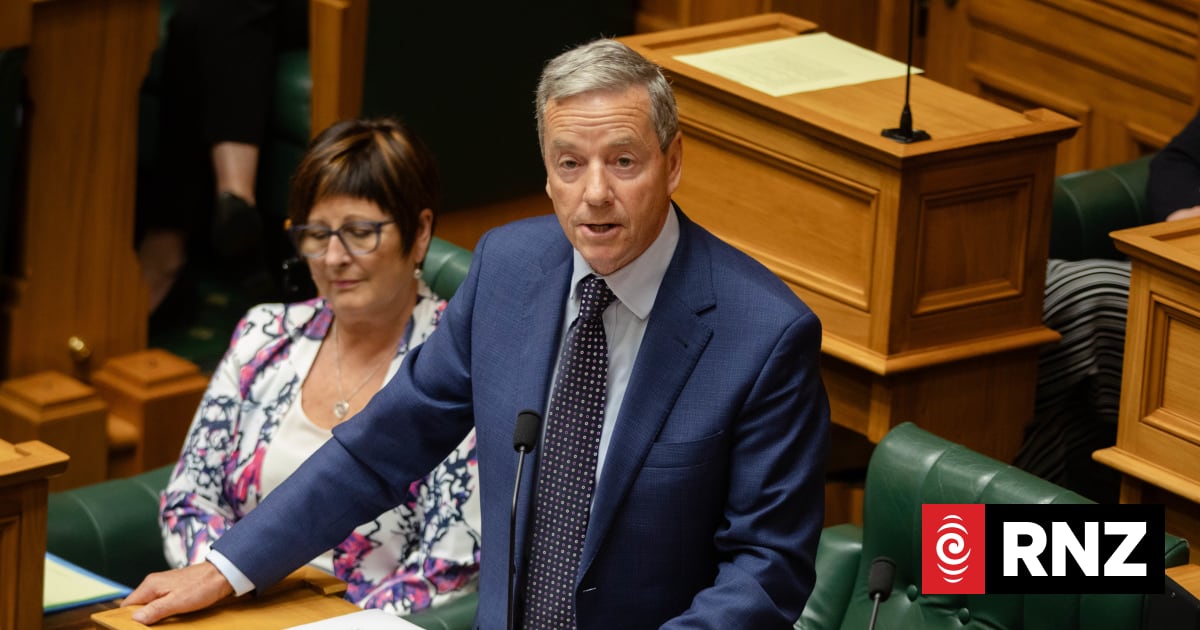
Outgoing National MP Andrew Bayly is using his final days in Parliament to urge all parties to start raising the superannuation age from next term, warning further delay will make the eventual fix more painful.
In an interview with RNZ, Bayly said the age of eligibility should be increased by one month every year from 2029, climbing to 68 by 2065.
He also wanted the dollar amount of the payments to rise more slowly, and said some people should be able to access the pension earlier – but at a lower rate – if they had poor health, shorter life expectancies or physically demanding jobs.
Bayly’s proposals were set out in a research paper published last month in the International Review of Public Administration, which he co-authored with economist Leonard Hong and data analyst Emmanuel Jo.
He told RNZ he had deliberatedly published in Asia to make it clear he was not speaking on National’s behalf, but was instead setting out his own “considered view based on economic and demographic modelling”.
Bayly said he had sent his paper to all party leaders in Parliament, arguing there was a “burning economic imperative” to act.
“This is the biggest economic issue facing New Zealand,” he said. “The cost of superannuation is growing exponentially, and we can’t just keep pushing it out for another day.”
Could this be the future of superannuation?
Under the current settings, Bayly and his co-authors estimated superannuation would consume almost 30 cents of every dollar of government tax revenue by 2065, up from about 19 cents today.
They said spending on super, health and education together would swallow nearly 80 percent of all tax revenue by then.
“This is a freight train coming down the line,” Bayly said. “What we’re advocating is a graduated approach now, rather than something being done in the middle of a crisis… we will have to be brutal if we delay it.”
In 2023, National campaigned on gradually lifting the super age to 67. National initially said “very slow, staged” adjustments would begin in 2037, but later pushed the start date back to 2044.
Bayly said that plan was “worthwhile but insufficient”, reducing super’s share of tax revenue to 26.5 percent by 2065.
Starting the increases in 2029 would shrink it further, to about 25 percent.
“The approach is gradual, planned, and provides successive cohorts with greater certainty for retirement planning,” the paper said.

Bayly and his co-authors estimate superannuation will consume almost 30 cents of every dollar of government tax revenue by 2065.
123RF
Bayly said significant savings could also be made by treating the pension the same as other welfare payments and indexing it to general inflation rather than wage growth.
He suggested a “moderated” approach with regular reviews to allow adjustments if pensioners fell too far behind the wider population.
The paper also proposed a limited early-access scheme for people who could no longer work because of reduced capacity, lower life expectancy or physically demanding jobs.
The authors said that would address one of the biggest objections to a later age of eligibility and make reform “more politically durable”.
They also backed compulsory KiwiSaver contributions and continuing payments into the NZ Super Fund.
An RNZ-Reid Research poll in July found 58 percent of voters wanted the super age to remain at 65, compared with 35.3 percent who supported an increase to 67. Another 6.8 percent were unsure.
The poll found more support for means-testing the pension, with 46.6 percent in favour, 40.7 percent opposed and 12.7 percent undecided.
Bayly’s paper discounted that option, arguing it would be “exceedingly difficult” to win support across Parliament for “such a radical change”.
Treasury forecasts released in May showed the annual cost of super rising from $24.7 billion this financial year to $31.2 billion in 2029/30.

Labour and NZ First both support keeping the eligibility age at 65.
RNZ
National has yet to set out the details of its policy for this year’s election, but finance spokesperson Nicola Willis warned in May that parties ignoring the rising cost were robbing young people for “their own political expediency”.
ACT campaigned in 2023 on rapidly increasing the super age to 67 by three months a year, starting almost immediately.
New Zealand First leader Winston Peters last week reiterated his party’s long-held opposition to changing access to current entitlements.
Labour and the Greens also supported keeping the age at 65. Te Pāti Māori last year argued Māori should be able to receive super up to 10 years earlier because of their lower average life expectancy.
Bayly announced in June he would step down at the election, bringing his 12-year career at Parliament to an end.
He became a minister outside Cabinet in 2021, holding the commerce, consumer affairs and small business portfolios. He resigned from those roles in February 2025 after what he described as an “animated discussion” with a staff member.