
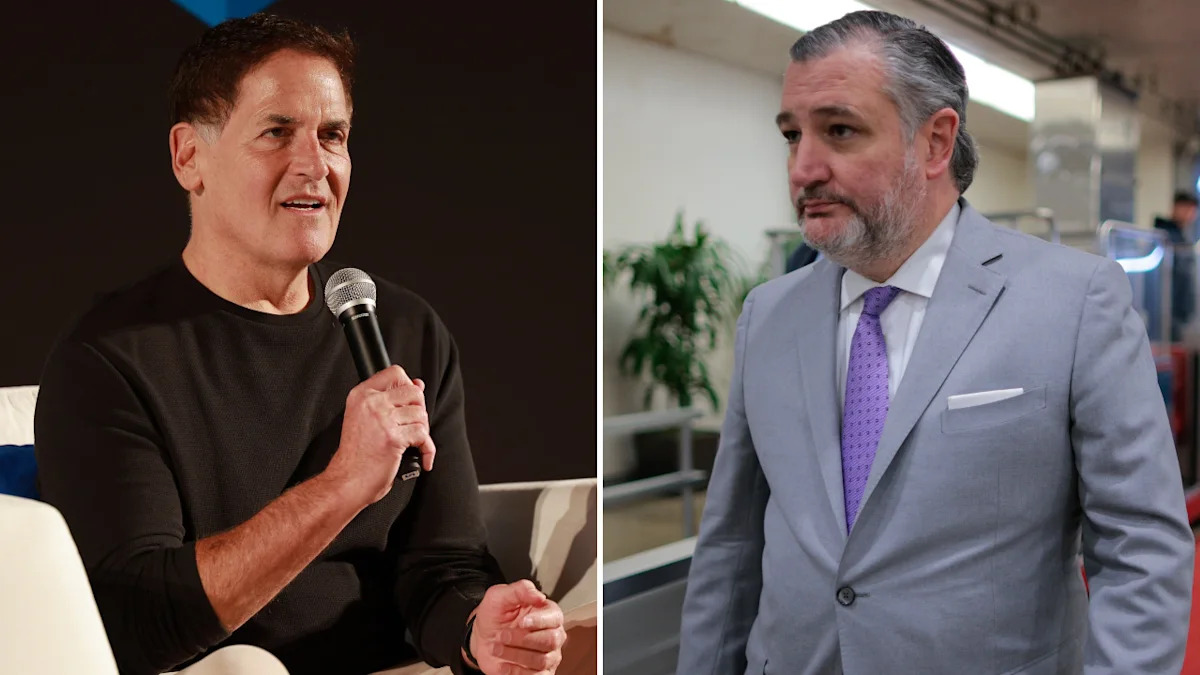
 Jason Mendez/Getty Images, Chip Somodevilla/Getty Images
Mark Cuban called out Ted Cruz for blocking healthy competition in healthcare.
In a recent post on X, the Shark Tank star first pointed to the U.S. deficit and high interest rates on debt as major affordability worries. If it were up to Cuban, he’d take on these issues partially by taxation, but also by fighting today’s uber-powerful healthcare conglomerates and opening up more competition to drive down costs.
Must Read
To do this, Cuban supported the bipartisan Break Up Big Medicine Act in his post on X, claiming, “The best place to cut spending is by removing the HealthCare middlemen that are Too Big To Care, which is exactly what the Break Up Big Medicine Bill does.”
Senators Elizabeth Warren and Josh Hawley introduced the Break Up Big Medicine Act this February. If passed, this bill would make it illegal for a parent company to own both a healthcare provider (such as doctors or medical practices) and a health insurer or pharmacy-benefit manager (PBM). Companies that already have these kinds of “vertical integrations” would have one year to separate.
In Cuban’s mind, breaking up these companies and bringing the free market into healthcare should fit Cruz’s conservative playbook.
“A true capitalist would understand how these economics work,” Cuban argued, adding that “They wouldn’t ignore the fact that our debt levels pull money away from business. And consumers.”
Cuban then challenged Cruz, questioning whether the Senator would “prefer people dying because they can’t afford care, and the economy continuing to slow down because we are having to print money to financially engineer our debt obligations.”
Cuban’s argument was in response to a previous post on X from Cruz, in which the senator criticized Cuban’s call for higher taxes and his support for Democratic U.S. Senate contender James Talarico. Cruz also argued President Trump’s tax cuts brought unemployment to a “50-year low” before the pandemic, while blaming Senate Democrats who “voted to let a $4 trillion tax increase hit Americans” last July when the One Big Beautiful Bill Act passed.
Moneywise reached out to Cruz for further comment but didn’t hear back before this story was published.
Story Continues
Cost and control in US healthcare
Whether people believe in Cuban’s call for healthcare reform, the U.S. deficit is in a very sick state. According to data from the U.S. Treasury Department, the federal government has a deficit of $1.8 trillion for fiscal 2026.
But just how much does healthcare contribute to this spending spree?
Recent data from the Centers for Medicare & Medicaid Services (CMS) suggests the national health expenditure (NHE) reached $5.3 trillion in 2024, or about 18% of the GDP. Put another way, annual health costs in the U.S. are now at approximately $15,474 per person.
And there’s no sign that spending on these programs will decrease without some intervention. The CMS suggests NHE is on pace to grow approximately 5.4% between 2025 and 2034, by which time it could reach 20.6% of total GDP.
It’s also clear that just a handful of companies control today’s healthcare industry. According to the Federal Trade Commission, three PBMs — Express Scripts, CVS Caremark and Optum Rx — now process about 80% of prescriptions in U.S. pharmacies. If you include the three PBMs below these top players, that figure rises to near total control at 90%.
Another report from the American Economic Liberties Project showed the wholesalers McKesson, Cencora and Cardinal Health now own 98% of drug distribution in the U.S., which study authors argue gives these companies leeway to “drive prices below competitive levels, leading to reduced output, drug shortages and market exits by generic drug manufacturers.”
Patients keep paying the price
There’s no telling when or if the Break Up Big Medicine Act will become law, but surveys show more Americans are feeling the pain of ever-rising healthcare prices.
Gallup recently reported that 49% of Americans say they’re “cost secure” when it comes to paying for healthcare expenses, marking the lowest level in the past five years.
Data from KFF confirms these findings, showing that about 50% of respondents now claim healthcare affordability is a challenge. These surging prices also mean more Americans are opting to hold off on essential care. KFF notes that 36% of adults either “skipped or postponed” healthcare due to cost-related issues, while 43% claimed they didn’t take prescription medications because they couldn’t afford it.
As healthcare becomes more and more of a burden, it makes sense why it’s such a hot topic in politics. Survey data from KFF showed healthcare costs could be one of the leading issues this midterm cycle, with 51% of Americans ranking it as a primary concern.
What To Read Next
Join 250,000+ readers and get Moneywise’s best stories and exclusive interviews first — clear insights curated and delivered weekly. Subscribe now.
This article originally appeared on Moneywise.com under the title: ‘Do you prefer people dying?’: Mark Cuban tells Ted Cruz a ‘true capitalist’ would raise taxes, slash healthcare costs
This article provides information only and should not be construed as advice. It is provided without warranty of any kind.