
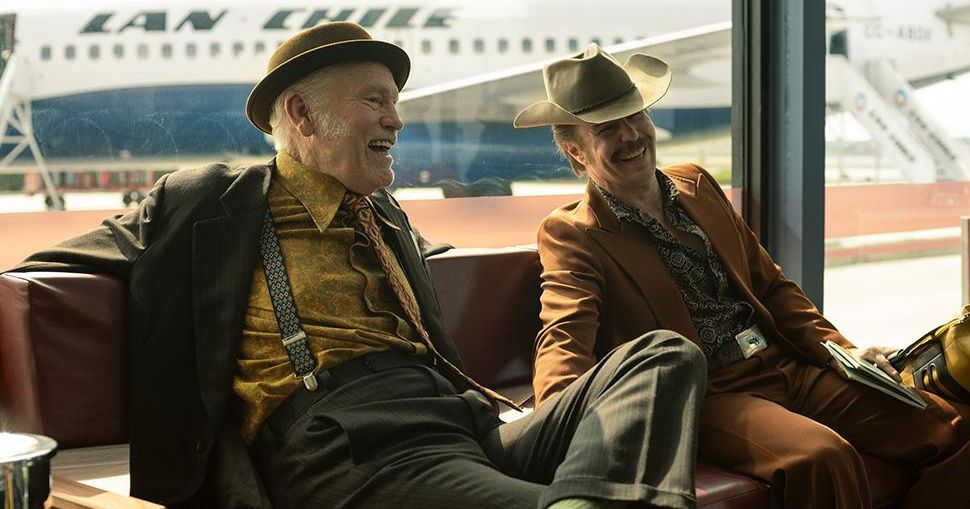
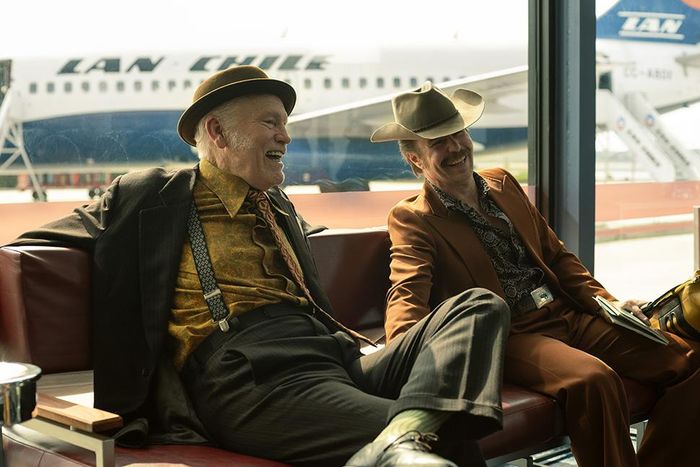
Photo: Searchlight Pictures
A melancholy hangout drama masquerading as a hit-man comedy, Martin McDonagh’s Wild Horse Nine plays at times like a more contemplative remake of the director’s classic In Bruges. Once again, we have two mismatched assassins traveling to a foreign land as they’re egged on by their foulmouthed, lunatic boss. Once again, we discover that our protagonists have ulterior, more existential motives. Once again, the past intrudes, loyalty is divided, and irreverent one-liners are delivered. But Wild Horse Nine has been built around the queasy charisma of the great John Malkovich, who has made a career out of blending fragility and menace, even in his smallest parts. The more vulnerable a Malkovich character is, the more dangerous and unknowable. Wild Horse Nine gives him the role of his career.
As Chris, a veteran CIA assassin with terminal cancer whose memory also seems to be going, Malkovich demonstrates a sinister insouciance that at first looks like psycho gloating. Headed to Chile’s Easter Island with his younger partner, Lee (Sam Rockwell), Chris can’t help but chat up two young women they meet at the airport, Monica and Alicia (Mariana Di Girólamo and Ailín Salas), about the country’s Marxist president, Salvador Allende. “Enjoy him while you can, ladies,” he yells, snidely. The year is 1973, and Allende will be murdered in a U.S.-backed coup on September 11. Chris has been an institutional angel of death for decades now; he was even involved with the JFK assassination, we suspect. Plus he’s planning to write his memoirs (shades of Burn After Reading, another excellent Malkovich performance), which has his masters — including his ruthless boss, MJ (Steve Buscemi) — all in a tizzy.
A master of repartee, McDonagh is in fine form here. Lee and Chris have stepped out of the world of postmodern genre, wisecracking assassins who could be the gabby uncles of Colin Farrell and Brendan Gleeson’s mob hit men from In Bruges or John Travolta and Samuel L. Jackson’s besuited killers from Pulp Fiction. The constant banter won’t render them any more real or authentic, but Malkovich has a downright supernatural ability to make even the strangest line of dialogue sound like he thought it up on the spot. “You only have to taste American cheese once to understand why we lost Vietnam,” Chris observes early on, which leads to a hilarious bit about how “gay countries” like France, England, and Belgium tend to have the good cheeses. The ever-present chill of mortality ensures that there’s also a lot of talk about who gets to go to heaven. Would a Nazi who threw himself on a hand grenade to save an old lady go to heaven? Will the Jews in heaven be upset when that Nazi shows up? Do dinosaurs go to heaven? What about moths? Will Chris? At one point, Chris imagines what his cancer might say, and he makes sure his cancer has a lisp. These are not CIA assassins from the year 1973. At times, they sound more like baked college students from the year 1996, when McDonagh premiered his first play, The Beauty Queen of Leenane. The writer-director even throws in a few anachronisms into the dialogue. (Was anyone in 1973 was using “ish” as a word?)
What are we watching here, really? As Chris loses his memory, he seems to be gaining a sense of right and wrong. Maybe he doesn’t always sound like a guy in 1973 because as death approaches he’s slipping into the infinite, of a timeless moral reckoning. Maybe that’s why he’s drawn to the mysterious, carved, giant heads of Easter Island, their solemn faces an eternal jury. Chris misspeaks, he blurts things out, he reflects bitterly on things he’s done. Playfully arguing with Alicia and Monica about how they met at a march for women’s rights, he observes, “Marches are just places where we can get the clearest photos of you without you knowing.” Watching the great Victor Jara perform the iconic “Gracias a la Vida,” he casually tells the girls, “He’s on a lot of our lists, actually.” (One of Chile’s greatest singers, Jara would be brutally killed that September, his body mangled by General Augusto Pinochet’s murderous regime.) Chris practically sees into the future, into the devastation he and his people will have wrought. He knows what’s coming for Chile — about the roundups of dissidents and students, about the torture planned for them in Santiago’s soccer stadium, about the inevitable executions.
It’s a tough juggling act McDonagh is attempting. On the one hand, he wants to entertain us with his characters’ irreverent one-liners, some of which veer into the realm of edgelord humor, like mocking people’s use of the word “indigenous” and the futility of protest. (I can easily see a future where right-wing bots on social media start sharing some of Chris’s observations sans context.) Meanwhile, he gives the film’s growing conscience to the protagonist with the longest list of sins. (Chris has killed, we’re told, 68 people, far ahead of Lee’s mere eight.) Is it sympathy he seeks for Chris, despite the monstrous century Chris represents? Or is it an effort to find grace in debasement and suffering, in the lowest of us all? I’m not sure Wild Horse Nine possesses the complexity to really wrestle with these larger questions, but somehow Malkovich himself holds the film’s many contradictions in exquisite balance. He’s never been better.
Sign up for the Vulture Daily
An entertainment newsletter for the pop-culture obsessed.
Vox Media, LLC Terms and Privacy Notice