
Photo: Quiver Distribution/Courtesy Everett Collection
Written early in her career, Night and Day is not exactly one of Virginia Woolf’s best-known novels. So, the possessive title of Tina Gharavi’s film, Virginia Woolf’s Night & Day, might well have been a marketing requirement, there to remind us of the story’s provenance. But that title also feels like a playful challenge. On its surface at least, this film is not Woolf’s Night and Day at all, but rather its own thing: handheld and hectic, stripped to its essence, happy to take wild liberties with its characters and narrative.
But maybe there’s something of Woolf in that notion, too: The author was apparently never quite happy with the book, and its critical reputation is that of a musty, crypto-Victorian tome, a far cry from her more modern work. I happen to love it, but I’m also happy this brisk, bouncy little adaptation exists.
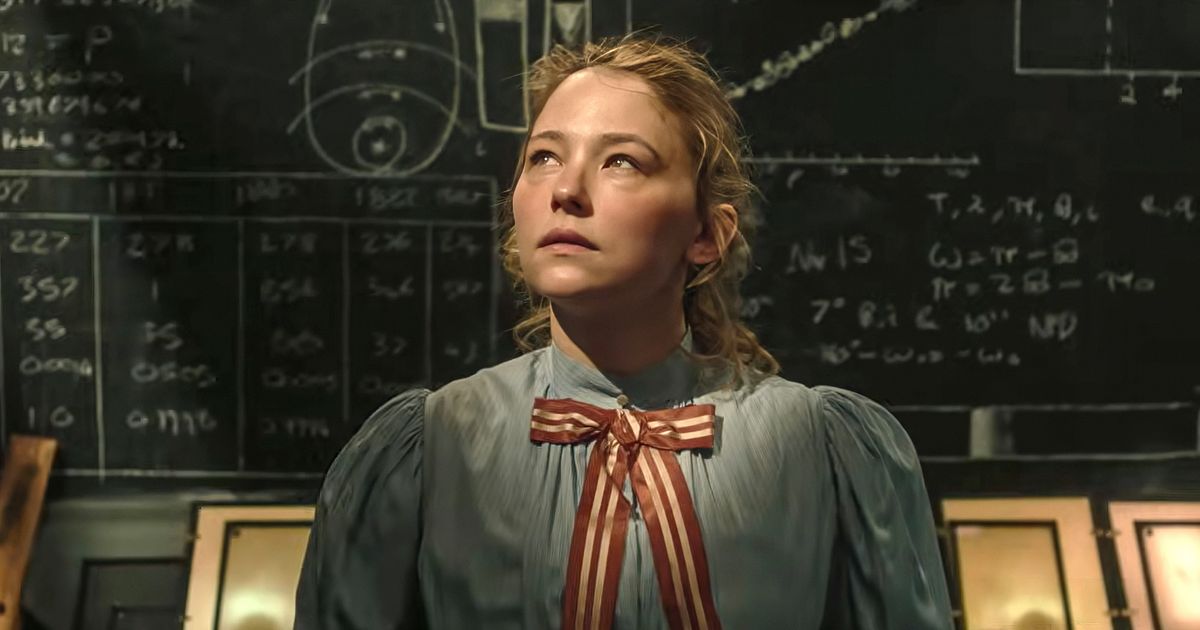
Set in 1910, the film (which opens theatrically today) centers primarily on Katharine “Kit” Hilberry (Haley Bennett), a plucky young woman from a distinguished family who wants to study astronomy, even though she lives in an age when women aren’t expected (or, frankly, allowed) to do such things. Depressed at the fact that her own brilliant mother’s (Jennifer Saunders) ambitions were thwarted by marriage, Kit is determined not to fall into the domesticity trap, even though her father (Timothy Spall) insists that she marry the klutzy amateur poet William Rodney (Jack Whitehall). Meanwhile, Kit gets pulled into the women’s suffrage movement, where she encounters the headstrong Mary Datchet (Lily Allen) and also finds herself drawn to brooding, hunky socialist Ralph Denham (Elyas M’Barek), an editor of modest means who reminds her that in English cities you can’t see the stars because of all the coal and factory smoke.
This is, to be clear, a massive streamlining of Woolf’s novel, which goes deep into the lives of William, Mary, and Ralph, among whom a series of intricate romantic attachments begin to develop. All that pretty much goes by the wayside here. What shines through, however, are the lively longings of Kit herself as the movie doubles down on an interest in science that is only intimated in the novel. It’s a contemporary twist, this whole STEM thing, but it’s compelling: Bennett’s earthy performance makes Kit’s desire to study astronomy a downright sensuous affair. The film’s opening scene has her wading naked in Hampstead Ponds at night, looking up at the blinking stars and naming the constellations to herself, then closing her eyes as if to let the galaxies above wash over her.
Night & Day is refreshingly unafraid of being corny. A more patient and subtle treatment of this material might have been truer to the source, but there’s charm in the film’s fast-paced, stylized, and colorful take on Woolf. This world’s heavens are lit with cosmic rays, its cityscapes otherworldly — everything seems to service an unabashed romanticism. When Kit takes her whole family out onto the lawn of her uncle’s country home to watch Halley’s Comet, Gharavi’s camera spins around the night skies and Simon Goff’s ethereal score soars. “We’ll all be dead the next time Halley pays us a visit,” Kit observes to the camera with a warm smile. The grand scale of cosmic time reminds her (and us) that social mores and strictures are tiny, meaningless things, that what matters is passion and freedom. A basic idea, but a moving one nevertheless.
Sign up for The Critics
A weekly dispatch on the cultural discourse, for subscribers only.
Vox Media, LLC Terms and Privacy Notice