
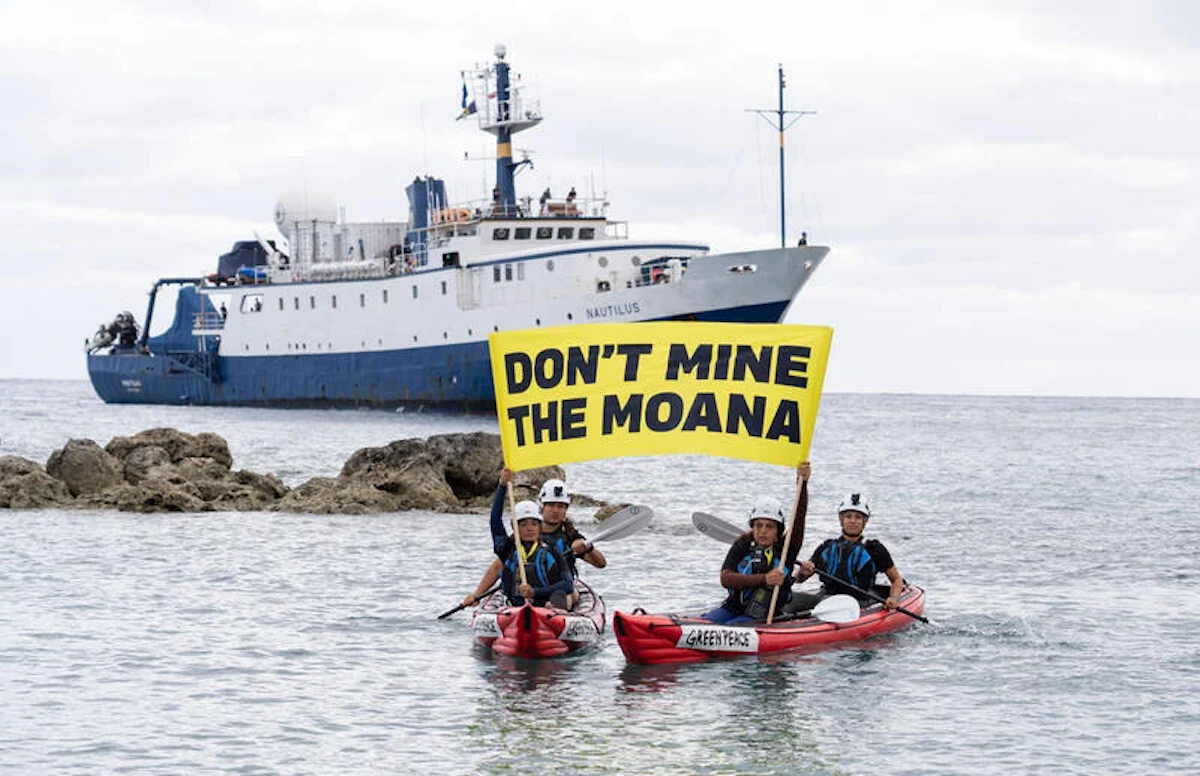
Strewn across the muddy depths of the South Penrhyn Basin is one of the world’s most valuable deposits of seafloor critical minerals, and the new port facility at Tongareva atoll will make its exploitation viable.
These minerals, used to develop advanced technologies such as weapons and medical equipment, are a priority for the Trump Administration.
The Cook Islands deal comes as New Zealand and the United States pursue a joint critical minerals framework of their own, one that – while technically ‘non-binding’ – critics warn could lock New Zealand into deals with overseas companies.
Any future mining operators based out of the future deepwater port on Tongareva/Penrhyn atoll will almost certainly be American; US Deputy State Secretary Christopher Landau explicitly said the port deal builds on the joint US-Cook Islands critical minerals framework signed in February, a type of framework Resources Minister Shane Jones has been trying to secure for New Zealand.
Landau announced the port co-investment in Palau this week at the Pacific Islands Forum, where he crossed paths with Jones and Foreign Minister Winston Peters.
Peters tells Newsroom critical minerals are a “third or fourth tier consideration” – his only mention of them in his press release on the port is in a quote attributed to Landau.
No matter the priority for Peters, the Americans are already moving to develop the resource.
The Cook Islands Investment Corporation has a new partnership with American firm Wetstone to fund exploration in the area, and a billion-dollar merger between American Ocean Minerals Corp and Odyssey Marine Exploration was recently announced.
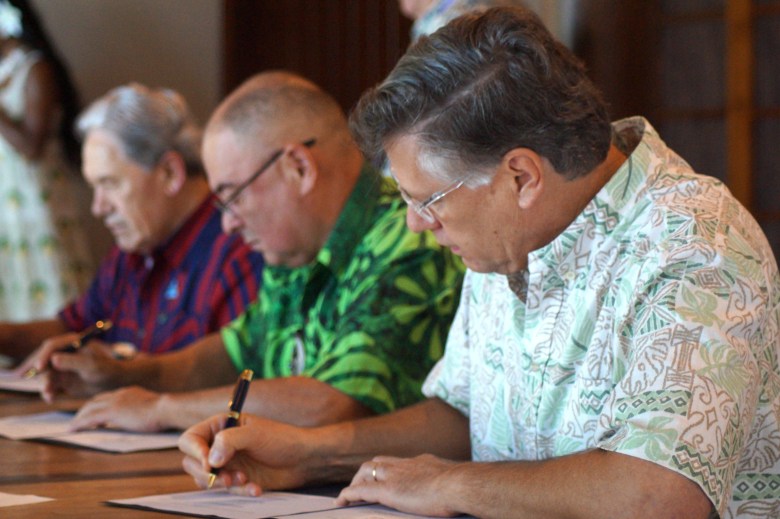 New Zealand’s Winston Peters, Cook Islands’ Mark Brown and the United States’ Christopher Landau signed a $102 million deal this week to build a new deepwater port, which will facilitate the exploration of seafloor mineral deposits. Photo: Sam Sachdeva
Nicole Bartlett, currently the policy advisor on marine critical minerals to the American National Marine Fisheries Service, was recently attached to the Cook Islands Seabed Minerals Authority, which oversees the resource.
Bartlett’s position sits within the National Oceanic and Atmospheric Administration, a group Jones wants to see in New Zealand’s waters.
Jones says it’s “astonishing” that the New Zealand government’s own research vessel, the MV Tangaroa, is doing critical minerals exploration in other jurisdictions rather than at home.
Some amount of phosphate – which is included in both the American and New Zealand critical minerals lists – can be found in the great stretches of seafloor muck surrounding the Auckland Islands.
Jones says it’s time New Zealanders were able to put a dollar value on this resource, a proposition he admits “is very controversial for some of the members of my beloved fishing industry”.
Emeritus Professor of Law at the University of Auckland Jane Kelsey is a longtime critic of the way Jones has pursued such a critical minerals framework, and says the suggestion that the port deal is not focussed on this industry is disingenuous: “It is explicitly and blatantly so”, she says.
Kelsey says we need to understand what the consequences of a critical minerals push in the Cook Islands are for Aotearoa, both as a party in the Pacific community, but also to understand what similar arrangements might involve here.
Kelsey is worried that New Zealand’s critical minerals framework with the United States was advanced – or even finalised – at the meeting in Palau. When asked if this happened, Jones says “absolutely not”.
While the framework is described as non-binding, Kelsey thinks the key commercial relationships that underpin it will come with obligations that make commitments effectively enforceable.
These potential companies – in the Cook Islands’ case, Odyssey and American Ocean Minerals Corp – could be given investor protections and state enforcement, a prospect Kelsey says is a very serious concern.
Her worries stem from the nature of negotiations thus far, which have not gone through a select committee process, and the details of which have been redacted in her official information requests.
“We have major commitments that are both ecological, climate-related, and foreign policy-related that are occurring under a cloak of secrecy,” says Kelsey.
She says this has to be a worry for democracy and for the downstream consequences of mining. “So much of this is happening behind closed doors,” she says.