
And having hope likely feels good – certainly better than the alternative, which is having no hope – something that New Zealanders had a sense of at the end of last year.
Watching the All Blacks fall apart at Twickenham last year – a befuddled mess, muddling their way through a 10-minute period after a Codie Taylor yellow card.
They played with no hooker, no plan, no connection between players and coaching box, and England swept in for the kill.
It was a tough watch, unlike anything from the All Blacks storied past where New Zealand reeked of rugby intelligence.
Defeat to England at Twickenham proved to be a breaking point for the All Blacks side. Photo / Photosport
Sitting at Twickenham while an average England team celebrated a rare but significant win against the All Blacks, it was almost impossible to have any hope.
That defeat came only six weeks after South Africa had enjoyed a record victory in Wellington and after Argentina had pulled the All Blacks apart in Buenos Aires.
The All Blacks were in a state – disunited, unhappy and unsure of who they were and what they were doing.
Looking into the distance and the prospect of the All Blacks coming to South Africa for a four-test series (eight-game tour) it was impossible to have any hope.
The prospect of sitting tied at 1-1 in RGR was unimaginable. No one could see anything other than it being 2-0 after two tests and the possibility of the series ending 4-0 to the Boks was feasible.
So the Celts are wrong. Hope doesn’t kill you.
Not having hope is the killer and now that the All Blacks are back and fit for purpose, it’s probably best if New Zealand Rugby writes off 2024 and 2025 as a well-meaning but failed experiment.
Scott Robertson had excelled in Super Rugby with the Crusaders and the decision-makers in the highest echelons of NZR were seduced by that and by his quirkiness.
The C-suite thought they had a coach who was going to revolutionise high-performance thinking and best practice in New Zealand and rebuild the All Blacks as a more open, accessible and front-facing team.
But they read it all wrong. They didn’t have what they thought they had and they certainly didn’t have what the All Blacks needed. They had mistaken an ability to breakdance for an ability to build a cohesive culture.
The set-up under Robertson was flimsy – nowhere near robust enough – with a convoluted coaching structure that stretched the sole forwards coach Jason Ryan way too thin, while two assistants tripped over each other building the attack.
Scott Robertson excelled at Super Rugby but was not what the All Blacks needed. Photo / Photosport
Culture was built around themed video clips and the leaders were disenfranchised – reduced, according to those in the know, to a kind of committee with powers to influence off-field activities but nothing else.
Robertson lacked international experience and life experience and simply didn’t have the skill-sets to be at the head of a complex and dynamic organisation such as the All Blacks.
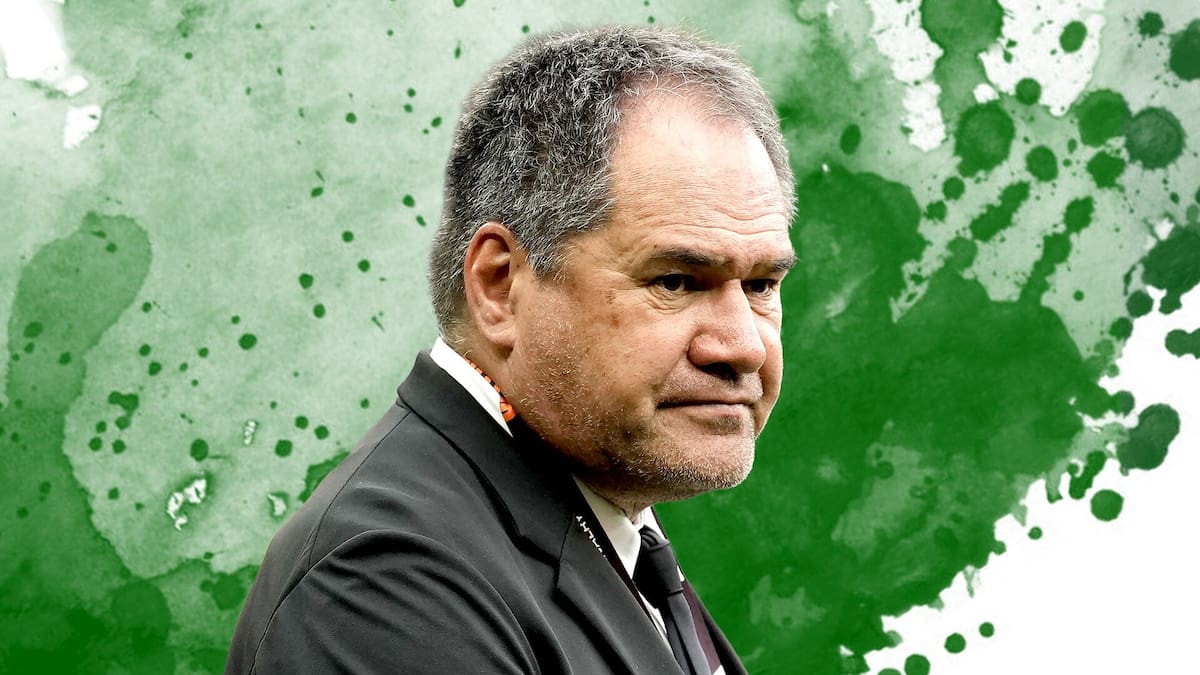
What’s coming out on this tour is a lot of whispering from people close to or connected with the team about how much happier, solidified and unified the players are under new coach Dave Rennie.
It seems now that things are good, everyone has a better appreciation of just how bad they were. It’s like having a hip replacement, the pre-surgery agony is better realised post-surgery.
But whatever mistakes NZR made in the appointment process and ongoing oversight of Robertson, the national body has at least moved swiftly and firmly to rectify the situation and made a strong and good decision in choosing Rennie.
The past is exactly that, and regardless of what happens in Soweto – or indeed Baltimore – there is reason again to believe in this All Blacks side.
The RGR series has come a little early in the transition process to be fretting too much if the All Blacks win or lose. South Africa are a beast – one that the All Blacks may need a few more tests together before they can tame it.
The All Blacks, though, have shown enough in the first two tests to say they are credible now – an authentic version of their true selves and not the sort of team that will fold the way they did last year late in the game in the crushing Wellington defeat.
This is now a team with a tight and maturing leadership group. It is a team that is benefitting from consistency in selection and gameplan.
There is more experience in and better structure to the coaching set-up. Ryan is now focused purely on scrums – and while it has been advantage South Africa in the set-piece battle, the experience of packing down against the best scrummaging side in the world four times in four weeks will be invaluable in the long run.
All Blacks coaches Tana Umaga, Neil Barnes, Dave Rennie and Jason Ryan.
That’s because there is a review-learn-and-adapt culture that has eliminated (most of) the players’ recidivist offending and created a growth environment.
But the biggest changes are quite simple. Rennie has got his players to answer three simple questions about what it means to them to be All Blacks, who they feel they are playing for and how they want to be perceived.
These are simple but powerful connection points, and it has enabled a sense of identity to form, and a realisation to develop that the players are playing for something bigger than themselves.
And, critically, Rennie has brought precise, simple and clear communication and a clarity around how he wants his team to play.
The players now know what they are doing and give them another 12 months to bed in their understanding and implementation of the gameplan and the All Blacks at the Rugby World Cup will be a significantly better team to the one they are now.
All of this means that hope is back regardless of what happens in the third test tomorrow morning and it is in no danger of killing anyone.
Gregor Paul is one of New Zealand’s most respected rugby writers and columnists. He has won multiple awards for journalism and written several books about sport.
Listen to Elliott Smith’s live commentary on Newstalk ZB Sport and iHeartRadio, or join the Alternative Commentary Collective on iHeartRadio and Radio Hauraki.