
With National polling below 30%, lower than the 38% it received in 2023, some projections suggest Bishop entering Parliament via the list could be under threat if the party retained many of the electorates won in 2023.
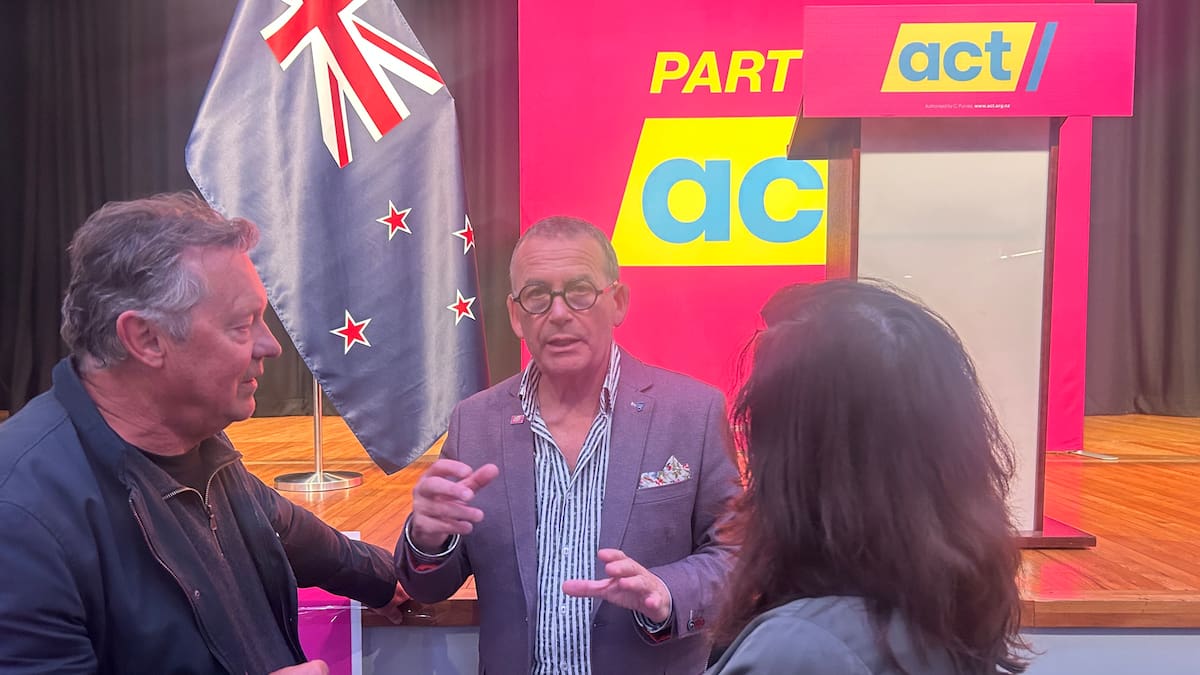
Act candidate Paul Henry held a public meeting in Lower Hutt last night. Photo / Adam Pearse
Asked whether Henry supported Hutt South constituents voting for Bishop, the Act candidate instead focused on the party vote.
“The best way to secure a right government that will do things to improve this country is to party vote Act, that is 100% the best thing to do,” he said.
“What I would encourage everyone in this room to do is look at your candidates and vote for the candidate in your area that is most likely to answer a phone call from you at 5 o’clock on a Friday night.
“That could be, in many areas, a National member of Parliament, and I know there are people out there saying, ‘Constituency vote National, party vote Act’.
“Absolutely, party voting Act is the best way if you want to secure a right-wing government that will do stuff for you.”
Henry was later challenged by another attendee about why Act was not getting more “mongrel” about the electorate vote, with the man referencing Te Pāti Māori’s strategy to ask only for the candidate vote in the Māori seats.
That strategy could create an overhang in Parliament – meaning there are more than 120 MPs in the House – because it could result in Te Pāti Māori winning more seats than its share of the party vote would entitle the party to.
In 2023, Te Pāti Māori received only 3% of the party vote but won six seats, creating a two-seat overhang, increasing the number of MPs in Parliament to 122.
The attendee suggested it would be foolish not to vote for National candidates as it was the only party on the right able to produce an overhang.
Act candidate Paul Henry signs a book after his public meeting. Photo / Adam Pearse
Henry, appearing reluctant to discuss the topic, referred to current polling and claimed there could be an overhang “by as much as 10 Members of Parliament”.
He acknowledged an overhang would give a “much better chance of securing a right government win” before explaining why he didn’t often discuss it.
“There are a lot of people who don’t like to be told what to do and because I think there are more and more people who are wise to the way MMP works, people like yourself and you’ve worked it out and you’ll talk to other people and maybe that’s the best way this news should filter around.
Henry said the man was “technically” correct, before referencing the Herald’s presence in the room.
“But technically what you’re saying is correct … but you got to be so careful saying these things and there are members of the media here, but there is a school of thought that says actually, party voting National is actually a wasted vote because they will get so many constituency votes that they require many, many, many more party votes to … get an extra Member of Parliament as opposed to Act, but we’re starting to talk about the nuances of MMP.”
Speaking to the Herald after he’d made it through a long line of people wanting selfies, Henry said the MMP system “lends itself to strategic voting” and believed people were understanding that more.
“We’ve got a situation now where very clearly Te Pāti Māori is training people to do a particular thing that up until now, no party has in its entirety.
“We had the situation obviously in Epsom where there was a bit of talk around it, but it’s quite a different thing when a party has an entire strategy such as Te Pāti Māori.”
Asked about his claim of a possible 10-MP overhang, Henry said the analysis hadn’t come from the Act Party but from “someone else who is doing a lot of political analysis”.
Henry refused to name the person, referring to them as “someone who does a lot of political analysis and bailed me up at a meeting the other day”.
Adam Pearse is the Deputy Political Editor and part of the NZ Herald’s Press Gallery team based at Parliament in Wellington. He has worked for NZME since 2018, reporting for the Northern Advocate in Whangārei and the Herald in Auckland.