
“But when we rolled out the product there was so much appetite just from the domestic market, and as we kept doing it, we found that the gap in the market was huge.”
He said Flicket enabled event organisers to become their own ticketing company.
“No one likes ticketing companies. We very much understand that, and everyone’s got horror stories of platforms crashing, not being able to get tickets and information not being clear.”
Flicket was established to challenge traditional ticketing models by giving event organisers greater control over customer data, revenue streams and fan engagement.
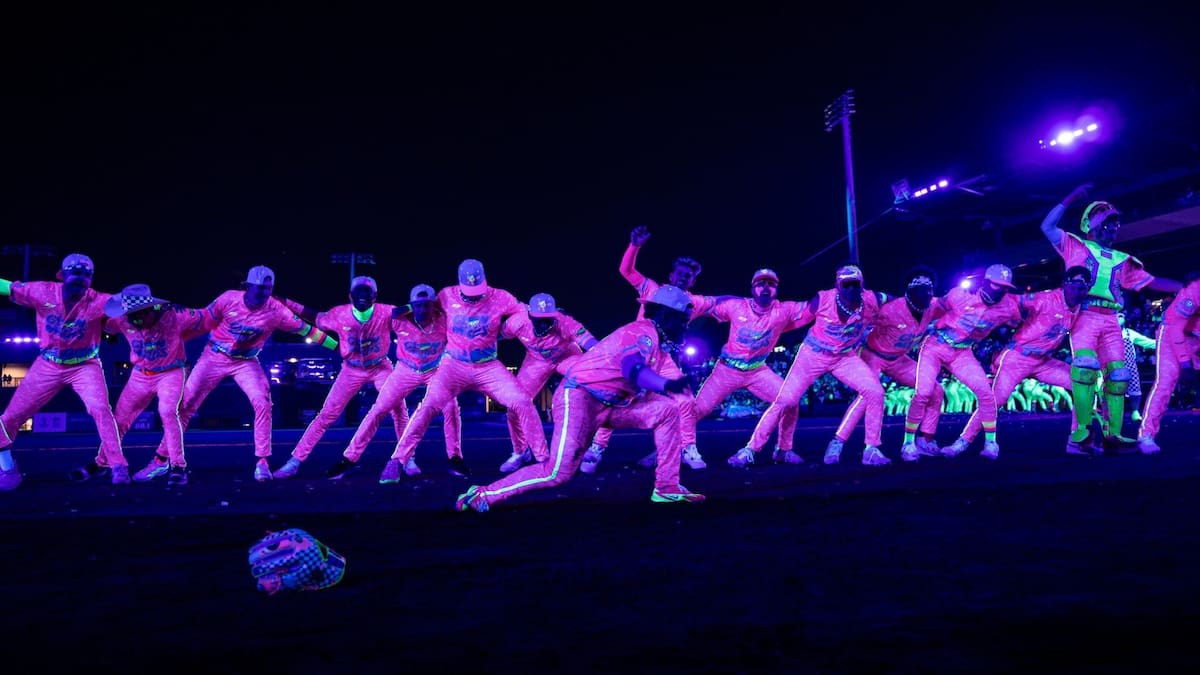
Flicket powered Cosmic Baseball, one of the United States’ fastest-growing touring sports attractions.
“There was so much demand of [event] organisers wanting to know who their fans were, wanting to have better control over how their product was marketed, what data was collected and then build better engagement,” Barwell-Smith said.
“We’re effectively solving the same customer problems from eight years ago, just at a bigger scale now, which is so cool.”
Securing international events
Since launching, Flicket has grown from a New Zealand start-up into an international business, operating in multiple overseas markets.
The company helped power New York Fashion Week and Cosmic Baseball, one of the United States’ fastest-growing touring sports attractions.
It also supported events in Las Vegas alongside the McLaren Formula One team and continues to expand across baseball, rodeo, college sports and live entertainment markets.
“The event where we realised we could be a major player was Cosmic Baseball,” Barwell-Smith said.
“It’s glow-in-the-dark baseball and it’s the coolest thing ever. They do the first couple of innings with some trick plays and then halfway through the lights go off.”
He said Flicket would sell more than one million tickets with Cosmic Baseball in the coming year.
“The engagement is massive and the biggest pivot we’ve seen for events has been the change in sports – it’s no longer just sport, you’re putting on the most entertaining product.”
Flicket’s Nic Mowday (left) Amelia Calvert, Jimmy Barwell-Smith and Jay Watphisit, and an Export Awards judge.
For organisers, running events was often “immensely stressful”, he said.
“You’ve got 10,000 things that can go wrong and so whatever we can do to help alleviate that stress always works really well.”
When asked about the challenges of scaling Flicket internationally, Barwell-Smith said the “biggest thing” was understanding what had made the company successful in New Zealand.
Flicket has supported ticketing for some of New Zealand’s biggest events, including Super Rugby and festivals such as Laneway, and most recently delivered ticketing for Australian DJ Dom Dolla’s New Zealand headline show.
“Each market has its own unique landscape and so it’s a blend of not wanting to completely change who you are and be inauthentic to other markets,” Barwell-Smith said.
“We want to retain what’s made us us and that’s just out-hustling our competitors.”
His advice to other companies looking to grow internationally was “to take the punt”.
“It is crazy, you’ll pull all-nighters, you pull together great people, you lean in and if you do the hard work and you’re honest and upfront, it works out.
“You’ll never think that you’re ready for it. If you’re not doing stuff that scares you and pushing you outside your limits, you’re not doing it right.”
Exporter of the Year
To be eligible for Exporter of the Year, the company had to have more than five years of international operations and annual revenue above $5 million.
Flicket is on track to support more than 4000 events and process more than $350m in gross transaction value this year.
“What we’re seeing across the platform is that we double each year,” Barwell-Smith said.
To be eligible for Exporter of the Year, Flicket had to have more than five years of international operations and annual revenue above $5 million.
He said the Exporter of the Year award was “huge” for the company.
“We do a lot of this almost in an isolated bubble. We run a pretty lean organisation so our heads are down just trying to do the good work.
“I think if you go out there trying to win awards you can lose sight of things, whereas we’ve let the hard work speak for itself.”
Barwell-Smith said in the past few years, the recognition had slowly started flowing in.
“We love the event industry and this is a long-term business for us, so we want that to be sustainable and want it to be something that we’re proud of.
“We’re looking forward to keeping the region proud and keep swinging for the fences.”
Kaitlyn Morrell is a journalist for the Bay of Plenty Times and Rotorua Daily Post. She has lived in the region for several years and studied journalism at Massey University.