

Comment: The sharemarket crash of 1987 was a major global event, but it hit New Zealand much harder than other countries.
It scarred an entire generation and completely changed the fabric of how we invest.
Black Monday saw the S&P 500 index in the US plunge 20.5 percent in a day, and it fell 33.5 percent from its peak in August of 1987 to its trough in December of that year.
However, the US economy avoided recession and the market had recovered those losses by July 1989, 20 months later.
The UK and Japan weren’t dissimilar, with major sharemarket indices falling 35.9 and 25.2 percent respectively.
Those are heavy losses, but the UK market had retaken its previous highs 26 months later and Japan within a year.
Here in Aotearoa, things were very different.
The sweeping economic reforms of the 1980s had transformed New Zealand almost overnight.
Financial markets were deregulated, exchange rate controls were removed and banks (which were suddenly flush with funds) competed aggressively for customers to lend to.
Easy credit fuelled a wave of speculation.

Want to stay across stories like this? Start your day with Newsroom’s top stories and analysis in your inbox.
Investors borrowed to buy shares, while a new breed of highly leveraged investment companies borrowed to buy businesses, commercial real estate, and sometimes each other.
Takeover activity exploded and dozens of companies listed on the stock exchange and optimism became almost euphoric.
In the five years leading up to the crash, our benchmark sharemarket index (which was the Barclays Capital Index in those days) rose almost 500 percent, way ahead of the US market’s 196 percent gain.
When global markets cracked in October 1987, we weren’t just caught in the downdraft.
Years of leverage and speculation turned an international market correction into a domestic financial crisis.
The New Zealand sharemarket fell 57.2 percent from top to bottom, a much steeper decline than the US, UK or Japan.
It also took us a lot longer to recover, and our market didn’t retake that September 1987 peak until October 1996.
That’s almost nine years after the bottom in early 1988, compared with just one or two in some other countries.
How New Zealand’s ’87 Crash Stood Apart
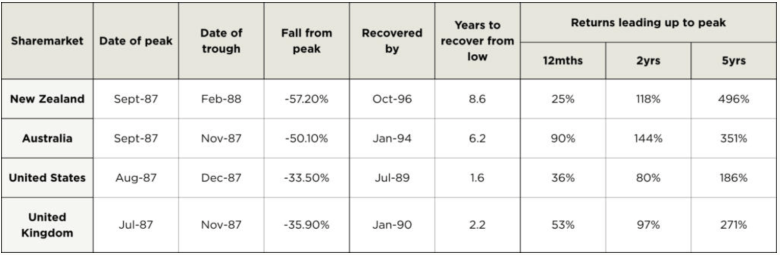
The crash was the culmination of an extraordinary period in our financial history and the damage spread well beyond the sharemarket.
Unlike the US, New Zealand entered recession in late 1987.
Dozens of listed companies disappeared over the following years as debt-fuelled business models unravelled, while commercial property slumped and banks were left nursing heavy losses.
Another legacy of the crash was the behavioural change we saw from investors.
Many investors who lost money vowed never to own shares again, and property became the preferred way to build wealth.
The crash wasn’t the only reason for that shift.
Falling interest rates, favourable tax settings, strong population growth and constrained housing supply in the decades that followed all contributed too.
But our country’s deepest sharemarket collapse, longest recovery and the severe destruction of investor confidence was another structural tailwind for residential property.
Nearly 40 years later, the scars of 1987 have faded.
The 45-year-olds who lost big back then are now in their 80s, while the children who witnessed that pain as teenagers are approaching 60.
Those children grew up with a distrust for the sharemarket, so their default financial plan was to buy a rental property or two.
That worked well through the 2000s and 2010s as prices increased at an annual rate of almost 7 percent, the return that ensures prices will double every 10 years.
Throw in some leverage and things looked better still, so everyone kept on doing it.
Their children, however, are now in their late 20s or early 30s and they’ve had a very different experience.
Anyone they know who has bought in the past five-and-a-half years has at best broken even, or at worst lost their deposit.
When you adjust for inflation and account for the costs of ownership (which keep rising) things look uglier still.
These 20- and-30-somethings still aspire to live in their own home, but rental property investments don’t hold quite the same attraction.
In contrast, they have no fear of financial assets like their grandparents did, thanks to KiwiSaver and the advent of modern investing platforms.
Index funds and exchange-traded funds are widely understood, international diversification has become normal, and share investing happens automatically every payday for millions of New Zealanders.
Our collective love affair with residential property isn’t over, but as an asset class it no longer enjoys the aura of invincibility it once did.
For decades, the memories of 1987 saw many New Zealanders favour property over financial assets.
Today’s investors have been shaped by a very different set of experiences.
They see the sharemarket as central to their wealth-building strategy, and they view volatility or declines as an opportunity.
Disclaimer: This information is general in nature and should not be regarded as specific investment advice. Craigs Investment Partners do not accept liability for the results of any actions taken or not taken upon the basis of this information, or for any negligent mis-statements, errors or omissions. Those acting upon this information and any recommendations do so entirely at their own risk. Craigs Investment Partners did not take into account the investment objectives, financial situation or particular needs of any particular person in the preparation of this information. This information does not constitute a representation that any investment strategy or recommendation is suitable to your individual circumstances or otherwise constitutes a personal recommendation. Craigs Investment Partners recommend seeking advice from a licensed financial adviser about your financial situation and goals before acquiring any financial products or making any investment decision. To talk to one of Craigs Investment Partners’ financial advisers, please call 0800 272 442. Craigs Investment Partners Limited is a NZX Participant firm. The Craigs Investment Partners Limited Financial Advice Provider Disclosure Statement can be viewed at craigsip.com/tcs. Visit craigsip.com.