
Venkat Raman
Auckland, September 7, 2026
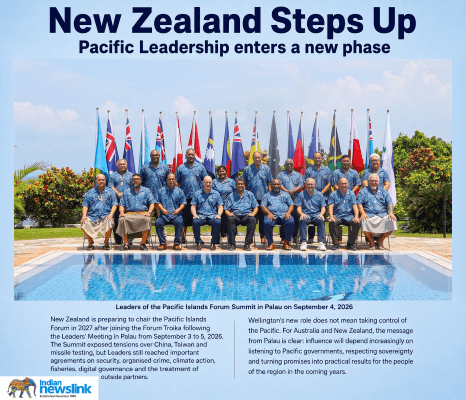
New Zealand is moving into the Leadership of the Pacific Islands Forum after the 55th Leaders’ Meeting in Palau, joining the Forum Troika ahead of hosting the organisation in Auckland in 2027. Palau remains the current Chair, but New Zealand is now the incoming Chair and will help shape the regional agenda.
Wellington has not “taken charge” of the Pacific.
The Forum is a consensus-based organisation of 18 members, and its Chair cannot dictate policy. What New Zealand gains is political influence: it can help set priorities, build consensus, represent collective positions and oversee implementation of decisions.
Prime Minister Christopher Luxon had outlined the challenge before travelling to Palau.
“New Zealand wants a Pacific region that is peaceful, prosperous, and resilient. The Pacific is facing a more complex set of challenges than ever before, and no one country can respond to them alone,” he said.
Mr Luxon said that overseas conflicts, economic uncertainty, and geopolitical competition have significant implications for Pacific countries, and that the consequences of these events are being felt now more than ever.
A rare break in consensus
The Palau meeting did not descend into open infighting. Still, it exposed geopolitical tensions shaping the Pacific, with China’s intercontinental ballistic missile test across the Pacific as one of the most contentious issues.
The Leaders expressed concern and called for greater notification before such tests.
However, Nauru dissociated itself from that section of the communiqué, producing the only formally recorded break in consensus.
The disagreement mattered because the Forum has traditionally prized unity. It also reflected the complicated diplomatic positions of Pacific countries as they manage relationships with China, Taiwan, the United States, Australia and New Zealand.
The China-Taiwan rivalry was visible around the Summit. Palau maintains diplomatic relations with Taiwan, while several Forum members recognise Beijing. The Forum nevertheless agreed on most of its agenda.
Security beyond defence
The Leaders endorsed the Regional Peace and Security Action Plan 2026–2030 and advanced Waqa Moana, a Pacific-led initiative aimed at combating organised crime, narcotics trafficking and other transnational threats. Australia announced a A$ 600 million package to support regional security and law-enforcement cooperation.
Pacific governments are concerned not only about military competition but also drug trafficking, cybercrime, illegal fishing, financial crime and disaster response.
A proposed Solomon Islands Regional Security Treaty was not adopted outright.
Leaders called for further consultation, showing that Pacific states want cooperation but remain cautious about arrangements that could weaken sovereignty or allow larger states to dominate decision-making.
Despite international attention on China and strategic rivalry, Climate Change remained at the heart of the Forum’s concerns.
The Leaders endorsed the BELAU Declaration for Urgent and Inclusive Climate Action, reaffirming the importance of the 1.5°C goal and accelerating the transition towards renewable energy. They also secured additional pledges for the Pacific Resilience Facility, intended to provide Pacific-owned financing for vulnerable communities.
Climate policy remains a test for both Australia and New Zealand. Pacific Leaders continue to demand stronger action, while Canberra’s fossil-fuel exports and Wellington’s oil and gas policies expose both governments to criticism.
The Forum also adopted the Waka Manu Regional Pacific Fisheries Strategy 2026–2035 and backed work on digital governance, artificial intelligence, health, disability rights and economic resilience.
Pacific Centrality with new rules for outsiders
The Forum had a message for ‘outsiders.’
The Pacific Leaders increasingly prefer China, the United States, Japan, Australia and New Zealand to respond to priorities set by Pacific governments rather than arrive with competing strategic agendas.
This strengthens ‘Pacific centrality,’ the principle that decisions affecting the region should be shaped first and foremost by Pacific countries themselves.
Foreign Minister Winston Peters had already emphasised New Zealand’s renewed engagement.
“We have placed a huge emphasis on the Pacific. For the first time in New Zealand history, we have undertaken high-level visits to all Pacific Islands Forum countries in the space of a single term. We have welcomed a range of Pacific Leaders to New Zealand,” he said.
Mr Peters cited this ‘as a vital programme of engagement with Pacific partners,’ saying, “We look ahead to New Zealand hosting the Forum next year.”
Those visits carry greater weight because New Zealand must demonstrate that its Pacific policy rests on sustained relationships rather than occasional Summit diplomacy.
The test for New Zealand and Australia
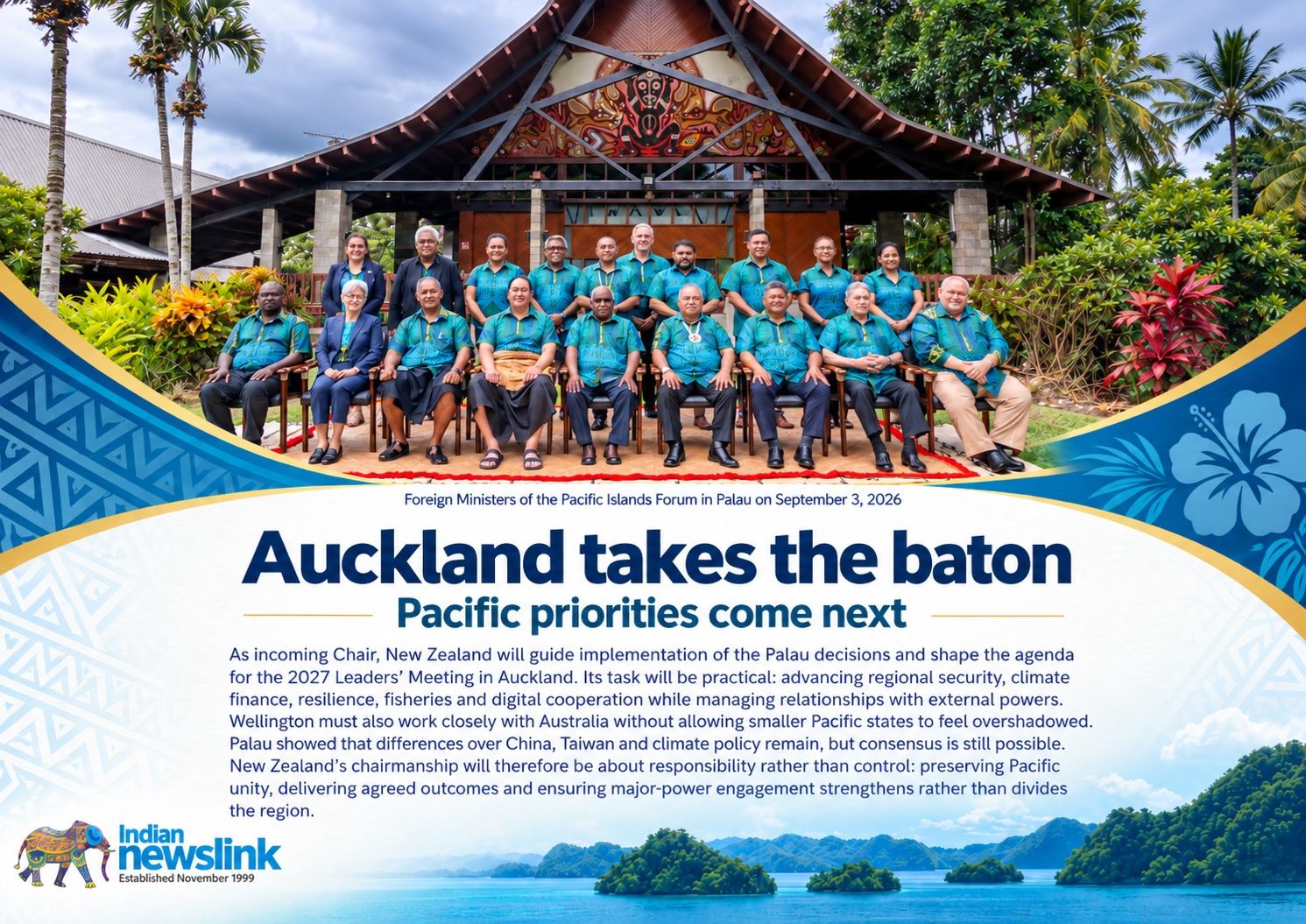
As incoming Chair, New Zealand will help oversee implementation of the Palau decisions and prepare the agenda for the 2027 Leaders’ Meeting in Auckland.
That allows Wellington to focus on practical delivery: regional security, climate finance, resilience, fisheries, digital cooperation and management of outside partners.
It also gives New Zealand a balancing role. It must maintain close strategic cooperation with Australia while ensuring smaller Pacific states do not feel that Canberra and Wellington are attempting to dominate the Forum.
The same lesson applies to Australia. Canberra remains the region’s largest development and security partner, but financial scale no longer guarantees political influence.
Pacific countries increasingly insist on being treated as sovereign partners with their own priorities, rather than pieces on a geopolitical chessboard.
The Forum’s direction is becoming clearer. It wants stronger regional institutions, greater economic and security cooperation, tighter expectations of external partners and more control over the way major powers engage with the Pacific.
Palau showed that tensions are real, particularly over China, Taiwan and climate policy.
But it also showed that disagreement need not destroy the Forum’s ability to act collectively.
For New Zealand, taking the Chair in 2027 will be less about “taking charge” than about taking responsibility. Its success will depend on whether it can preserve Pacific unity, turn declarations into practical outcomes and ensure that engagement by larger powers strengthens rather than divides the region.
If Wellington can do that, New Zealand’s chairmanship will benefit not only itself and Australia, but the wider Pacific at a time when global competition is placing unprecedented pressure on the region.