
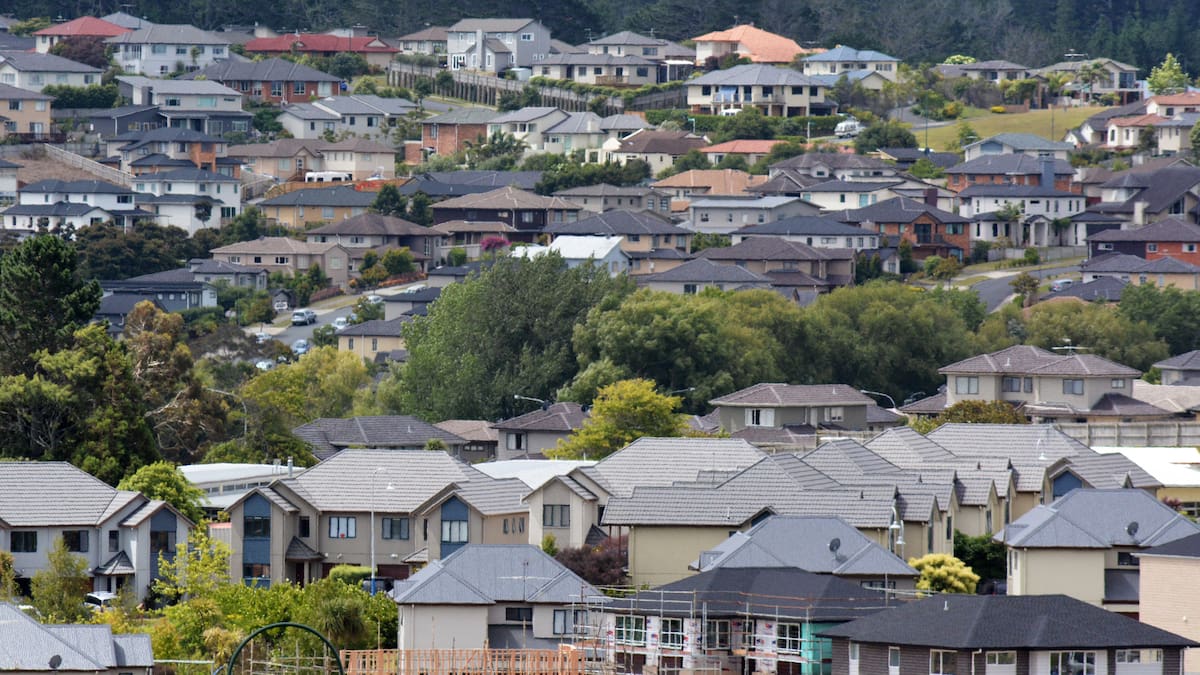
Wellington recorded the largest quarterly decline since March 2023 with the average home value falling 3.5% to $878,001.
QV national spokesperson Simon Petersen said the latest figures show buyers remain firmly in control heading into spring.
“Buyers have plenty of choice, they’re taking their sweet time, they’re negotiating hard, and they’re prepared to walk away if the numbers don’t stack up. That’s putting downward pressure on property values,” he said.
Petersen said it was more of a slow deterioration rather than a sudden correction.
“The market has been flat to gently falling for some time, and those smaller movements are now starting to add up in some parts of the country.”
He said while the overall direction is clear, the pace of change still varies considerably from place to place.
Christchurch, one of the country’s more resilient housing markets this year, slipped 0.5% – its first negative quarterly result in 11 months.
Across the main urban areas, home values fell furthest this winter in Gisborne, down 5% over the three months to the end of August. Greymouth (-3.7%) and Hastings (-2.9%) also recorded larger-than-average declines.
There were pockets of growth in the lower South Island, with Queenstown recording a 1% quarterly increase, while home values inched 0.1% higher on average in both Timaru and Invercargill.
Petersen said the next few months would test whether the market had any real appetite to break out of its holding pattern.
“Spring usually brings more listings and more activity, but not necessarily more competition,” he said.
“If buyer confidence stays where it is, vendors may simply find themselves competing harder for the same pool of cautious purchasers.
“Last week’s [Official Cash Rate] increase is another factor for buyers to weigh up, alongside the wider economic outlook. Household budgets are still under pressure, the election is getting closer, and buyers know they don’t need to rush.”
Wellington recorded the largest quarterly decline since March 2023 with the average home value falling 3.5% to $878,001. Photo / 123rf
Yesterday, the National Party pledged to make it easier for first-home buyers to get 5% deposits by extending the income cap under an existing First Home Loan scheme to $300,000.
Currently, the scheme has an income cap of $95,000 for an individual buyer with no dependents or $150,000 for a loan to multiple buyers or a single buyer with dependents.
Squirrel Mortgages chief executive David Cunningham told Newstalk ZB this morning the existing caps were way too low.
“Raising them to $300,000, it really opens it up to most young Kiwis looking to buy a home and gives them access to what’s a really good scheme,” he said.
“People are certainly pushing well over the current cap … you could argue there doesn’t need to be a cap at all.”
Cotality chief property economist Kelvin Davidson told Newstalk ZB it was a “sensible” policy.
“As soon as you’ve got two people earning in the household you can easily go over those caps pretty quickly,” he said.
“From what I can tell it will help more people into home ownership because there are some people who are being shut out because they are over the income caps.”
Davidson said he didn’t see it as a big risk to pushing house prices higher, noting first-home buyers already hold a record share in the market.
“We’re not talking about thousands of people here. [Increasing the cap] is not going to transform the market. It will help some people.”