
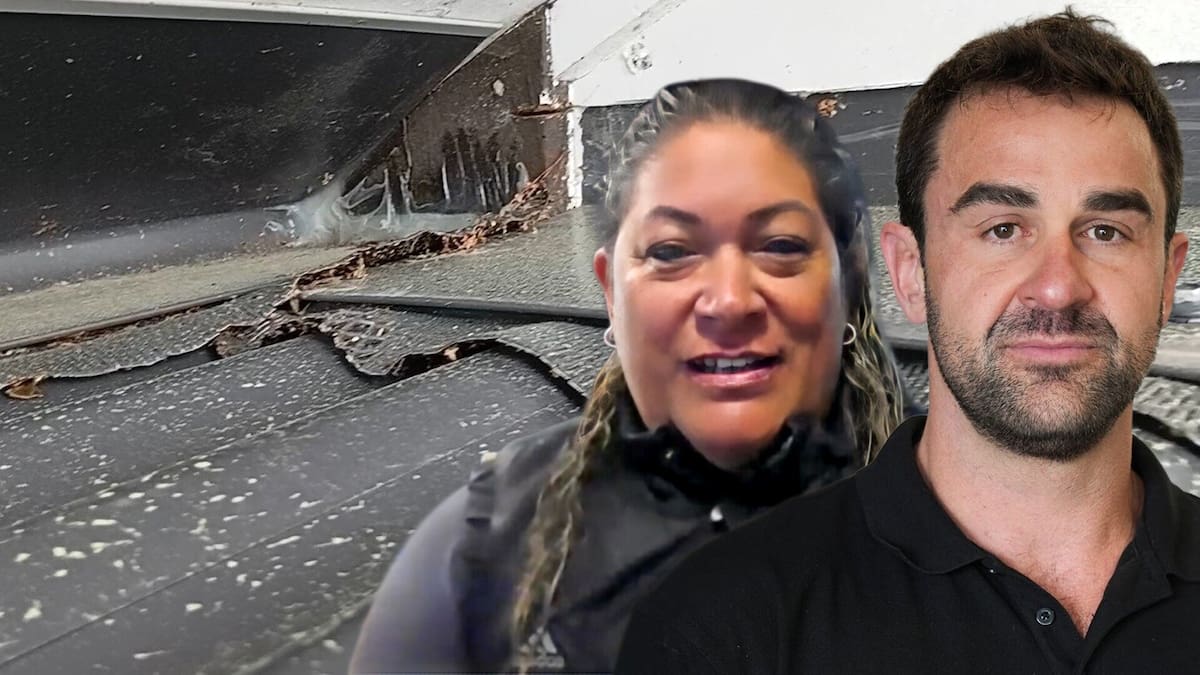
“It’s been heartbreaking and stressful. I’m just disappointed.”
Leaks from a newly installed roof damaged the shelving in Swinitha Brown’s hot water cupboard.
Brown provided images and videos to the Herald which show water dripping from the kitchen extractor fan, watermarks from leaks in her hot water cupboard and sunlight shining into her attic through a hole in the new roof.
Roofbuddy – which markets itself as helping customers find “vetted” and “trusted” roofers – has apologised.
The company’s CEO James Logan accepted the work was substandard, said he’s “sorry Ms Brown has been through this” and has now agreed to fix the botched job.
Sunlight can be seen shining through a hole in Swinitha Brown’s newly installed roof.
“We have a tremendous amount of empathy for the situation that she’s in,” he told the Herald.
Brown took the roofer and Roofbuddy to the Disputes Tribunal.
At the hearing, Roofbuddy agreed to supply new materials and pay for the installation of a new roof.
While agreeing to remediate the work, Logan said Roofbuddy did not accept liability for the defective job, with a decision on that to be determined by the tribunal at a later date.
The roofer, who was asked to attend the hearing, didn’t turn up.
Swinitha Brown is using towels and buckets to collect water from leaks in her roof.
Roofbuddy’s website states that roofers who join its platform need Licensed Building Practitioner (LBP) certification.
The Herald has confirmed the Napier-based roofer chosen to replace Brown’s roof was not licensed and has since shut down his business.
Asked whether Roofbuddy’s marketing was misleading, Logan said it wasn’t.
However, after the Herald questioned the website description that roofers need to be LBP-certified, Logan changed it to say certification must be held by the business owner or a staff member.
“I’ve had every page reviewed today against one principle: describe only what we do,” he said.
Logan said its checks prior to “on-boarding” the roofer to its site included relying on a reference from an LBP who’d employed him, confirmation his company was registered, that he had liability insurance and that Roofbuddy had also verified he had completed 22 other jobs without issue.
Logan said when linking up with Roofbuddy, the roofer also said a member of his team was licensed.
Roofbuddy has subsequently improved its checks.
“Our verification at the time relied on the documents supplied … together with that reference. We have since strengthened this: licensing is now checked directly against the [Licensed Building Practitioner] public register,” he said.
An assessment from roofing firm Edwards and Hardy described the finished job as very poor. Its report noted multiple issues, including rusty chimney flashings that were starting to pull away just six months after installation. Photo / Edwards and Hardy assessment report.
Brown said her experience with the roofer was an “absolute shambles” with poor communication and shoddy workmanship that was carried out without the use of scaffolding despite the safety equipment being included in the original quote.
Old roofing iron was left strewn across her backyard despite the quote also including disposal of scrap.
“Our supposedly new roof is worse off than our old roof was,” she told the Herald.
Old roofing iron was dumped on Swinitha Brown’s front lawn.
When the new roof leaked during heavy rain, Brown paid for roofing company Edwards and Hardy to inspect the condition of the roof.
It produced a report that recommended the roof be “fully stripped back and redone by a professional”.
The report, completed in March this year, found evidence of rusty, damaged flashings that were showing signs of water ingress.
The use of silicone was “extensive” and translucent roofing panels were “cracked and damaged and some parts are missing”.
Scratches were visible on newly installed flashings and silicone was used excessively to patch up holes, according to an independent assessment.
“The roof condition is poor, considering it was completed no more than six months ago,” the report said.
Emails show Brown raised concerns about the leaking roof with Roofbuddy on January 5 this year and a representative responded and urged her to contact the roofer, as they held the warranty.
Swinitha Brown’s engaged a roofing company through the platform Roofbuddy and ended up with a defective roof that leaks in heavy rain.
On January 12, Roofbuddy emailed Brown with information about the Consumer Guarantees Act, recommended the Edwards and Hardy assessment and offered to review its findings.
Roofbuddy emailed again on January 27, offering to discuss the inspection of the job.
“Our written offer in January to review her findings and work out how we could help went unanswered; the next document we received was the tribunal’s notice. She has our full support anyway,” Logan said.
Brown subsequently received a call from the roofer, who she claimed swore at her while saying “that’s what you get when you go for a quote that’s cheap”.
“I was fuming. I just thought, how can you just fob somebody off and have the audacity to say that to me and have no accountability or responsibility of owning that he has stuffed up our roof?”
Water bubbles in the wall in Swinitha Brown’s bathroom because of leaks.
The Herald contacted the roofer, who said he was a former patched gang member who’d “had a bad run” with his roofing business.
He claimed the roof could have been damaged by other roofers climbing up on to it and that he was let down by contractors, like scaffolders, who “didn’t turn up”.
Brown rejected the roofer’s claims, said there were plenty of alternative scaffolding firms in Gisborne and noted the only other person to climb on to the roof was the expert assessor.
Roofbuddy CEO James Logan. Photo / Cameron Pitney
Logan is adamant Roofbuddy didn’t walk away from its responsibilities and said there have been 38 other cases, including Brown’s case, where the company resolved issues for customers who used its platform.
He sent the Herald a breakdown of instances where he said his company paid to finish jobs or refunded customers when roofers abandoned a job, left it partially completed, or did substandard work.
He said Roofbuddy incurred costs in every case and had the company not helped those customers, they would have been left out of pocket with “no remedy whatsoever”.
Roofers on Roofbuddy who failed to meet their obligations were “deplatformed”, he said.
Swinitha Brown is using towels and buckets to collect water from leaks in her roof.
Roofbuddy’s website says it offers independent quality assurance checks on completed jobs, but Logan said that in Brown’s case, the roofer told her he would handle all sign-offs and it wasn’t necessary to contact Roofbuddy for an inspection.
“That instruction should never have been given or accepted,” Logan said.
He said while the checks it carried out were “by no means perfect”, he believed the protections his company offered are better than relying on the “unregulated open market”.
Logan referred the Herald to another customer, David Collinge, who lives in Wellington’s Ngaio and used Roofbuddy to find a roofer to re-roof his home late last year.
Collinge said after paying a deposit for the job, the owner of the roofing company “ghosted” him, “took my money and then disappeared”.
“My first response was extreme anger.”
However, he said when he raised the issue with Roofbuddy, they “had my back” and completed the job.
“Without Roofbuddy, I would have been in a lot of trouble as I am on a pension.”
He said Roofbuddy’s issue could be that there were “cowboys” who wanted to use the platform.
He believed Roofbuddy’s systems to check roofers could be improved.
“Roofers should have to prove their worth by passing an interview or providing proof of their qualifications. But the main thing is someone tried to rip me off and Roofbuddy put it right,” he said.
While Roofbuddy has a policy of hosting LBP-certified roofers, most re-roofing projects don’t legally require a roofer with such qualifications.
The Ministry for Business, Innovation and Employment (MBIE) told the Herald that constructing a new roof is considered Restricted Building Work (RBW) if resource consent is required.
In those circumstances, the work must be undertaken or supervised by an LBP.
However, an LBP is not required when old roofing iron is replaced with comparable materials.
“When undertaking any kind of building work, it is always advisable to check whether your tradesperson is appropriately licensed,” an MBIE spokeswoman said.
Brown said she did ask the roofer for his LBP licence.
“He [the roofer] told me that I didn’t need to see it and that it was not my issue.”
Michael Morrah is a senior investigative reporter/team leader at the Herald. He won News Journalist of the Year at the 2025 Voyager Media Awards and has twice been named reporter of the year at the NZ Television Awards. He has been a broadcast journalist for 20 years and joined the Herald’s video team in July 2024.