
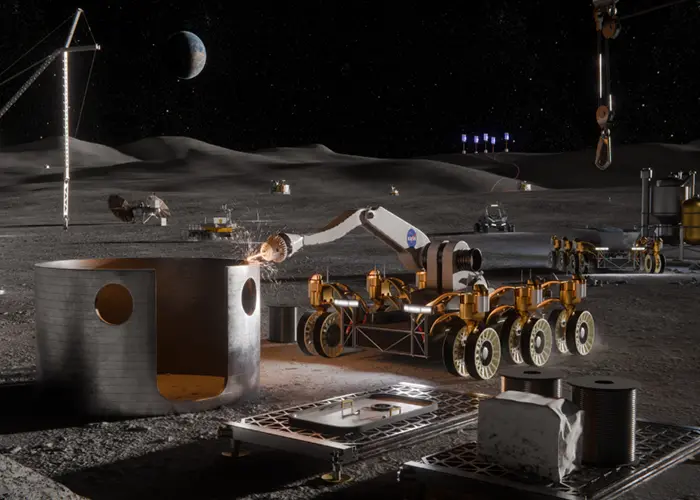
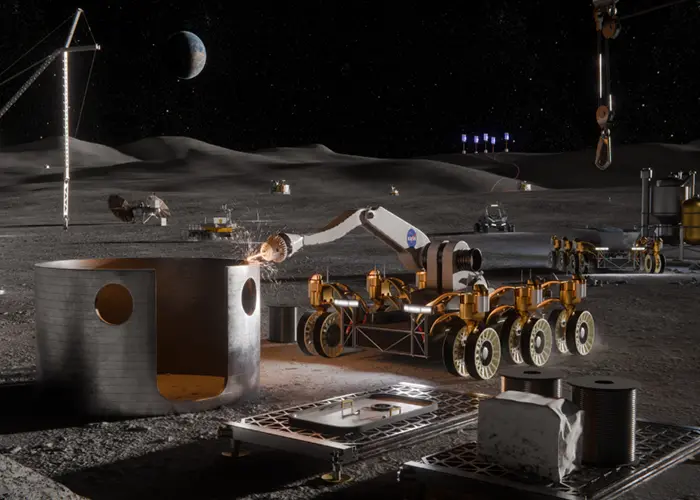
NASA is seeking proposals to advance technology and infrastructure aimed at supporting exploration of the Moon and establishing a Moon base in the lunar South Pole region.
Announced on Tuesday, Sept. 8, the solicitation targets capability gaps including power generation, oxygen extraction, and producing materials on the Moon needed for construction and operations.
“NASA is accelerating the development of key technologies and closing critical gaps needed for long-term human exploration at the Moon,” said Greg Stover, director of NASA’s Advanced Research and Technology Division. “Partnering with industry will strengthen the U.S. industrial base as we mature the capabilities and infrastructure needed for a sustainable lunar presence.”
The agency said the NextSTEP-3 Broad Agency Announcement, Appendix A: Lunar Enabling Infrastructure Accelerator solicitation aims to mature and demonstrate capabilities in five areas:
• Vertical solar array technology for power generation, management, distribution, and energy storage.
• In-situ resource utilisation oxygen from regolith production to extract oxygen bonded to lunar rock and dust.
• A radioisotope Stirling generator, described as nuclear energy technology that uses heat from fissile materials to generate electric power for spacecraft systems in remote environments.
• In-space advanced manufacturing to reduce reliance on resupply missions from Earth and improve mission flexibility and resilience.
• Innovative nanomaterials production to improve the commercial availability and quality of nanomaterials for lunar exploration.
NASA said the solicitation is intended to cultivate U.S.-led capabilities while maintaining open competition among private industry, academic institutions, and not-for-profit entities, with international partners participating through U.S.-led teams.
The agency said it may apply insights from contracts awarded under the solicitation—including technical data and demonstration results—to shape future acquisition strategies.
More information on NextSTEP-3 is available at https://go.nasa.gov/4x20o3t.