
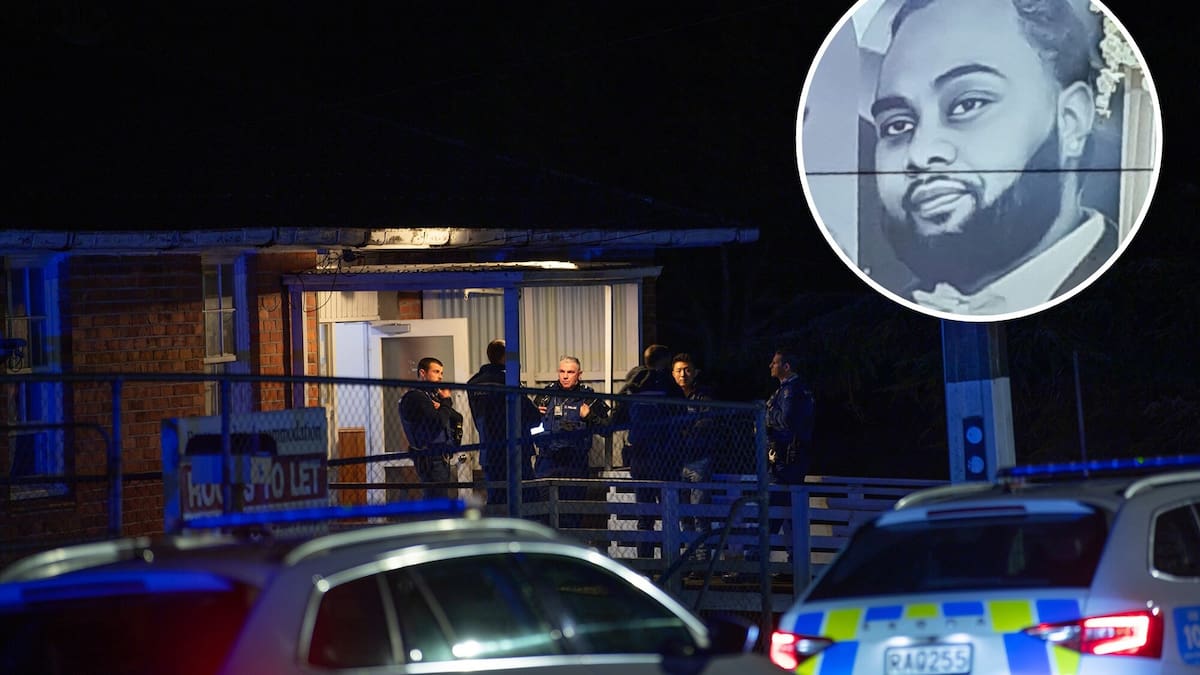
“That decision is something our family will never understand. That is something we will think about for the rest of our lives,” the family representative, reading out a shared statement, said.
What the court was told, however, was that Tumaialu, 32, was deported from Australia in 2019 after serving a sentence for another “escalation of violent fisticuffs” when he was 18 years old.
His childhood was marked by violence and abuse and a psychological report before the court said he had antisocial and narcissistic personality traits and anger issues made worse by substance abuse.
CCTV footage showed the night of June 29, 2025, started friendly, as Tumaialu and Fifita, 33, sat together on the deck of Beatty Lodge in Auckland.
The pair were seen coming in and out of their rooms throughout the evening and sitting together on the deck while talking, smoking and eating.
Then at 8.20pm Fifita stood up, followed seconds later by Tumaialu, and both men raised their fists.
According to a summary of facts, Fifita threw the first punch, but Tumaialu blocked it and threw him to the ground.
When the victim got up, Tumaialu lunged at him with both hands and Fifita backed away, then swung back.
“The defendant walked forward as Mr Fifita backed away,” the Crown stated in the summary of facts.
The pair moved away from the CCTV’s view, but the court heard this was when Fifita was stabbed, as cameras captured him already bleeding by the time he threw a chair at Tumaialu and chased him off the deck.
Tumaialu approached the victim again seconds later, breaking a leg off a small table that Fifita had thrown off the deck, but he walked away after Fifita threw his bag at him. The hostilities lasted just over one minute.
Three minutes later, Tumaialu returned to the deck, tidied up and sat down next to Fifita as if nothing had happened.
Fifita picked up a piece of wood and swiped it at Tumaialu but he didn’t make contact, and the man did not react.
Ivan Jordan Fifita died after an Ōtāhuhu incident in June 2025. Uepa Tumaialu was sentenced today for his manslaughter.
They sat together for a few more minutes before Tumaialu left for his room.
Another resident called 111 a short time later after noticing blood on Fifita’s hands as he clutched his stomach and had blood coming from his mouth.
The defendant left the lodge within a minute of 111 being called. He threw the bloody knife in a nearby driveway and checked into other accommodation.
He was arrested the next day after showing up at the Ōtāhuhu Probation Office.
He declined to speak with police at the time about what had happened.
An autopsy of Fifita showed he died from a single stab wound that penetrated his liver and went through muscle tissue to his heart.
Sleepless nights, tears and breakdowns
A victim impact statement was read out in court by a family member on behalf of Fifita’s wider whānau, outlining the “profound and lasting consequences” of his killing and their devastating loss.
He said their grief had been overwhelming, with pain that followed them every day along with immense heartbreak, anger and frustration.
There had been “countless” sleepless nights, tears and breakdowns and family members who had once been “outgoing and full of life” were now quiet and withdrawn.
“I have seen them lying awake at night unable to sleep because the pain of losing Ivan is constantly on their minds.”
Their emotional pain had not lessened with time, he said, as the reality Fifita is not coming home has become more difficult to accept.
Their suffering was made worse by every court appearance, forcing them to relive the worst day of their lives and the circumstances of Fifita’s death “over and over again”, he said.
They understood there was a fight between Tumaialu and Fifita, but he said they didn’t know why the defendant hadn’t called emergency services.
“That decision is something our family will never understand. That is something we will think about for the rest of our lives,” he said. “We know we will never have the answer to that question.”
They had been robbed of a future with Fifita, who was deeply loved.
“His life mattered and his absence is felt every single day.”
He said they respectfully asked the court to consider the profound, lifelong effect the killing had on his family.
Three strikes
For Tumaialu’s sentence, Crown lawyer Jazmine Cassidy was seeking a seven-year starting point with an uplift of six months for his relevant violence-related history in Australia and New Zealand.
Tumaialu’s history showed continued, escalated levels of offending that had led to Fifita’s death, she said.
Williams was seeking a 25% sentence reduction for Tumaialu’s guilty plea, while Cassidy said 10% was more appropriate as he had pleaded guilty six months before a trial was set.
She also noted that because the killing was on the day the Sentencing (Reform) Amendment Act 2025 came into force, any discounts for Tumaialu’s personal circumstances were capped at 40%.
Justice Pheroze Jagose pointed out that the Three Strikes Law was also reinstated in June 2025, and Tumaialu qualified.
The Crown also asked that Tumaialu serve 50% of any prison sentence.
Williams, on the other end, was seeking a six-year starting point for his client and said the “only issue” with the Crown’s submissions was that there was no accommodation “at all” for Fifita’s conduct on the night he died.
A ‘mutual confrontation’
“I think the point is there’s at least a mutual confrontation,” Justice Jagose interjected.
Williams also argued there was no premeditation in Tumaialu’s actions, to which the judge replied there was “some” in him carrying a knife.
Williams said in terms of his client only pleading guilty in April, there were issues with his mental health and moments when he threatened to fire him or changed his mind, which the judge accepted.
Justice Jagose acknowledged Fifita’s family in court and what they had said in their statement.
“They are traumatised by your decision to leave Mr Fifita bleeding and dying,” he said, addressing the defendant.
He said Tumaialu had declined to participate in Corrections’ pre-sentence report, nor had he offered anyone who knows of his background to speak on his behalf.
But the report said he had a violent and abusive childhood in New Zealand and Australia with periods of homelessness.
Police investigating the scene at Beatty Lodge in Ōtāhuhu, Auckland, where 501 deportee Uepa Tumaialu fatally stabbed Ivan Fifita. Photo / Hayden Woodward
He was deported from Australia after being sentenced there to 45 months in prison in 2013 for intentionally causing serious injury in what the judge at the time called “an unnecessary escalation of violent fisticuffs”, Justice Jagose said.
Back in New Zealand, he had been in and out of prison for family violence, property and traffic charges, including the use of a knife and machete.
He had previously indicated to the court, the judge said, his gang connections as well as multi-substance abuse to self-medicate for schizophrenia.
Multiple psychological assessments before the court from his previous offending suggested Tumaialu might have a personality disorder or at times be suffering from paranoid schizophrenia or drug-induced psychosis.
But in an assessment of Tumaialu this year, a psychiatrist said while he was concerned about the man’s self-reported mental illness, he diagnosed him with an unspecified psychotic disorder.
However, the psychiatrist did not think there was a connection with that disorder and Fifita’s killing.
What he did think had a connection with the manslaughter was Tumaialu’s anti-social and narcissistic personality traits, anger management and impulsivity issues, all exacerbated by substance abuse.
Justice Jagose began with a starting point of six-and-a-half years’ imprisonment with an uplift for Tumaialu’s history and reductions for background, mental health and guilty plea.
He landed at an end sentence of four years and 10 months in prison, and imposed no minimum period of imprisonment, saying Tumaialu’s release, and the future safety of the community, would be in the hands of the Parole Board.
Tumaialu was also given his first strike, meaning any further qualifying offending could have harsher consequences.
Ella Scott-Fleming has been a journalist for three years and previously worked at the Otago Daily Times, Gore Ensign and Metro Magazine. She has an interest in court and general reporting. She’s currently based in Auckland covering justice-related stories.
Join the NZ Herald’s Open Justice team for Case by Case, a video and podcast series examining the disputes and decisions making headlines across New Zealand.