
Foldables – where Samsung, Oppo and others have models on the market for years – are already a premium price category because they involve cutting-edge display technology.
But that’s been amplified by the “RAMageddon” effect, or data centres sucking up components, making them scarce and expensive for consumer products.
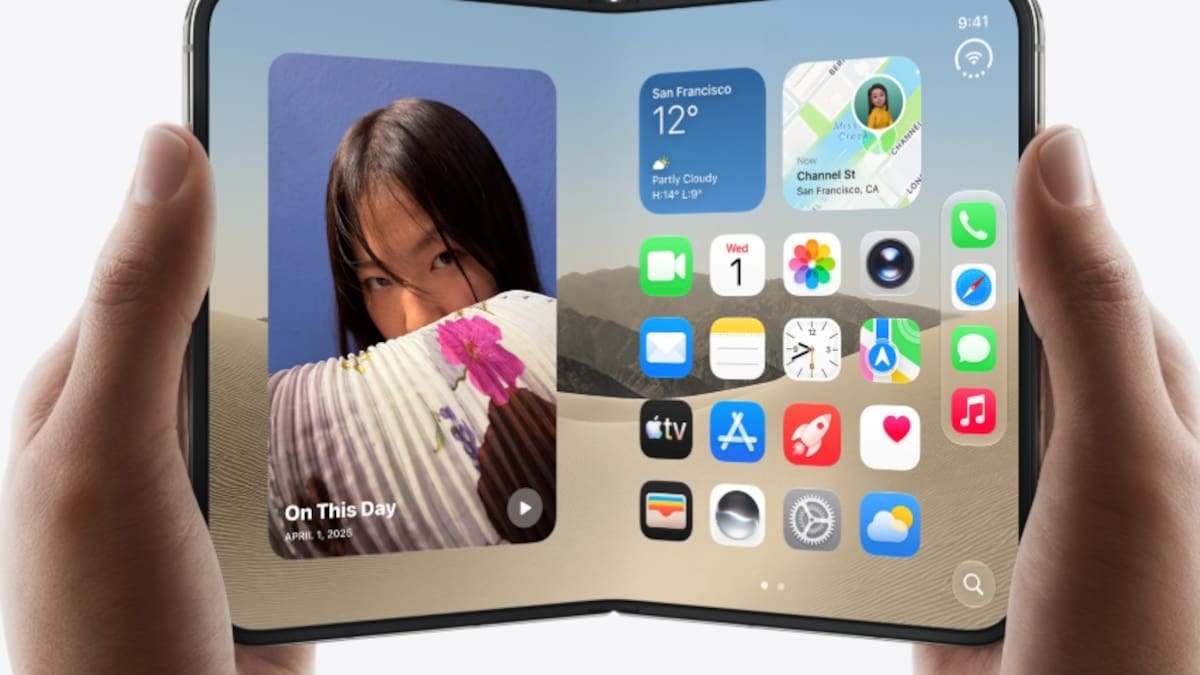
As widely expected, the Duo has a squat “passport” form factor, similar to Samsung’s recently released Galaxy Fold8 (which costs $3099 with 256GB, $3499 with 512GB or $4299 with 1TB), but with curved edges on its right.
The outer display is 5.4-inches. The “open passport” interior offers 7.6 inches.
The Duo has a TouchID sensor on the button, but no FaceID (like other foldables, some biometric features have been cut to save space). You can also unlock it with your Apple Watch. Touch ID is mounted on the side, so you can use it whether the Duo is open or closed.
Apple’s “What’s in the box” shot for the new Duo.
The new foldable comes in two colours: Night Sky and Star White, aka dark blue or white.
The early generations of foldables from other phone makers made sacrifices on battery life and phone quality.
The Duo goes in the other direction with battery life: Apple says Duo will last up to 31 hours using its inner display and up to 44 hours using its outer screen. That’s longer than the iPhone 18 Pro (34 hours) or 18 Pro Max (43 hours), also previewed today.
The Duo’s outer screen.
As you mix and match screens, Apple says to expect around 24 hours of typical use per charge for the Duo.
The Duo has the same dual 48-megapixel rear camera system as the iPhone 17, but lacks the “pro control” smarts of the new iPhone 18 Pro and Pro Max, such as variable aperture.
The Duo offers 0.5 to 2x optical zoom to the 18 Pro and Pro Max’s 0.5 to 8x.
You down get the same 48MP Fusion Ultra Wide outer camera as the iPhone 18 Pro models.
And the Duo benefits from the same Photographic Styles updates, allowing you to tweak textures and grain levels in shots.
The foldable also has a 12MP inner display camera and a 12MP front or “cover” or “selfie” camera. That compares to 18MP for the iPhone 18 Pro and Pro Max’s selfie cams.
The Duo does get a number of foldable-specific camera features, including Duo FaceTime, which lets someone join a video call on the outer display.
For “timer” photos, there’s also a new Smart Take feature that can automatically take photos once it detects you’re striking a pose within the frame.
Under the bonnet, the Duo features the same new 6-core CPU, 7-core GPU A20 Pro chip as the new 18 Pro and Pro Max.
Apple iPhone Duo features an alarm clock mode.
Durability was an issue for some early foldables.
Apple says the Duo’s hinge uses support ribs and ceramic-fibre inserts that are three times stronger than Grade 5 titanium.
A custom nanotexture reduces glare and reflections, while AI-assisted manufacturing pairs each hinge with its best-fit housing for precise alignment, the company says.
Controls shift from the outer display to the inner screen and dynamically adjust depending on how the phone is positioned.
See the Duo’s full tech specs here.
The iPhone 18 Pro.
iPhone 18 Pro and Pro Max
Apple also revealed two new iPhones today: the iPhone 18 Pro and Pro Max.
Each has the same design as its predecessor, including aluminium unibody introduced last year and the same display size (16.3-inch and 16.9-inch respectively).
But beneath the surface there are a number of key changes, including the new A20 processor, promising a performance boost of up to 40% over the 17 Pro, and the new 48MP Fusion Main camera with variable aperture that automatically shifts between ƒ/1.48, ƒ/1.8, ƒ/2.8 and ƒ/4 depending on lighting and depth of field. The widest option delivers 50% better low-light performance, Apple says.
The Qualcomm cellular modem used in the iPhone 17 is replaced by Apple’s C2, which the firm says will deliver faster uploads (a key factor as AI shifts the historic upload/download balance) but consume 15% less power.
The 18 models also have a completely redesigned thermal cooling system that triples the cooling surface area. That means the 18 Pro models can run intensive tasks for longer without having to throttle down the processor. Apple says you’ll see up to 40% sustained performance gains.
An upgraded Dynamic Island can now show three Live Activities at once, while continuing to enable Face ID.
There are four colours: Black, silver, glacier, and an all-new burgundy. Pre-orders begin September 13, with availability from September 18.
The Pro is priced from $2549, the Pro Max from $2749 – $200 more than their predecessors’ base pricing amid the rampocalypse.
See the full tech specs here.
Apple also released the Apple Watch Series 12 with higher-frequency heart rate and HRV, the Watch Ultra 4 which Apple says “introduces readiness, a new feature that analyses a user’s recent activity, training load, vitals, and sleep score to offer insight into their capacity for the day ahead and AirPods 5 with up to 50% better active noise cancellation. ANC is now standard for all AirPods. Battery life is rated at four hours with ANC turned on, and hour better than the AirPods 4.
More to come
Chris Keall is an Auckland-based member of the Herald’s business team. He joined the Herald in 2018 and is the technology editor and a senior business writer.