
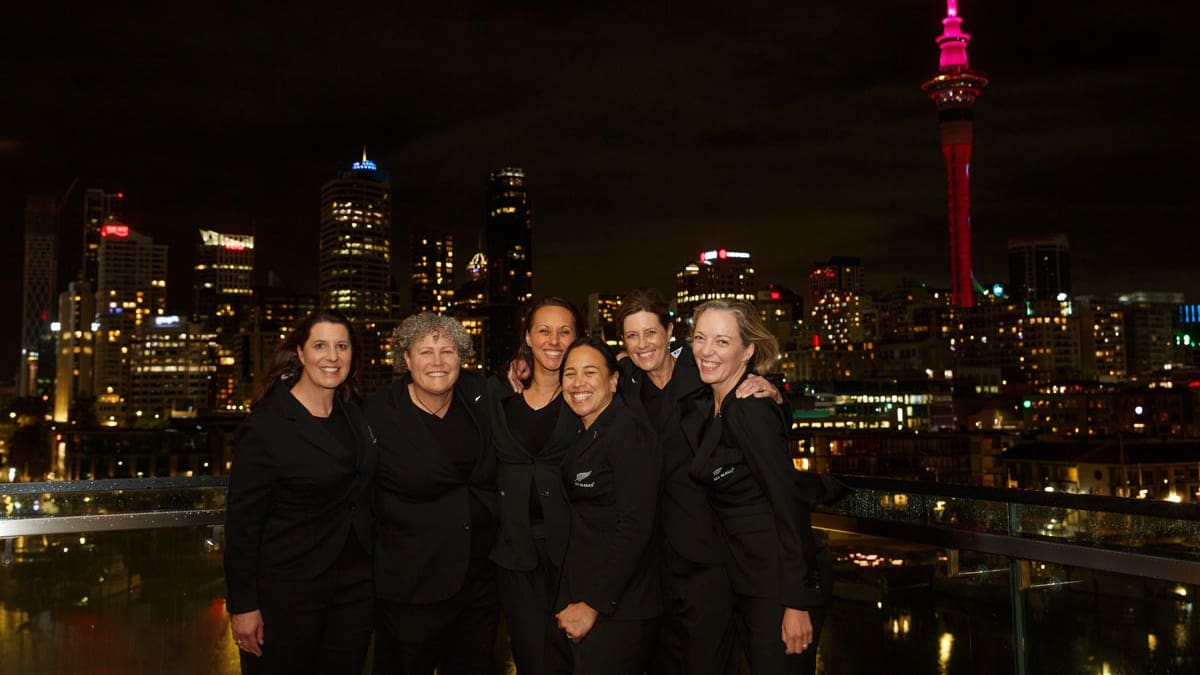
Megan Compain, who had a stint with the All Blacks between 2010-2020 as sponsorship and commercial manager before rejoining again in 2024 in a similar but revamped role, says: “You’re here because you’re the best that the union has determined to do your job.
“And then you do your job and you earn their [players’] respect and trust, and gender doesn’t play into it in this environment.”
There is unanimity among the female staff that the All Blacks’ environment is gender-blind. None feel that they are treated differently or have been particularly conscious of the growth in the number of women working inside the team.
They all say it surprises them when people outside the team are shocked at the gender mix of the All Blacks camp. Inside the team, they say there is little to no recognition of gender, it simply isn’t a thing that the players notice or talk about.
Teresa Te Tamaki, who joined the All Blacks in 2024 as a physiotherapist after 10 years working with the Chiefs, says that the challenge of working in the team is the same for the women as it is for the men.
It’s about being good at the job and winning the respect of the players through intuitively knowing what they need and when. Gender is irrelevant.
“It needs to be the right fit,” she says. “And if you’re good at your job, if you know your people and if you pick your moments about when you need to have a slightly softer side perhaps or when you need to be firm, if you do that then you’re good. If you can’t read the room and you don’t know how it needs to be, then it’ll be an issue if you’re male or female.
“The question is … ‘Do you find these guys quite easy to read?’ When to respect, when to joke, when to tell them off.
“They are a respectful group and it’s sometimes about making sure that they know that if there is something that they don’t like, if they prefer something, whether it’s specifically to do with an individual physio, they need to be able to say it.
“You want to make sure that they are very clear if what they are receiving is what they need.”
All Blacks prop Tyrell Lomax runs through strength testing exercises with All Blacks assistant physiotherapist Teresa Te Tamaki. Photo / Getty Images
New Zealand’s history – much like most other leading rugby nations’ – saw women placed on the periphery of rugby throughout most of the 20th century, in much the same gender-assigned roles that reflected the societal views and practices of the time.
The men played and the women worked in the kitchen to feed them afterwards. The men played and the women gathered up their dirty kit and washed it so it would be ready the following week.
The men played and the women attended to their cuts and scrapes. The men were lionised, the women marginalised and rugby’s gender inclusion was the respective team captains remembering at the after match to thank “the ladies in the kitchen” for their hard work.
With that serving as the historical backdrop, there is a danger of the female contingent either being subconsciously assigned or deliberately assuming old-world gender roles.
After all, the All Blacks are a team of young men enduring emotional highs and lows while they live out of suitcases – and there could be a temptation to mother them.
The very suggestion sets a few teeth on edge as gendered language, stereotypes and false presumptions don’t have a place inside the team.
“If a player’s sick and not at a game and watching the game, I might text him to check he’s okay,” team services manager Paula Powlesland says.
“I don’t think it’s necessarily that I’m female. I think it’s just that I am a caring person. And I had a moment to do that.
“But there’s plenty of fathers that are fathering types. Barnsey’s [assistant coach Neil Barnes] the kind of guy who will put his arm around and cuddle you like a dad. He fathers me. Fathers us.
“If you’re a people person, you’re probably being a people person, no matter what. And if you’re not, if you’re a bit more full-on, scary, you probably are doing the same, male or female. If you’re gruff or business-minded or whatever, that’s going to be the case.
“Some boys might feel more comfortable that it’s a female that’s checking in on them and others would feel less comfortable with it. I don’t know. I think it’s down to personality types more than gender.”
The last time the All Blacks toured South Africa [with midweek games] was 1996 and there was one woman – media officer Jane Dent – in the tour party.
Between 2004 and 2008, there was another sole female presence in team doctor Deb Robinson, before team services manager Bianca Thiel came on board in 2006 and nutritionist Kat Darry in 2008.
After Robinson moved on in late 2011, Darry and Thiel became known as “Thelma and Louise”, but they never saw that as anything other than a term of endearment and acceptance.
Both say that their experience with the All Blacks has defied all stereotypes. Darry – who is the mother of Sam Darry, who started the third test against the Springboks at lock – says her initial introduction to the team in the early 2000s was unimaginably family friendly.
The Darry family celebrate the All Blacks debut of Sam Darry (third from left) in San Diego. Kat Darry (left) is the team’s nutritionist. Photo / Christchurch Star
She had been doing some work for the Highlanders when their coach at the time, Tony Gilbert, was appointed to work with Sir Wayne Smith at the All Blacks: “Tony rang me and I was three weeks away from giving birth to Sam.
“He said he wanted me to come and work with the All Blacks. I said, ‘I’m about to give birth. I’m heavily pregnant’. But he said, ‘Don’t worry, take your baby with you’.
“So Sam travelled with me for a whole year. He came as a baby into the All Blacks’ environment while I worked with them.
“The manager at the time, Andrew Martin, who everyone knew as the Colonel, was incredible. He organised someone to come and look after Sam, or he just came in his car seat and I’d be seeing players.
“They never blinked for a minute. They just said, ‘bring your baby with you’.”
Theil says that when she came into the All Blacks, she was in a same-sex marriage. She has two children, one of whom she says is high-functioning autistic.
And when her family were invited to watch the 2015 World Cup final at New Zealand Rugby (NZR) headquarters in Wellington: “She didn’t like the noise in the room. So they built a little tent for her in the back of the room, so she could watch it in there with her headphones on and then she came out towards the end, she was sitting with everyone else proudly, watching the boys.”
Having had four women – Robinson, Thiel and Darry – as well as media manager Jo Malcolm, who came in on contract – at the 2011 World Cup, All Blacks coach Sir Steve Hansen was keen to have more female influence in the management team when he took over in 2012.
He had been part of the coaching team that inherited an All Blacks side in 2004 that was still wedded to amateur habits, such as using alcohol as a weapon to foster grudges and agendas between players, and with no rules around bringing women back to the team hotel.
He, and fellow coaches Smith and Sir Graham Henry, worked tirelessly to rebuild a values-based culture, where the players had greater respect for diversity and inclusion and greater responsibility for living up to expectations.
“I remember Steve saying that he loved having some women in the environment because it softened it and took away from that culture [of 2004],” Darry says.
“He felt that the boys tended to be more polite, that their language was always better in and around us. And so he always liked to keep that flow going because he felt that boys had much more respect for women.”
Given the broader picture of pay inequality in the wider labour market, continual cases of inappropriate behaviour against women in the workplace and the imbalance of male to female executives, it seems unrealistic to believe that those females who have journeyed to the All Blacks have found things quite as Lego Movie as they say.
Surely not everything is awesome? There must have been some subconscious bias encountered along the way? Some inappropriate suggestions or casually misogynistic language?
Or surely there have been times when the women in the All Blacks have felt they have had to work harder to have their voice heard or win the respect they deserve?
“I think absolutely in the past, there’s been times where I’ve had to be bolshier to prove that I should be listened to,” media manager Juliet Calder, who joined the team midway through 2024, says.
“And that probably wouldn’t have been necessary in the same way if I wasn’t female. That’s fair to say.”
All Blacks communications manager Juliet Calder (right) ahead of a media conference. Photo / Photosport
Darry says she has only had one incident where there was something inappropriate said: “It was when I started with Otago. And it was one of my husband’s friends who was in the team. He said, ‘Oh, I know why Katrina wants her job so she can be in the changing rooms post-game with the men walking around’.
“And I was like, really? Is that what you think? And that is the only comment in my whole career – and that was like 30 years ago.”
For Compain, who was the first New Zealander to play in the WNBA in the US, the challenge was not about winning the respect of the players but convincing some people in NZR that she was qualified to do the role when she started in 2010.
“In terms of the All Blacks environment, nobody ever queried my lack of rugby understanding or background,” she says.
“They embraced my performance background and the union was the opposite. I found I was fighting against the union, internally, for my lack of rugby knowledge to a point and then they kind of realised, ‘she’ll be okay at her job so she can pass’.
“But those initial years, it’s like, well, if you don’t know rugby, then you are no good to us? But in this environment, the players and the management understood performance.”
Gemma Brown, who is not technically assigned to the All Blacks but, as NZR general manager commercial partnerships, has spent most of the tour with them, says her only gripe lies with people outside the team asking her how she copes being away from her two children for so long and how her husband manages.
“And I’m like, in the same way every one of these women cope with their husbands being away.
“Exactly the same. They cook and they get the kids to school. They get s*** done.”
Her secondary gripe is that she doesn’t feel that the same question is asked of any of the men with children who are on the tour. The inequity between whom the question is asked carries an underlying expectation that a woman should not be away from her children but men can – and it’s the sense of being judged that rankles with Brown.
But the one universal complaint from the female contingent is that they don’t yet have issued team kit that was designed for women. The everyday adidas kit that they wear is all designed for males.
The formal, match-day No 1 outfits have at least been individually tailored but the big hope is that next year, they will be able to wear gear that is made for women, rather than small men.
The one place that has remained off-limits for women in the All Blacks is the coaching box. There has been a female doctor, a female physio, media managers, business managers, sponsorship managers and brand managers – but no coaches of any kind.
That’s a reflection of the game’s history and the fact that comparatively so little money has been invested in the women’s game and that it’s only really in the last 10 years that development programmes and talent pathways have started to be built.
It is only in the last 12 months that the Black Ferns have had a female coach. The view among the female contingent inside the All Blacks is that it will be a long time before there is a woman coach in the country’s leading male team.
But it would be the tipping point in terms of making every facet of the All Blacks accessible to women, in the same way that every facet of the Black Ferns is accessible to men.
“Anything could be achievable at that point,” Compain says. “The trend is happening in other sports. You’ve got women coaching in the NBA.
“Isn’t there a female coaching in the NFL? A kicking coach? There are former Black Ferns that coach men’s club teams, and that’s where it has to start for almost anyone. It would naturally be a bridge, right? That would be the crossover.”
Gregor Paul is one of New Zealand’s most respected rugby writers and columnists. He has won multiple awards for journalism and written several books about sport.
Listen to Elliott Smith’s live commentary on Newstalk ZB Sport and iHeartRadio, or join the Alternative Commentary Collective on iHeartRadio and Radio Hauraki.